古籍文化

Search documents
湖南图书馆里办庙会
Xin Lang Cai Jing· 2026-02-11 19:49
Core Viewpoint - The Hunan Library is enhancing cultural engagement by integrating traditional customs with modern technology during the 2026 New Year cultural fair, aiming to attract more young readers and promote local culture [1][2]. Group 1: Cultural Activities - The library is hosting a vibrant cultural fair where readers can participate in activities such as calligraphy, making traditional lanterns, and crafting heritage items [1]. - The event features a "Five Blessings" stamp collection activity, allowing participants to unlock digital collectibles and animations related to famous Hunan figures [1]. Group 2: Community Engagement - The library is extending its cultural services beyond its premises by collaborating with local institutions to offer community activities like poetry challenges and spring couplet writing [2]. - The initiative aims to break the traditional boundaries of libraries, making cultural experiences more accessible and engaging for the public [2]. Group 3: Innovative Promotion - A new reading promotion activity called "Script Murder in Ancient Books" is introduced to attract younger audiences, providing an immersive experience based on lost chapters of ancient texts [1].
杭博跨年展“一苇杭之”正式启幕
Mei Ri Shang Bao· 2025-12-15 03:10
Core Viewpoint - The exhibition "A Feather in Hangzhou - Exhibition of Ming and Qing Ancient Books" at the Hangzhou Museum showcases the historical significance and artistic value of ancient texts, featuring six rare ancient books included in the National Precious Ancient Books Directory for the first time to the public [1][2]. Group 1: Exhibition Overview - The exhibition is divided into four main sections: "Learning from the Ancients - Initial Understanding of Ancient Books," "Investigating Things to Attain Knowledge - The Artistic Form of Ancient Books," "Diverse Schools - Characteristics of Ming and Qing Book Printing," and "Culture Resides Here - The Publication and Narrative of Ancient Books in Hangzhou" [1]. - Six ancient book treasures from the museum's collection, which are part of the National Precious Ancient Books Directory, will be displayed, highlighting their rarity and historical importance [2]. Group 2: National Precious Ancient Books Directory - The National Precious Ancient Books Directory is an authoritative list approved by the State Council, aimed at systematically identifying, protecting, and inheriting the essence of Chinese ancient books, with strict selection criteria focusing on age, rarity, textual significance, and unique craftsmanship [2]. - As of now, a total of 13,026 ancient books have been included in this directory, with seven from the Hangzhou Museum being part of the second batch, and six of these will be exhibited [2]. Group 3: Exhibition Experience - The exhibition design incorporates thoughtful elements to enhance the aesthetic experience of ancient books, maintaining a "restrained bookish atmosphere" while using contemporary expressions to convey the beauty of ancient book formats [2]. - Three immersive experience scenarios are designed to engage visitors through visual and auditory elements, allowing them to appreciate the essence and craftsmanship of ancient texts [2]. - Visitors can receive a specially designed experience manual during the first month of the exhibition, which guides them in exploring the exhibition and includes a bookmark with quotes from ancient texts [3].
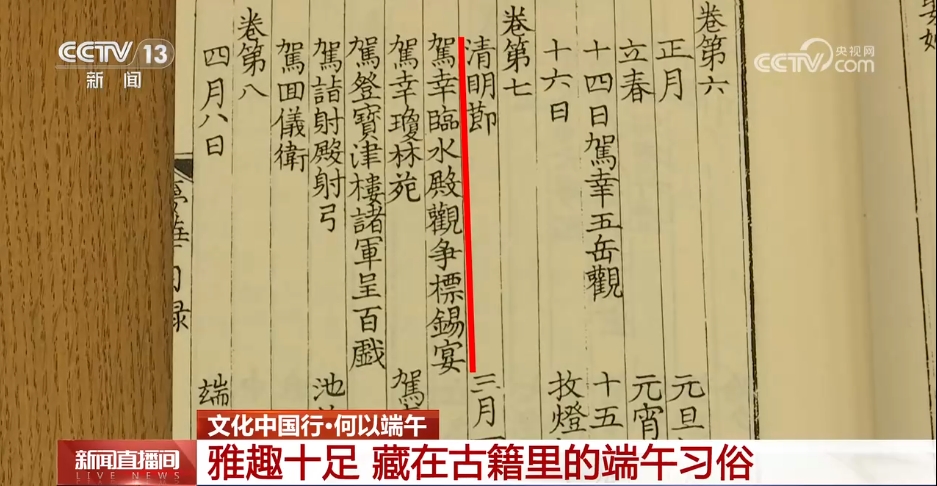
文化中国行丨雅趣十足 藏在古籍里的端午习俗
Yang Shi Wang· 2025-06-01 08:41
Group 1 - The article highlights the rich cultural traditions associated with the Dragon Boat Festival, emphasizing its historical significance and various customs that have evolved over time [1][3][5] - It mentions the ancient practice of dragon boat racing, tracing its origins back to texts like "Mu Tianzi Zhuan" and "Jingchu Suishiji," which document the customs of commemorating Qu Yuan [3][5][7] - The article describes the transformation of boat designs, such as the "Fei Fu" boat evolving into the more elaborate "Feng Zhou" during the Qing Dynasty, showcasing the local customs in Hubei [3][5] Group 2 - The article references the use of colorful silk threads tied on arms during the festival, symbolizing the five elements and the harmony with nature [7] - It discusses the unique tradition in Sichuan where children wear "Xiang Hou Sun," a herbal sachet shaped like a monkey, believed to provide protection and peace [9] - The article also notes the historical significance of the Dunhuang murals, which depict the early forms of dragon boat racing and other related customs [5][7]