后石油时代转型

Search documents
从边缘到基石:2025年海湾资本与中国合作回顾
Zheng Quan Shi Bao Wang· 2026-01-01 13:33
Core Insights - In 2025, Gulf sovereign funds transitioned from passive investment in Chinese assets to becoming cornerstone investors and strategic partners in major Chinese enterprises, marking a significant structural shift in their investment approach [1][2][3]. Group 1: Investment Scale and Structure - The total investment from the Gulf Cooperation Council (GCC) countries to China is projected to reach $20-25 billion in 2025, accounting for approximately 10% of their total foreign investment [2]. - Direct investments in the primary market, including foreign direct investment (FDI) and sovereign fund investments, are expected to amount to $16-19 billion, reflecting over 30% growth from the previous year [2]. - In the secondary market, investments through channels like QFII and Stock Connect are anticipated to reach $8-10 billion, with Gulf sovereign funds accounting for 40-50% of this increase [3]. Group 2: Country-Specific Investment Trends - The UAE is the most active Gulf nation in investing in China, with its sovereign funds accounting for over 50% of the total Gulf investment in 2025, particularly in sectors like electric vehicles and AI [4]. - Saudi Arabia's Public Investment Fund (PIF) is focusing more on domestic projects while still maintaining a selective investment strategy in China, including issuing RMB-denominated bonds [4]. - Qatar Investment Authority (QIA) and Kuwait's sovereign fund are adopting a more cautious investment approach, primarily increasing their stakes in blue-chip A-shares through QFII [5]. Group 3: Investment Logic and Sector Preferences - Gulf capital is increasingly driven by industrial logic rather than solely financial returns, seeking technology transfer and supply chain collaboration [7]. - Investments in new energy and smart vehicles represent about 35% of total Gulf investments in China, with key players like NIO and BYD being targeted [8]. - The focus on AI and advanced manufacturing accounts for approximately 25% of investments, indicating a strategic interest in core technologies of the Fourth Industrial Revolution [8]. - Investments in biomedicine and life sciences are also emerging, with around 20% of Gulf capital directed towards this high-barrier sector [8]. Group 4: Chinese Investment in the Gulf - Chinese investments in the Gulf are shifting from engineering contracts to deeper industrial engagement, emphasizing long-term operations and local partnerships [10][11]. - Notable projects include Lenovo's establishment of a PC manufacturing facility in Saudi Arabia, which signifies a move towards integrated investment models [10]. - Chinese companies are increasingly involved in local logistics and digital infrastructure, enhancing their operational footprint in the Gulf [12]. Group 5: Future Outlook - The investment scale between China and Gulf countries is expected to continue growing, with Gulf investments potentially exceeding $30 billion and Chinese investments reaching $40-50 billion by 2026 [13]. - There is a potential diversification of asset types, including investments in core commercial real estate in major Chinese cities [13]. - Mechanisms for cooperation are anticipated to evolve, with the second China-Arab States Summit expected to enhance institutional frameworks for investment collaboration [15].

从边缘到基石:2025年海湾资本与中国合作回顾
证券时报· 2026-01-01 13:14
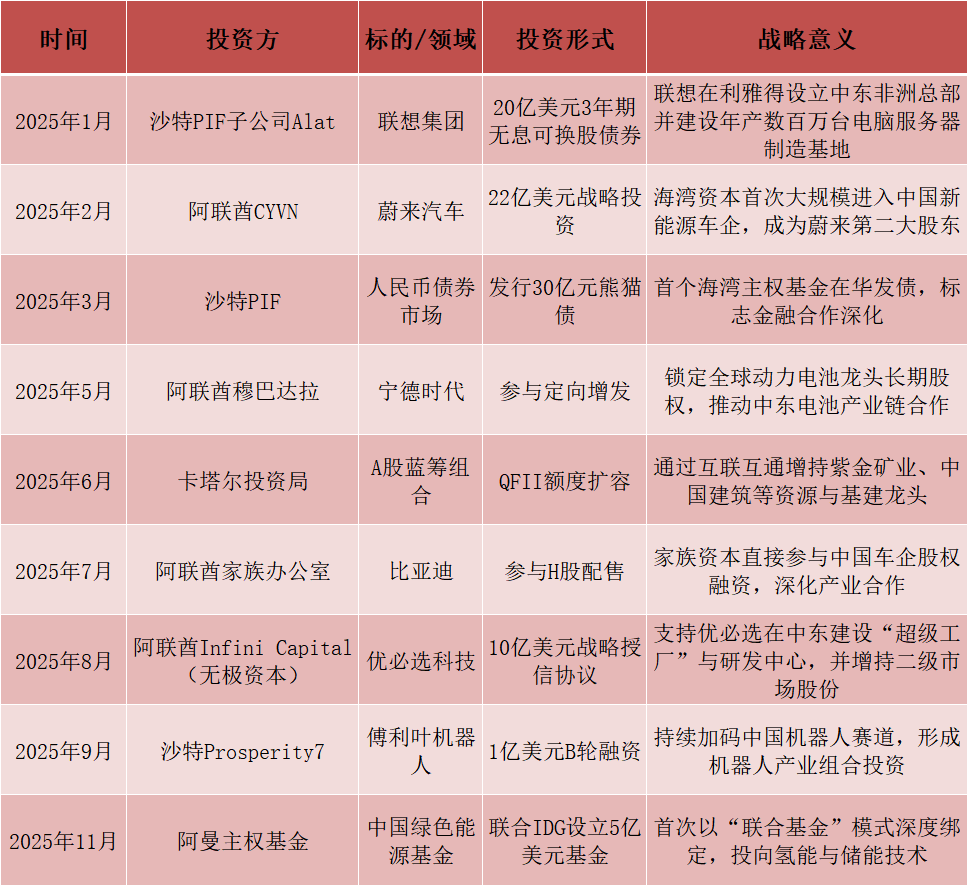
Core Viewpoint - In 2025, Gulf sovereign funds transitioned from passive investment in Chinese assets to becoming cornerstone investors and strategic partners, directly engaging in equity financing and long-term holdings in leading Chinese companies, marking a significant shift in bilateral investment dynamics [1][2]. Group 1: Investment Scale and Structure - The total investment from the Gulf Cooperation Council (GCC) countries to China is projected to reach $20-25 billion in 2025, accounting for approximately 10% of their total foreign investment of around $200 billion [2]. - In the primary market, foreign direct investment (FDI) and sovereign fund direct investments are expected to total $16-19 billion, reflecting over 30% growth from the previous year, driven by enhanced cooperation mechanisms and the implementation of visa-free policies [2][3]. - In the secondary market, investments through channels like QFII and Stock Connect are anticipated to reach $8-10 billion, with Gulf sovereign funds accounting for 40-50% of this increase, focusing on long-term strategic investments in resource, new energy, and manufacturing sectors [3][4]. Group 2: Country-Specific Investment Trends - The UAE is the most active Gulf nation in 2025, with its sovereign funds investing over 50% of the total Gulf investment in China, particularly in sectors like electric vehicles and artificial intelligence [4][5]. - Saudi Arabia's Public Investment Fund (PIF) has slowed its external investment pace, focusing more on domestic mega-projects while still maintaining selective investments in China [4]. - Qatar Investment Authority (QIA) and Kuwait's sovereign fund are adopting a more cautious investment approach, primarily increasing their stakes in blue-chip A-shares through QFII channels [5]. Group 3: Investment Events and Trends - 2025 saw a shift from sporadic investments to a more normalized and strategic collaboration between Gulf capital and Chinese enterprises, with significant investment events highlighting this trend [6][9]. - Notable investments include the UAE's CYVN investing $2.2 billion in NIO, marking a significant entry into China's new energy vehicle sector, and Saudi PIF issuing RMB bonds, indicating deepening financial cooperation [7][9]. Group 4: Investment Logic and Industry Preferences - Gulf capital's investment logic has shifted from purely financial returns to a focus on industrial logic, seeking technology transfer and supply chain collaboration [10][11]. - Investments in new energy and smart vehicles account for approximately 35% of total Gulf investments in China, with significant stakes in companies like NIO and BYD [11][12]. - The focus on artificial intelligence and advanced manufacturing represents about 25% of investments, indicating a strategic interest in core technologies of the Fourth Industrial Revolution [11][12]. Group 5: China's Investment in the Gulf - Chinese investments in the Gulf have evolved from engineering contracts to deeper industrial engagement, emphasizing long-term operations and local partnerships [13][14]. - Companies like Lenovo and Huawei are establishing manufacturing and operational bases in the Gulf, reflecting a shift towards integrated investment models that enhance local capabilities [13][15]. - The logistics sector is also seeing significant Chinese investment, with companies like J&T Express building major automated logistics hubs in Saudi Arabia [15][16]. Group 6: Future Outlook for 2026 - The investment scale between China and Gulf countries is expected to continue growing, with Gulf investments in China potentially exceeding $30 billion and Chinese investments in the Gulf reaching $40-50 billion [17][18]. - There will be a diversification of asset types, including potential investments in core commercial real estate in major Chinese cities [17][18]. - Mechanized cooperation is anticipated to enter a new phase, with upcoming political summits expected to enhance institutional frameworks for bilateral investment [18][19].