后量子阈值算法

Search documents
微算法科技(NASDAQ:MLGO)基于后量子阈值算法的区块链隐私保护技术
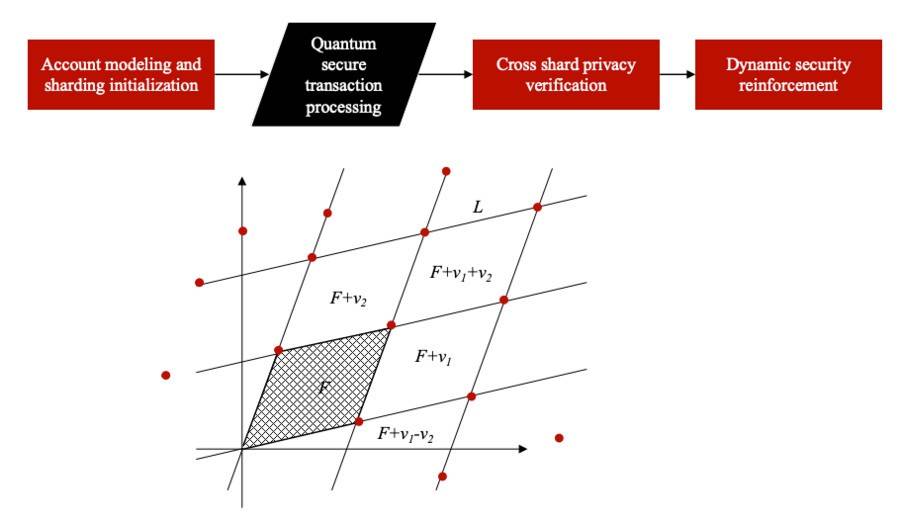
Sou Hu Cai Jing· 2026-02-03 06:20
Core Viewpoint - The traditional cryptographic systems face threats from quantum computing, which can compromise blockchain security. MicroAlgorithm Technology (NASDAQ: MLGO) proposes a post-quantum threshold algorithm framework to ensure quantum resistance and privacy protection in blockchain infrastructure for the Web 3.0 era [1][5]. Group 1: Technology Overview - The proposed technology utilizes post-quantum cryptography, specifically the CRYSTALS-Dilithium signature algorithm, replacing traditional ECDSA to enhance security against quantum attacks [1][4]. - The framework incorporates threshold signature technology, distributing key management across multiple nodes to prevent single points of failure and enhance privacy [4][5]. - A dynamic sharding mechanism maps blockchain accounts to a weighted graph structure, optimizing transaction density within shards while controlling cross-shard communication costs [3][4]. Group 2: Transaction Processing - The transaction signing module employs the CRYSTALS-Dilithium algorithm to generate quantum-resistant signatures, with storage space for these signatures controlled to be 1.2 times that of non-quantum signatures [3][4]. - Communication between nodes utilizes the NewHope key exchange protocol, combined with Physical Unclonable Functions (PUF) to defend against quantum man-in-the-middle attacks [3][4]. - Smart contracts are enhanced with lattice-based homomorphic encryption, allowing for condition-based payment verification without exposing original data, particularly in supply chain finance scenarios [3][4]. Group 3: Privacy and Compliance - Cross-shard privacy verification is achieved through zero-knowledge proofs generated by the source shard, ensuring transaction legitimacy and state verification while minimizing data exposure [4]. - The system supports a dual-chain architecture, where the main chain handles quantum-safe transactions and the side chain remains compatible with existing protocols, facilitating a smooth transition [4][5]. - A linkable group signature scheme is implemented for regulatory compliance, enabling transaction audits without revealing user identities, thus maintaining privacy while ensuring compliance with regulations [4][5]. Group 4: Future Prospects - As quantum computing technology advances, the quantum resistance of MicroAlgorithm Technology's blockchain privacy protection technology will become increasingly significant [5][6]. - Future optimizations in algorithm efficiency and scalability are expected to accommodate larger blockchain networks and enhance applications in privacy-sensitive areas [5][6].