
哺乳动物空间科学实验

Search documents
随神舟二十一号载人飞船上行并返回地面 “太空小鼠”成功孕育幼仔
Ren Min Ri Bao· 2025-12-28 22:08
Core Viewpoint - The successful birth of nine offspring from a mouse that returned from space marks a significant milestone in China's space research, demonstrating the feasibility of conducting mammalian space experiments and laying the groundwork for future studies on the effects of space environments on multiple generations of mammals [1]. Group 1 - A female mouse from the Shenzhou 21 mission successfully gave birth to nine pups after returning to Earth, with six currently surviving, indicating a normal survival rate [1]. - The four experimental mice were launched on October 31 and returned on November 14, completing a full cycle of mammalian space experiments, which includes preparation, in-orbit experimentation, and sample recovery [1]. - This achievement establishes a comprehensive technical solution for conducting mammalian space experiments, paving the way for larger-scale studies in the future [1]. Group 2 - Scientists will conduct systematic research on the offspring, focusing on their growth and development, as well as physiological and pathological changes [1]. - Further observations will be made on the reproductive capabilities of the offspring, with the aim of producing a second generation of mice to explore the potential genetic and developmental impacts of the space environment [1].
“飞天小鼠”名字揭晓!(内含彩蛋)
Xin Lang Cai Jing· 2025-12-27 08:21
Group 1 - Four mice were sent to space aboard the Shenzhou 21 manned spacecraft, marking China's first mammal space science experiment [3] - The mice were named Wangtian, Lanyue, Zhuoyun, and Zhudream, following a public naming campaign [3] - The naming campaign generated a variety of creative suggestions from the public, showcasing engagement and interest [8][11] Group 2 - The mice were well cared for in the space station, maintaining normal activities such as eating, drinking, and sleeping [14] - Upon returning to Earth on November 14, one female mouse successfully gave birth to nine pups, with six surviving, indicating a normal survival rate [19]

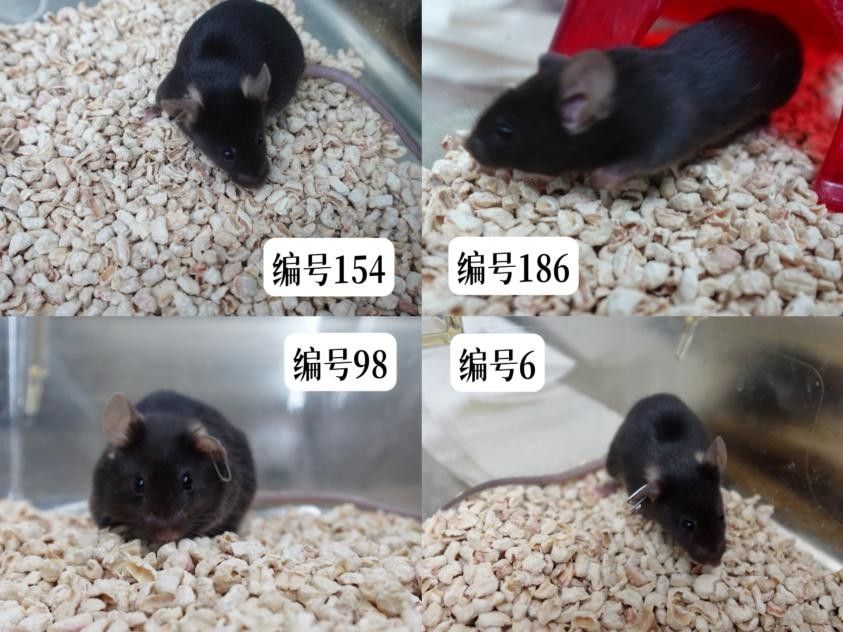
我国首批“太空小鼠”返回后产仔
Xin Lang Cai Jing· 2025-12-27 07:22
Core Insights - The successful birth of nine offspring from space mice after a 14-day space mission demonstrates that short-term spaceflight does not significantly impact the reproductive capabilities of mammals [1][4] - The research provides valuable samples for future studies on the effects of space environments on mammalian life [1][4] Group 1: Mission Overview - Four mice were launched into space on November 4, with an initial plan for a five-day mission, which was unexpectedly extended to 14 days due to delays in the return flight [2][3] - The research team faced challenges in ensuring the survival of the mice, particularly concerning food and water supplies during the extended mission [2][3] Group 2: Survival Strategies - The team coordinated with astronauts to provide water from the space station and selected soy milk as an emergency food substitute for the mice [3][4] - Extensive testing was conducted to ensure that the soy milk would not clog the feeding apparatus, allowing the mice to consume it successfully [3][4] Group 3: Post-Mission Observations - Upon return, the mice exhibited signs of weakness and significant weight loss, indicating the impact of microgravity on their muscle and skeletal systems [5] - The research team monitored the mice closely, leading to the discovery of mating behavior and the eventual birth of nine healthy pups [5] Group 4: Future Research Directions - The team plans to continue monitoring the offspring and conduct further studies on the physiological and genetic impacts of space environments on multiple generations of mammals [5] - Future missions aim to extend the duration of mice in space to 30 days to simulate human physiological conditions during long-term space travel [5]
太空小鼠曾遭遇断粮挑战
Xin Lang Cai Jing· 2025-12-27 01:14
Core Viewpoint - The successful breeding of "space mice" in a microgravity environment demonstrates that short-term spaceflight does not significantly impact reproductive capabilities, paving the way for future mammalian space science experiments [1] Group 1: Research Findings - The "space mouse" mother gave birth to a total of 9 pups, with 6 surviving (3 males and 3 females), indicating a normal survival rate [1] - The research team observed that the "space mouse" mother exhibited a stronger desire to protect her pups, potentially influenced by her experiences in space [1] - The experiment faced challenges, including a food supply issue, which was mitigated by using soy milk as an emergency food source for the mice [1] Group 2: Future Research Directions - The research team plans to continue studying the "space mice" to observe changes in growth, reproduction, and aging after their return to Earth [1] - Systematic research on the "space mouse pups" will focus on their growth curves and physiological changes, with plans to breed subsequent generations to explore the potential genetic and developmental impacts of the space environment [1] - The ultimate goal is to conduct more extensive studies on various biological questions related to human health through future space missions involving mice [1]
层层选拔、垃圾收集、营养均衡、漂浮睡觉……中科院专家解读我国首次哺乳动物空间科学实验
Xin Hua She· 2025-11-03 16:36
Core Points - The article discusses China's first mammal space science experiment, where four mice were sent to the Chinese space station for research purposes [1][2]. Group 1: Experiment Overview - The experiment involves four C57BL/6 mice, known for their genetic uniformity, which are crucial for scientific data collection [1][2]. - The mice underwent a rigorous selection process, including various tests to assess their physical and cognitive abilities, resulting in 100 candidates before selecting the final four [2]. - The selected mice will be monitored for their physiological responses to the space environment, contributing to understanding how living organisms adapt to space conditions [2][3]. Group 2: Living Conditions and Adaptation - The "space small mammal feeding device" was developed to ensure a comfortable living environment for the mice, with controlled temperature, humidity, and oxygen levels [3][4]. - Initial observations indicate that the mice are adapting well to microgravity, displaying active behavior and normal eating habits [3][4]. - The feeding mechanism is designed to accommodate the unique challenges of space, ensuring that the mice can access food and water effectively [4].