商业航天规模化

Search documents
国联民生证券:商业航天产业正处规模化关键期 建议关注新材料领域细分赛道领先、推进航天验证企业
智通财经网· 2026-01-14 02:12
Core Insights - The commercial aerospace industry is at a critical transition from validation to scaling, requiring a focus on efficiency, cost, and reliability to create a sustainable business ecosystem [1][2] Group 1: Importance of Chemical Materials - The commercial aerospace sector relies on chemical materials to support its business model, emphasizing cost reduction and efficiency improvements through material advancements [1] - High-performance alloys and composite materials can achieve component lightweighting, directly reducing launch costs by $10,000 for every kilogram of satellite weight reduced [1] Group 2: Key Developments in Commercial Aerospace - The government aims to promote the safe and healthy development of emerging industries like commercial aerospace, with significant catalysts expected by the end of 2025 [2] - Major events include the launch of the Long March 12 rocket and the introduction of IPO guidelines for commercial rocket companies to enhance financing channels [2] Group 3: Lightweight Materials and Their Impact - Lightweight materials are crucial for the aerospace economy, enabling large-scale access to space while minimizing costs [3] - Carbon fiber, UHMWPE fiber, and PEEK are highlighted as key lightweight materials that can significantly reduce weight and enhance performance in aerospace applications [3] Group 4: Specialized Materials for Spacecraft Performance - Spacecraft must operate in extreme conditions, necessitating specialized materials for thermal management and radiation resistance [4] - Materials like aramid paper and ceramic matrix composites provide essential properties such as high-temperature resistance and lightweight characteristics, benefiting from increased demand due to more rocket and satellite launches [4]

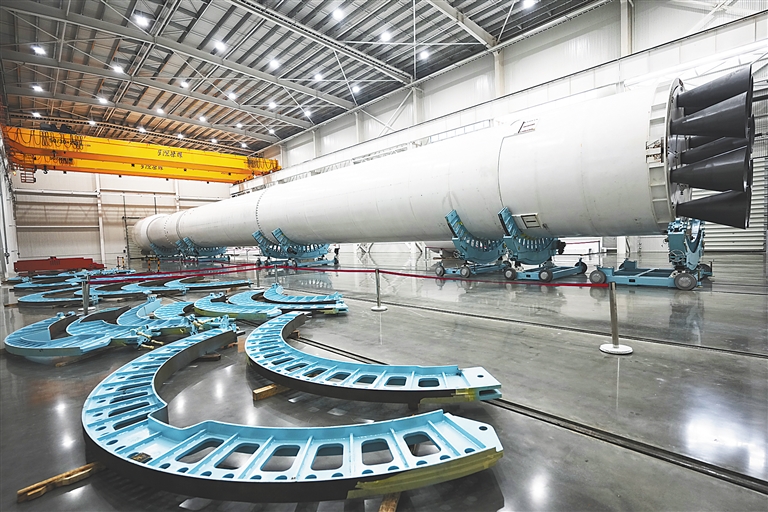
星际荣耀海南“火箭工厂”在文昌竣工
Hai Nan Ri Bao· 2025-10-10 01:35
Core Viewpoint - The completion of the "rocket factory" by Galactic Glory in Wenchang marks a significant step for China's commercial aerospace sector, transitioning from a launch site to a manufacturing hub [3][5]. Group 1: Factory Overview - The total investment for the rocket assembly and testing factory is approximately 450 million yuan, with a total construction area of 28,800 square meters [3]. - The factory adopts an innovative "assembly, testing, and reuse" model, achieving a one-stop closed loop for rocket production, system testing, and post-recovery reuse inspection, significantly shortening the R&D cycle and reducing launch costs [3][4]. - The factory is expected to have an annual production capacity of 24 rockets, which will increase to 36 rockets after the second phase of expansion [3]. Group 2: Related Projects - In addition to the assembly and testing factory, Galactic Glory is advancing three major projects: a 106 million yuan offshore recovery platform system, and a 350 million yuan general-purpose power system testing base [3][4]. - The offshore recovery platform is crucial for the vertical recovery of liquid rocket stages and is set to undergo testing in Hainan [4]. - The power system testing base, which has received approval from the National Space Administration, will conduct 10 to 12 rocket engine tests annually, serving multiple aerospace companies [4]. Group 3: Strategic Importance - The three projects together form a closed industrial chain of "manufacturing—testing—recovery—reuse," aiming for the successful first flight and sea recovery of the Hyperbola-3 rocket [5]. - The factory is expected to receive its first Hyperbola-3 rocket by the end of this year for assembly and testing, with large-scale ground tests planned for the same timeframe [5][6]. - Hainan's free trade port offers significant advantages in market access and policy approval, enhancing project efficiency [5]. Group 4: Industry Development - The proximity of the factory, power system testing base, and Hainan's commercial launch site creates an efficient collaborative aerospace industry cluster [5]. - The development model of "driving production with launch sites" is evolving into an innovative development advantage for the aerospace industry in Wenchang [5]. - The Wenchang International Aerospace City has attracted over 700 industry chain enterprises, benefiting from the relaxation of commercial aerospace restrictions in the 2025 updated negative list for market access [5].