因果链数据集

Search documents
英伟达把自动驾驶核心技术公开了,吴新宙牵头研发,VLA大模型和海量数据免费用
3 6 Ke· 2025-12-03 10:52
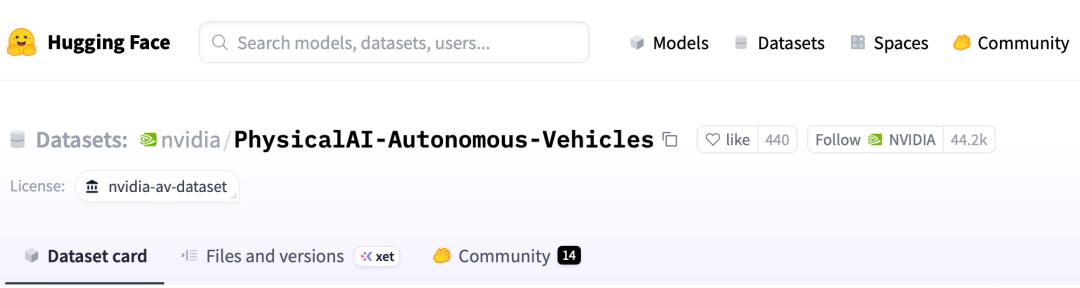
Core Insights - NVIDIA has officially released and open-sourced its new Vision-Language-Action (VLA) model, Alpamayo-R1, and plans to open-source some core datasets in future updates [1][2]. Group 1: Model and Dataset Release - The corresponding dataset for the Alpamayo-R1 model has been uploaded to the open-source community, totaling approximately 100TB, marking NVIDIA's first open-source VLA model [2]. - The dataset can be used for both commercial and non-commercial purposes, allowing companies with limited VLA technology experience to quickly engage in VLA development [2]. Group 2: Technological Advancements - The introduction of Alpamayo-R1 signifies a shift in autonomous driving technology from mere "behavior imitation" to a new stage of deep "causal reasoning" [4]. - Alpamayo-R1 addresses critical safety issues in long-tail scenarios, achieving a 12% improvement in planning accuracy compared to baseline models and reducing off-road accident rates by 35% [5]. Group 3: Model Architecture and Training - The model employs a modular and efficient architecture that balances "slow thinking" and "fast action," driven by NVIDIA's Cosmos-Reason visual language model for complex environmental understanding [13]. - A new training strategy incorporating reinforcement learning (RL) has significantly improved reasoning quality by 45% and reasoning-action consistency by 37% [17]. Group 4: Industry Impact - The open-sourcing of Alpamayo-R1 and its dataset may lead to a reshaping of the autonomous driving industry, lowering entry barriers for small and medium-sized companies and research institutions [19]. - This move reflects NVIDIA's "soft and hard integration" strategy, showcasing the model's performance reliant on NVIDIA's powerful GPU capabilities and the Cosmos framework [19].