困惑度

Search documents
骂得越狠,ChatGPT回答越准,PSU研究实锤,狂飙84%准确率
3 6 Ke· 2025-10-15 01:51
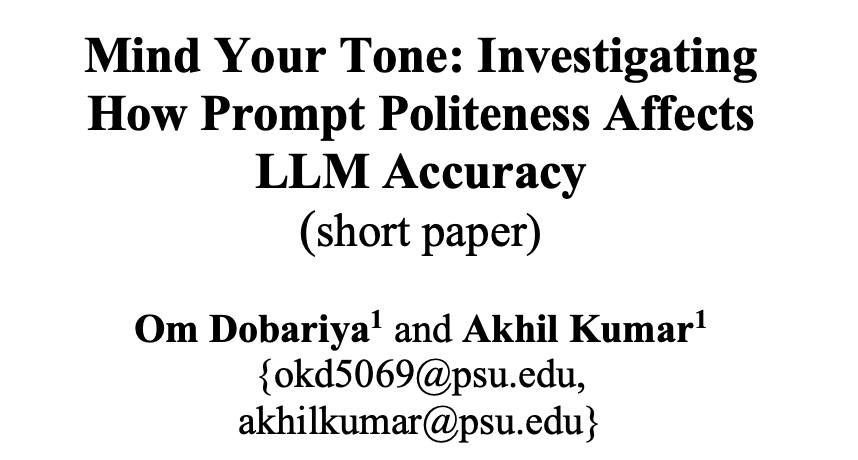
Core Insights - A recent study from Penn State University reveals that using ruder prompts leads to higher accuracy in responses from ChatGPT, with a surprising accuracy rate of 84.8% for very rude prompts compared to 80.8% for very polite ones [1][15]. Group 1: Research Findings - The study created a dataset of 50 foundational questions across various fields, reformulated into five levels of politeness: very polite, polite, neutral, rude, and very rude [1][11]. - ChatGPT-4o was tested with a total of 250 prompts, and the results showed that ruder prompts consistently outperformed polite ones in terms of accuracy [1][15]. - The accuracy rates for different politeness levels were as follows: very polite (80.8%), polite (81.4%), neutral (82.2%), rude (82.8%), and very rude (84.8%) [15][16]. Group 2: Methodology - The researchers employed a paired sample t-test to assess the statistical significance of the accuracy differences across various politeness levels [1][14]. - Each question was presented to ChatGPT-4o with specific instructions to ensure that it answered independently of previous context, focusing solely on the multiple-choice format [1][13]. Group 3: Implications and Future Research - The findings suggest that the tone of prompts significantly influences the performance of large language models (LLMs), indicating that politeness may not enhance response quality as previously thought [1][19]. - Future research may explore the emotional weight of polite phrases and their impact on LLM performance, as well as the concept of perplexity in relation to prompt effectiveness [1][21].

扩散语言模型真的会比自回归好?理论分析结果可能恰恰相反
机器之心· 2025-06-10 08:41
Core Insights - The article discusses the potential of diffusion language models (DLMs) in text generation, comparing them to autoregressive models (ARMs) and highlighting the efficiency paradox observed in practical applications [1][3][7]. Group 1: Model Comparison - Autoregressive models generate text token-by-token, achieving high quality but limited by serial processing speed, especially for long sequences [3]. - Diffusion language models, particularly Masked Diffusion Models (MDMs), theoretically allow parallel sampling of multiple tokens, suggesting a potential efficiency improvement [3][4]. - However, practical experiments show that MDMs often require more sampling steps to match the accuracy of ARMs, leading to higher inference costs [3][4][12]. Group 2: Evaluation Metrics - The research emphasizes that the comparison between DLMs and ARMs heavily depends on the chosen evaluation metrics [10][15]. - Two key metrics are introduced: Token Error Rate (TER) for assessing token-level accuracy and Sequence Error Rate (SER) for evaluating overall sequence correctness [10][11]. - MDMs can demonstrate efficiency advantages when evaluated on TER, but they struggle with SER, particularly in tasks requiring logical consistency, such as mathematical reasoning [11][12][15]. Group 3: Practical Implications - The findings suggest that DLMs may be more suitable for tasks prioritizing text fluency and throughput, where some sequence-level imperfections are acceptable, such as creative writing [15]. - Conversely, for tasks demanding high sequence-level accuracy and logical correctness, ARMs remain the better choice due to the linear increase in sampling steps required by MDMs as sequence length grows [15][16]. - The research lays a theoretical foundation for understanding the comparative advantages and limitations of MDMs, indicating that the success of diffusion techniques in image generation does not directly translate to language generation [16].