提示工程

Search documents
独家对话引元星河CEO李植宇:企业级AI进入“基础层与应用层协同爆发”周期
Tai Mei Ti A P P· 2026-01-08 02:08
Core Insights - The statement "AI is not a choice but a matter of survival" emphasizes the critical importance of AI in digital transformation for enterprises by the end of 2025 [2] - The role of CIOs is evolving from a cost center to a strategic partner in driving AI integration within organizations, with ultimate decision-making power resting with top executives [2][5] Industry Trends - Enterprise AI is transitioning from a phase of "barbaric growth" to a critical period of "collaborative explosion" between foundational and application layers, indicating a significant market evolution [3] - Global AI investment is projected to reach $315.9 billion in 2024 and grow to $1.2619 trillion by 2029, with a compound annual growth rate (CAGR) of 31.9% [3] China Market Focus - The Chinese enterprise AI service market is expected to reach 45.6 billion yuan by 2025, with a CAGR of 38.2% [4] - The AI Agent application market in China is projected to grow to 23.2 billion yuan by 2025, with an astonishing CAGR of 120% from 2023 to 2027 [4] Shifts in AI Demand - Companies are shifting their AI needs from merely providing tools to delivering value, indicating a maturation in the understanding of AI's role in business [5] - The focus is now on customized AI applications and quantifiable business outcomes, moving beyond traditional cost-cutting perspectives [5] AI Application Challenges - Only 12% of global enterprises are expected to achieve normalized AI application in core business decisions by 2025, highlighting significant barriers to adoption [8] - The primary challenge in core decision-making applications is the need for a closed-loop system of "data-insight-action," which many current AI systems struggle to achieve [9][10] Service Provider Landscape - Four main types of service providers have emerged in the enterprise AI space: large model technology providers, agent service providers, traditional software vendors, and data + AI vertical service providers [6] - New entrants like Yuan Yuan Xing He are attempting to redefine the market by offering end-to-end process reconstruction and organizational change capabilities [7] Future Directions - The future of enterprise AI is expected to evolve towards "controllable, collaborative, and ecological" systems, moving from mere tool empowerment to comprehensive system reconstruction [13][14] - The integration of AI into business processes is anticipated to enhance productivity significantly, with predictions that 60% of manufacturing enterprises will adopt integrated AI models by 2028 [14] Value Verification in AI Projects - The shift from traditional project delivery to value verification models is becoming crucial, with success rates for value verification projects significantly higher than traditional methods [11] - The complexity of measuring ROI in AI projects is a major reason for hesitance in investment, with 68% of companies citing difficulties in accurately assessing ROI [12]


AI时代,为什么我们需要学好哲学?
3 6 Ke· 2025-12-29 03:26
Core Insights - The article emphasizes the importance of philosophical training in enhancing programming skills, particularly in the context of artificial intelligence (AI) [1] - It discusses the emerging field of "prompt engineering," which focuses on crafting effective prompts to guide AI in generating desired outputs [2] - The relationship between users and knowledge is fundamentally changing due to generative AI, allowing for personalized and adaptive learning experiences [3][4] Group 1: Importance of Philosophy in Engineering - Philosophical training can improve reasoning, logic, and first-principles thinking, which are essential for effectively utilizing AI [1][6] - The ability to ask the right questions is crucial for obtaining accurate outputs from AI, as vague prompts can lead to incorrect or fabricated answers [2] Group 2: Prompt Engineering - "Prompt engineering" is described as an art form where users learn to create concise and expressive prompts to achieve desired AI responses [2] - Techniques such as few-shot prompting can guide AI by providing examples, enhancing the accuracy of outputs like sentiment analysis [2] Group 3: Changing Knowledge Dynamics - Generative AI alters the traditional relationship between authors and readers, allowing for customized content generation based on user input [3] - The technology bridges the gap between existing knowledge and the knowledge required to tackle specific topics, making learning more accessible [4] Group 4: The Role of Critical Thinking - As knowledge becomes more accessible through AI, the importance of critical thinking and the ability to discern accurate information increases [4][6] - Users must maintain a skeptical attitude and apply philosophical thinking to responsibly utilize AI-generated information [4][6] Group 5: Future of Programming and AI Interaction - The article suggests that the future of engineering will require clear thinking models and the ability to engage critically with AI outputs [6] - The shift towards using natural language for programming could lead to more efficient and creative development processes, allowing for rapid creation of complex applications [5][6]
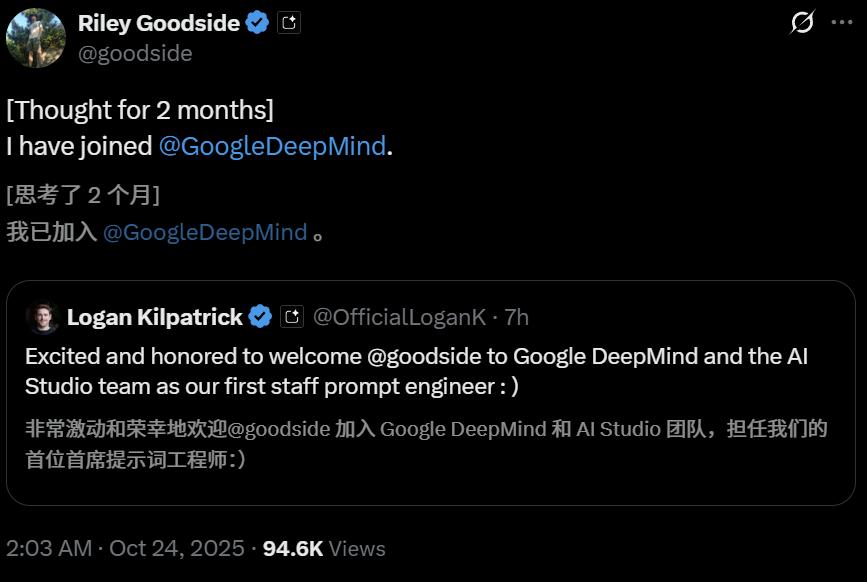
教全世界与AI对话的男人,正式加入DeepMind,提示工程封神
3 6 Ke· 2025-10-24 12:57
Group 1 - The core point of the article is the rise of prompt engineering as a profession, highlighted by Riley Goodside's recent joining of Google DeepMind, marking a significant milestone in the field [1][6][12] - Riley Goodside became famous for earning over one million dollars annually by engaging with AI, particularly ChatGPT, which popularized the role of prompt engineers [1][6][12] - The profession of prompt engineering has gained legitimacy and importance over the past three years, contrary to initial skepticism about its sustainability [12][9] Group 2 - DeepMind's CEO Demis Hassabis and product head Logan Kilpatrick publicly welcomed Goodside, indicating the significance of his role within the company [2][3] - Goodside's background includes a degree in computer science from PennWest California and experience in data-related roles at various companies, showcasing his expertise in the field [8] - The article discusses the evolution of prompt engineering, emphasizing its role as a frontier in the development of large language models (LLMs) and the importance of effective prompt design [13][12] Group 3 - Goodside's notable contributions include designing advanced prompts that enhance the capabilities of AI models, demonstrating the potential of prompt engineering to unlock AI's full potential [19][10] - The article mentions the concept of "glitch tokens," which are specific tokens in AI models that can lead to unexpected outputs, showcasing the intricacies of prompt engineering [15][16] - Goodside's work is seen as a bridge between traditional programming and the new paradigm of interacting with AI through natural language prompts [9][13]

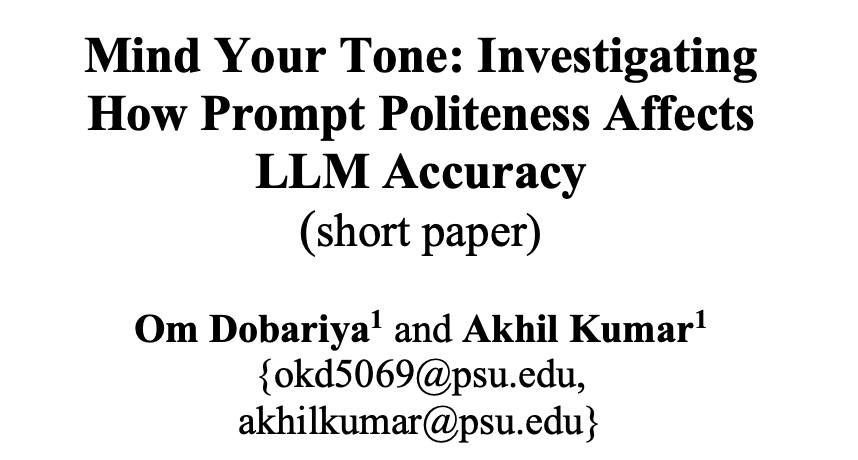
骂得越狠,ChatGPT回答越准,PSU研究实锤,狂飙84%准确率
3 6 Ke· 2025-10-15 01:51
Core Insights - A recent study from Penn State University reveals that using ruder prompts leads to higher accuracy in responses from ChatGPT, with a surprising accuracy rate of 84.8% for very rude prompts compared to 80.8% for very polite ones [1][15]. Group 1: Research Findings - The study created a dataset of 50 foundational questions across various fields, reformulated into five levels of politeness: very polite, polite, neutral, rude, and very rude [1][11]. - ChatGPT-4o was tested with a total of 250 prompts, and the results showed that ruder prompts consistently outperformed polite ones in terms of accuracy [1][15]. - The accuracy rates for different politeness levels were as follows: very polite (80.8%), polite (81.4%), neutral (82.2%), rude (82.8%), and very rude (84.8%) [15][16]. Group 2: Methodology - The researchers employed a paired sample t-test to assess the statistical significance of the accuracy differences across various politeness levels [1][14]. - Each question was presented to ChatGPT-4o with specific instructions to ensure that it answered independently of previous context, focusing solely on the multiple-choice format [1][13]. Group 3: Implications and Future Research - The findings suggest that the tone of prompts significantly influences the performance of large language models (LLMs), indicating that politeness may not enhance response quality as previously thought [1][19]. - Future research may explore the emotional weight of polite phrases and their impact on LLM performance, as well as the concept of perplexity in relation to prompt effectiveness [1][21].
Claude 的秘密:AI 聪不聪明,取决于你给它什么工具 | Jinqiu Select
锦秋集· 2025-09-12 08:48
Core Insights - Anthropic has introduced new features in Claude that allow direct creation and editing of various mainstream office files, expanding AI's application in practical tasks [1] - The company emphasizes a shift in mindset towards designing tools for AI agents rather than traditional coding practices [3] - The effectiveness of AI agents is heavily reliant on the quality and design of the tools provided to them [8] Group 1: Tool Design Principles - The core principle is to design intuitive and user-friendly tools for uncertain, reasoning AI, rather than focusing solely on input-output like traditional programming [3] - Tools should be evaluated through real and complex tasks to ensure they meet practical needs and can identify genuine issues [4] - It is more beneficial to create integrated workflow tools that handle multi-step tasks rather than offering a collection of fragmented API functionalities [5] Group 2: Tool Evaluation and Improvement - Clear and precise descriptions of tools are crucial, as they are the only means for AI to understand their purpose [6] - The process of building and testing tool prototypes should involve comprehensive evaluations to measure performance and iteratively improve the tools [15][21] - Engaging AI agents in the evaluation process can help analyze results and refine tools effectively [33] Group 3: Effective Tool Usage - Selecting the right tools is essential; more tools do not necessarily lead to better outcomes, and tools should be designed with the unique capabilities of AI agents in mind [36] - Tools should be organized into namespaces to avoid confusion among AI agents when selecting which tool to use [39] - Returning meaningful context from tools is important, prioritizing high-information signals over technical identifiers [42] Group 4: Future Outlook - The approach to building effective tools for AI agents must evolve from predictable, deterministic patterns to non-deterministic models [54] - A systematic, evaluation-driven method for improving tools will ensure that as AI agents become more powerful, the tools they use will also evolve accordingly [54]

1500篇关于提示工程的学术论文表明你所知道的一切都是错误的
3 6 Ke· 2025-08-22 03:12
Core Insights - Companies with annual recurring revenue (ARR) exceeding $50 million are adopting strategies that contradict popular social media advice on prompt engineering [1][11] - The research indicates that traditional prompt engineering wisdom is often based on anecdotal evidence and small-scale tests, leading to ineffective practices [2] Misconceptions in Prompt Engineering - Misconception 1: Longer and more detailed prompts yield better results; research shows structured short prompts are more effective and cost-efficient, reducing API costs by 76% [3] - Misconception 2: More examples always help; recent studies indicate that excessive examples can confuse advanced models like GPT-4 and Claude [4][5] - Misconception 3: Perfect wording is crucial; the format and structure of prompts are more important than specific wording, with XML format outperforming natural language by 15% for certain models [6] - Misconception 4: Chain of thought prompts are universally applicable; they are effective for math and logic tasks but can hinder performance in data analysis, where table-based reasoning is more effective [7] - Misconception 5: Human experts create the best prompts; AI systems can optimize prompts more effectively and quickly than human experts, taking only 10 minutes compared to 20 hours for humans [8] - Misconception 6: Prompt engineering is a one-time task; ongoing optimization is essential as prompt performance declines over time, with systematic improvements potentially increasing performance by 156% over 12 months [9][10] Effective Strategies for High-Performing Companies - Successful companies focus on optimizing business metrics rather than model metrics, prioritizing user satisfaction and task completion rates [11] - They automate prompt optimization, employing systematic methods for continuous testing and improvement rather than manual iterations [11] - These companies emphasize structure, organization, and clarity over clever wording or lengthy examples [11] - They tailor techniques to specific task types, using appropriate methods like chain of thought for math and direct instructions for other applications [11][14] - They treat prompts as products, requiring ongoing maintenance and improvement based on real user data [11] Methodological Gap - The persistence of misconceptions stems from a fundamental methodological gap between academic research and industry practices, with academia relying on controlled experiments and industry often depending on intuition [12] - Understanding these research findings is crucial for anyone building AI capabilities, emphasizing structure over content and the importance of automated optimization [12][13] Competitive Advantage - Companies that base their prompt engineering on research rather than traditional views achieve significant competitive advantages, realizing higher performance at lower costs [17][18] - They can focus human expertise on high-value activities like defining goals and evaluating outcomes instead of manual prompt crafting [18] Questions for Teams - Teams should shift their focus from "How can we write better prompts?" to "How can we systematically optimize our AI interactions based on empirical evidence?" [19] - This perspective encourages data-driven approaches, enabling the development of scalable AI functionalities that deliver sustainable value [19]
上下文工程指南
3 6 Ke· 2025-08-10 23:10
Core Concept - The article emphasizes the evolution of prompt engineering into "context engineering," highlighting its importance in optimizing large language models (LLMs) for task execution [3][5][19]. Summary by Sections Definition and Importance - Context engineering is described as a critical process that involves adjusting the instructions and relevant background needed for LLMs to perform tasks effectively [3][5]. - The term "context engineering" is preferred as it encompasses the core tasks of prompt engineering while addressing its limitations [5][19]. Practical Application - A specific case study using n8n to develop an AI agent workflow illustrates the practical implementation of context engineering [6][7]. - The workflow includes designing management prompts, debugging instructions, and managing dynamic elements like user input and date/time [7][10]. Key Components of Context Engineering - Effective context engineering requires careful consideration of instructions, user inputs, and structured input/output formats to ensure clarity and efficiency [11][12]. - The article outlines the necessity of defining subtasks with specific parameters such as unique IDs, search queries, source types, and priority levels [12][13]. Tools and Techniques - The use of tools like n8n facilitates the integration of dynamic context, such as current date and time, which is crucial for time-sensitive queries [15][18]. - RAG (Retrieval-Augmented Generation) and memory mechanisms are discussed as methods to enhance workflow efficiency by caching user queries and results [16][17]. Challenges and Future Directions - The article notes that context engineering is complex and requires multiple iterations to refine the process [25][26]. - It anticipates that context engineering will evolve into a core skill for AI developers, with potential for automation in context handling [28][29][30].

当所有人都在学提示工程时,聪明人却专注于掌握这项技能
3 6 Ke· 2025-08-02 00:32
Core Insights - The article emphasizes the emerging importance of communication skills in the context of AI, particularly the ability to translate AI insights into actionable human decisions, which is becoming a core competitive advantage [3][14][18] Group 1: Current Trends in AI and Workforce - Many professionals are focusing on learning prompt engineering and AI tool usage to adapt to workplace changes driven by AI [2][8] - A small group of specialists is positioning themselves in more valuable areas by learning how to make AI serve human needs rather than competing with it [3][9] Group 2: Challenges in AI Implementation - Despite the rapid advancements in AI, many AI-generated outputs are often ignored by teams due to a lack of understanding of how to bridge the gap between AI insights and human decision-making [5][6][11] - The current bottleneck lies in human comprehension, as many professionals are not effectively translating AI outputs into actionable insights [6][7] Group 3: The Role of the "Translation Layer" - The concept of a "translation layer" is introduced, which involves individuals who can convert AI's outputs into understandable and actionable human directives [9][10][14] - Companies need professionals who can explain AI recommendations to non-technical executives and help prioritize AI insights for actionable plans [16][17] Group 4: Strategies for Becoming a Key Translator - The article outlines three steps to become a key translator: recognizing the nature of the transformation, identifying gaps between AI outputs and human needs, and establishing oneself in the translator role [9][11][13] - Emphasizing the importance of simplifying complex AI insights and contextualizing them within the organization's culture and priorities is crucial for effective communication [13][14] Group 5: Future Outlook - As AI continues to evolve, the demand for professionals who can effectively interpret and implement AI insights will grow, making communication skills increasingly valuable [15][18] - The future will favor those who can bridge the gap between AI capabilities and human understanding, ensuring that AI serves as a tool for enhancing decision-making rather than a competitor [10][18]
「幻觉」竟是Karpathy十年前命名的?这个AI圈起名大师带火了多少概念?
机器之心· 2025-07-28 10:45
Core Viewpoint - The article discusses the influential contributions of Andrej Karpathy in the AI field, particularly his role in coining significant terms and concepts that have shaped the industry, such as "hallucinations," "Software 2.0," "Software 3.0," "vibe coding," and "bacterial coding" [1][6][9]. Group 1: Naming and Concepts - Karpathy coined the term "hallucinations" to describe the limitations of neural networks, which generate meaningless content when faced with unfamiliar concepts [1][3]. - He is recognized as a master of naming in the AI community, having introduced terms like "Software 2.0" and "Software 3.0," which have gained traction over the years [6][9]. - The act of naming is emphasized as a foundational behavior in knowledge creation, serving as a stable target for global scientific focus [7]. Group 2: Software Evolution - "Software 1.0" refers to traditional programming where explicit instructions are written in languages like Python and C++ [12][14]. - "Software 2.0" represents a shift to neural networks, where developers train models using datasets instead of writing explicit rules [15]. - "Software 3.0" allows users to generate code through simple English prompts, making programming accessible to non-developers [16][17]. Group 3: Innovative Programming Approaches - "Vibe coding" encourages developers to immerse themselves in the development atmosphere, relying on LLMs to generate code based on verbal requests [22][24]. - "Bacterial coding" promotes writing modular, self-contained code that can be easily shared and reused, inspired by the adaptability of bacterial genomes [30][35]. - Karpathy suggests balancing the flexibility of bacterial coding with the structured approach of eukaryotic coding to support complex system development [38]. Group 4: Context Engineering - Context engineering has gained attention as a more comprehensive approach than prompt engineering, focusing on providing structured context for AI applications [43][44]. - The article highlights a shift towards optimizing documentation for AI readability, indicating a trend where 99.9% of content may be processed by AI in the future [45].

梳理了1400篇研究论文,整理了一份全面的上下文工程指南 | Jinqiu Select
锦秋集· 2025-07-21 14:03
Core Insights - The article discusses the emerging field of Context Engineering, emphasizing the need for a systematic theoretical framework to complement practical experiences shared by Manus' team [1][2] - A comprehensive survey titled "A Survey of Context Engineering for Large Language Models" has been published, analyzing over 1400 research papers to establish a complete technical system for Context Engineering [1][2] Context Engineering Components - Context Engineering is built on three interrelated components: Information Retrieval and Generation, Information Processing, and Information Management, forming a complete framework for optimizing context in large models [2] - The first component, Context Retrieval and Generation, focuses on engineering methods to effectively acquire and construct context information for models, including practices like Prompt Engineering, external knowledge retrieval, and dynamic context assembly [2] Prompting Techniques - Prompting serves as the starting point for model interaction, where effective prompts can unlock deeper capabilities of the model [3] - Zero-shot prompting provides direct instructions relying on pre-trained knowledge, while few-shot prompting offers a few examples to guide the model in understanding task requirements [4] Advanced Reasoning Frameworks - For complex tasks, structured thinking is necessary, with Chain-of-Thought (CoT) prompting models to think step-by-step, significantly improving accuracy in complex tasks [5] - Tree-of-Thoughts (ToT) and Graph-of-Thoughts (GoT) further enhance reasoning by allowing exploration of multiple paths and dependencies, improving success rates in tasks requiring extensive exploration [5] Self-Refinement Mechanisms - Self-Refinement allows models to iteratively improve their outputs through self-feedback without requiring additional supervised training data [8][9] - Techniques like N-CRITICS and Agent-R enable models to evaluate and correct their reasoning paths in real-time, enhancing output quality [10][11] External Knowledge Retrieval - External knowledge retrieval, particularly through Retrieval-Augmented Generation (RAG), addresses the static nature of model knowledge by integrating dynamic information from external databases [12][13] - Advanced RAG architectures introduce adaptive retrieval mechanisms and hierarchical processing strategies to enhance information retrieval efficiency [14][15] Context Processing Challenges - Processing long contexts presents significant computational challenges due to the quadratic complexity of Transformer self-attention mechanisms [28] - Innovations like State Space Models and Linear Attention aim to reduce computational complexity, allowing models to handle longer sequences more efficiently [29][30] Context Management Strategies - Effective context management is crucial for organizing, storing, and utilizing information, addressing issues like context overflow and collapse [46][47] - Memory architectures inspired by operating systems and cognitive models are being developed to enhance the memory capabilities of language models [48][50] Tool-Integrated Reasoning - Tool-Integrated Reasoning transforms language models from passive text generators into active agents capable of interacting with the external world through function calling and integrated reasoning frameworks [91][92]