国产轴体崛起

Search documents
还记得 Cherry 键盘吗?它快被国产干破产了
3 6 Ke· 2025-12-09 03:21
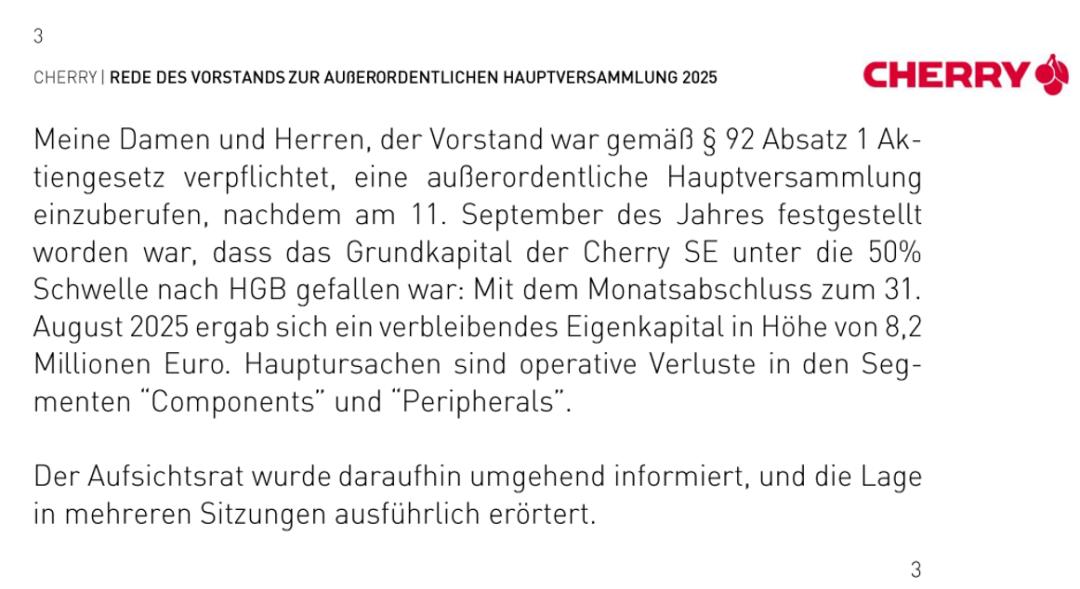
Core Viewpoint - Cherry, once a dominant player in the mechanical keyboard market, has seen a significant decline over the past decade due to increased competition from domestic manufacturers in China, leading to a critical financial situation where its equity has fallen below the 50% warning line [1][4][55]. Group 1: Company Background - Cherry was originally founded in 1953 in Illinois, USA, and later moved its production and R&D to Germany, establishing a strong reputation in the mechanical switch market with its Cherry MX switches [9][10]. - The company initially focused on industrial applications, leveraging its expertise in micro switches to develop the MX switch in 1983, which became a standard in mechanical keyboards [10][12]. Group 2: Market Dynamics - The rise of eSports around 2005 significantly boosted the demand for mechanical keyboards, with Cherry's switches becoming the preferred choice among gamers [12][13]. - However, as the market expanded, domestic manufacturers in China began to emerge, capitalizing on the growing demand and offering competitive alternatives to Cherry's products [16][22]. Group 3: Competitive Landscape - By 2014, the Chinese mechanical switch market experienced exponential growth, driven by the transition of internet cafes to gaming-focused environments, which increased the demand for mechanical keyboards [23][27]. - Domestic manufacturers like Kailh, Jialda, and TTC began to dominate the market, with Kailh's production reaching 200 million switches in 2014, a 20-fold increase from the previous year [28]. Group 4: Quality and Innovation Challenges - Despite the initial success of domestic switches, quality issues arose due to aggressive price competition, leading to a perception that Chinese switches were less reliable than Cherry's [33][34]. - In response to market pressures, some Chinese manufacturers began to innovate, focusing on improving switch quality and developing new features to differentiate themselves from Cherry [38][40]. Group 5: Shifts in Consumer Preferences - The consumer landscape has shifted towards customization and unique tactile experiences, with players seeking specific sound profiles and feel, which Cherry has been slow to adapt to [44][46]. - Domestic manufacturers have embraced this trend, offering customizable options and faster production times compared to Cherry, which has struggled with its traditional industrial focus [51][63]. Group 6: Financial and Strategic Implications - Cherry's financial reports indicate a reliance on its industrial micro switch business, with less emphasis on the consumer electronics market, which has contributed to its declining market share [55][56]. - The company has acknowledged the competitive threats from Chinese manufacturers, but its slow response to market changes has left it vulnerable [63].