
国土空间治理

Search documents
昆明完成城市存量国土空间现状评估
Xin Lang Cai Jing· 2026-01-19 22:17
Core Insights - The project in Kunming has successfully passed provincial review, establishing a comprehensive digital foundation for urban high-quality development and refined governance [1] Group 1: Project Overview - The project, led by Kunming's Natural Resources and Planning Bureau, involved a systematic survey of approximately 350,000 existing buildings within the central urban area of 826 square kilometers [1] - It integrates various data sources, including basic surveying, land investigation, 3D visualization, cadastral surveys, property registration, and data from 15 municipal departments, achieving standardized integration of spatial resources [1] Group 2: Applications and Benefits - The results support regular assessments of land space planning, providing quantitative data for supply and demand analysis of "people, land, and housing" [1] - The project identifies key areas for urban renewal, such as inefficient land use, urban villages, and old residential communities, facilitating scientific implementation of urban renewal actions [1] - A cross-departmental information platform has been established to share data, aiding decision-making for key provincial and municipal projects, including planning along the Panlong River and Southern Power Grid route selection [1] Group 3: Future Directions - Kunming will continue to enhance its land space governance system based on the project's outcomes, aiming to modernize governance capabilities and support the development of an innovative, livable, beautiful, resilient, civilized, and smart modern city [2]
浙江:2026年计划供应建设用地30万亩以上
Zhong Guo Xin Wen Wang· 2026-01-09 14:24
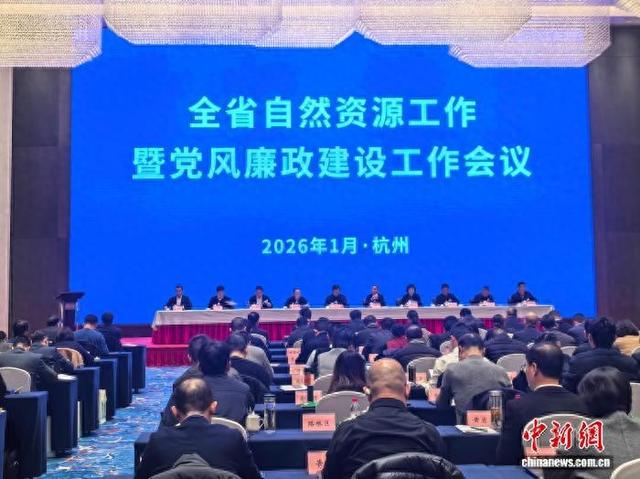
Core Insights - The Zhejiang Provincial Natural Resources Work Conference held on January 9, 2023, aims to enhance the quality and efficiency of existing land resources by 2026, supporting the construction of an innovative Zhejiang and a modern industrial system [1][3]. Group 1: Land Supply and Industrial Development - The province plans to establish a differentiated supply mechanism for industrial land based on per-acre benefits, with a target of supplying over 300,000 acres of construction land by 2026, where industrial land will account for over 30% of the land offered [3]. - At least 80% of the industrial land will support private investment projects, reflecting a strong focus on fostering private sector participation in industrial development [3]. Group 2: Strategic Actions and Policy Implementation - In 2022, the Zhejiang Natural Resources Department implemented major strategies and actions to support significant industrial projects, small and medium-sized private enterprises, and rural revitalization, optimizing resource allocation policies [3]. - The province aims to supply 372,600 acres of construction land by 2025, with mineral rights for fluorite mining reaching a ten-year high [3]. Group 3: Urbanization and Spatial Governance - China's urbanization is transitioning from rapid growth to stable development, with a focus on improving existing urban spaces rather than expanding them [3]. - The key goals for land space governance include achieving a more coordinated and orderly land space pattern, precise resource protection and utilization, and a resilient ecological security barrier [4]. Group 4: Future Goals and Technological Integration - By 2030, Zhejiang aims to achieve significant progress in modernizing land space governance, enhancing governance systems, and improving service support for high-quality development [5]. - The province plans to establish a legal and intelligent system for natural resource management, integrating artificial intelligence into spatial governance [5].

自然资源部启动2025年城市国土空间监测
Zhong Guo Zi Ran Zi Yuan Bao· 2025-06-10 01:38
Core Points - The Ministry of Natural Resources has issued a notice to conduct urban land space monitoring across cities at the prefecture level and above by 2025, focusing on public services, livability, transportation convenience, and safety resilience [1][2] - The monitoring will utilize the results of the 2024 land change survey as a base map, incorporating high-resolution remote sensing images and relevant data collected by June 2025 [1] - The monitoring aims to update and refine information on land use, construction volume, land structure, infrastructure, and service functions to support urban planning and governance [1] Group 1 - The notice emphasizes the importance of quality in monitoring work, requiring the establishment of a quality management system and accountability mechanisms [2] - The Ministry will provide optimized quality inspection software, and provincial natural resource departments must ensure the quality of monitoring results [2] - Monitoring results will undergo quality sampling checks, with results reported nationwide [2] Group 2 - The notice stresses the application of monitoring results, urging natural resource departments to enhance data application mechanisms in urban planning and land use management [2] - There is a call for sharing monitoring results with relevant departments, particularly those providing specialized data, to create a closed-loop workflow [2] - Provincial natural resource departments are required to feedback monitoring results to local governments [2]