
国有企业

Search documents
波黑经济增长创十年来新低
Shang Wu Bu Wang Zhan· 2025-11-05 16:54
Core Insights - Bosnia's economic growth has reached its lowest level since 2012, facing dual pressures of weak consumption growth and declining industrial output [1] - The Foreign Investment Promotion Agency predicts a 14% decrease in investment this year, following a record investment of 1.7 billion marks last year [1] - Analysts highlight that the deterioration of the investment environment is primarily due to inconsistent regulations, overlapping jurisdictions, and a lack of incentives [1] Investment Environment - The president of the Foreign Trade Chamber of Bosnia emphasizes the urgent need to restore tax incentives for export-oriented enterprises, similar to practices in the EU and neighboring countries [1] - Croatia and Austria remain the main sources of investment in Bosnia, with around 200 Austrian companies creating over 8,000 jobs locally [1] Potential Growth Areas - Economic analysts suggest that Bosnia should not only focus on attracting foreign investment but also explore the potential of state-owned enterprises, overseas compatriots, and the entrepreneurial economy [1]
三部门印发《行政事业单位、国有企业、上市公司选聘资产评估机构管理办法》的通知
Sou Hu Cai Jing· 2025-11-03 14:18
Core Points - The regulation aims to standardize the selection of asset appraisal institutions by administrative units, state-owned enterprises, and listed companies, enhancing the quality of asset appraisal services [3] - The selection process must adhere to principles of fairness and justice, utilizing methods such as public bidding and competitive negotiation [5][6] - The evaluation criteria for asset appraisal institutions include qualifications, integrity, management quality, and project experience, with a significant emphasis on quality control [4][5] Group 1 - The selection of asset appraisal institutions must comply with relevant laws and regulations, and decisions should be made by the shareholders' meeting, board of directors, or internal departments [3] - Listed companies must select asset appraisal institutions that are legally registered to provide securities services [4] - The selection documents must include essential information such as appraisal objectives, scope, and evaluation criteria [4] Group 2 - The evaluation of asset appraisal institutions should focus on quality control systems, ethical standards, and past regulatory compliance [5][6] - The pricing evaluation will use the average bid of compliant institutions as a benchmark, with specific scoring formulas [6] - Results of the selection process must be publicly disclosed, including the chosen institution and appraisal fees [6] Group 3 - Institutions involved in the selection process must maintain proper documentation for at least ten years and ensure information security [6][7] - Regulatory bodies will oversee the selection process, and violations may lead to corrective actions or penalties [8][9] - The regulation applies to both statutory and non-statutory appraisal activities, with specific provisions for government procurement projects [12][13]

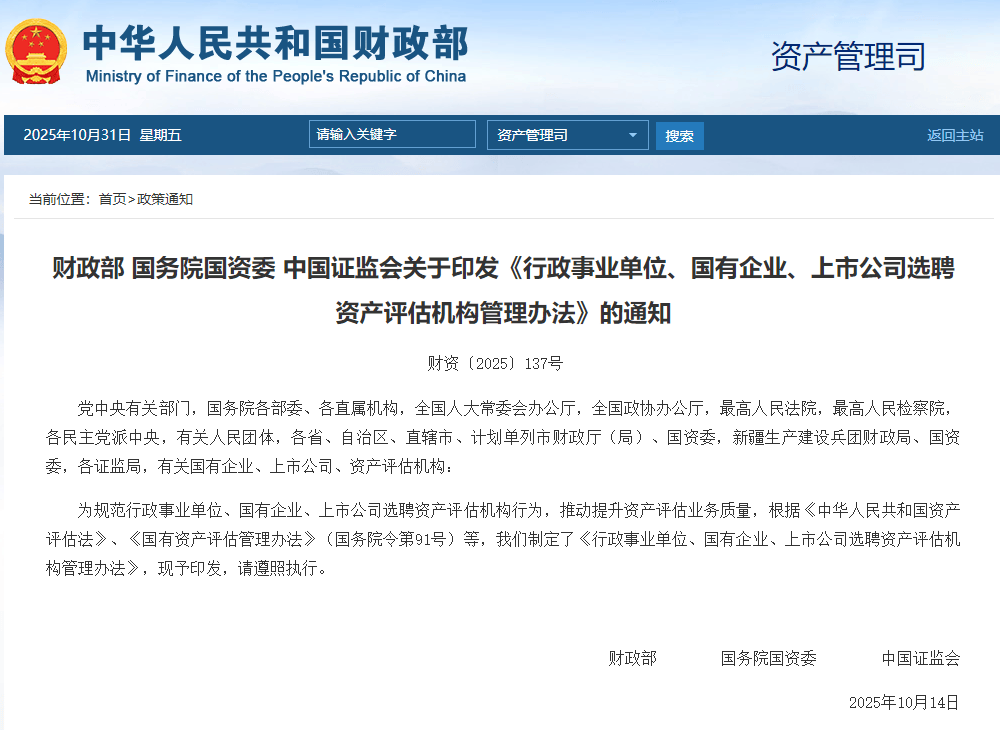
三部门印发《行政事业单位、国有企业、上市公司选聘资产评估机构管理办法》
Zheng Quan Ri Bao Wang· 2025-10-31 12:25
Core Points - The Ministry of Finance announced the implementation of the "Management Measures for the Selection of Asset Appraisal Institutions by Administrative and Public Institutions, State-owned Enterprises, and Listed Companies" to enhance the quality of asset appraisal services [1][2] Group 1 - The selection units must refine the evaluation criteria for asset appraisal institutions and record the evaluation opinions of the participants [1] - Evaluation factors for asset appraisal institutions include appraisal fees, qualifications, integrity records, internal management, quality control, work plans, resource allocation, information security management, risk-bearing capacity, and relevant project experience [1][2] Group 2 - Each valid application must be evaluated and scored individually, with the quality control level weighted at no less than 40% and the appraisal fee for major asset evaluations not exceeding 15% [2] - The selection units should consider the purpose of the appraisal, the scale of the assets, and the characteristics of the assets when determining the classification standards for major asset evaluations [2]