土地治理

Search documents
利比里亚启动土地管理改革高层对话 拟修订法律以强化土地管理局职能
Shang Wu Bu Wang Zhan· 2025-12-05 03:22
Core Viewpoint - The Liberia Land Authority (LLA) is initiating a two-day high-level dialogue to improve land governance and address long-standing issues of unclear responsibilities, aiming to amend the Administrative Code and establish an independent chapter for LLA to clarify its statutory functions [1] Group 1: Land Governance Issues - The LLA was established in 2016 to consolidate various land management functions, but some departments, such as the Ministry of Public Works and the Tax Authority, continue to exercise functions that should have been transferred, leading to land conflicts and management chaos [1] - Participants in the dialogue include representatives from the government, legislative bodies, and the Swedish embassy, emphasizing the need for legal coordination, community rights education, and inter-departmental collaboration to achieve fair, transparent, and efficient land governance [1] Group 2: Objectives of the Dialogue - The dialogue aims to revise the Liberia Administrative Code, specifically Chapter 12, to enhance the clarity of LLA's roles and responsibilities [1] - The discussions are intended to support national development goals by improving land governance practices [1]
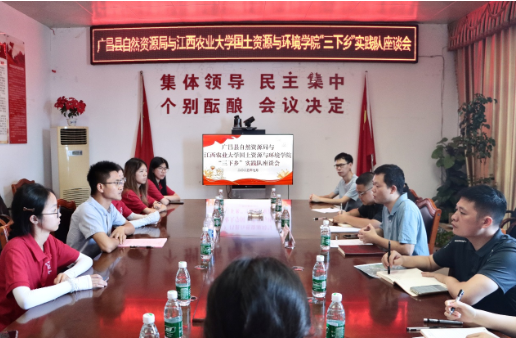
校地联动共商土地治理,青春赋能助力乡村振兴 ——江西农大“三农”实践队与广昌县自然资源局开展土地资源专题座谈会
Zhong Guo Shi Pin Wang· 2025-07-08 08:08
Core Insights - The discussion between Jiangxi Agricultural University’s youth practice team and the Guangchang County Natural Resources Bureau focused on land resource management challenges in hilly areas, emphasizing the need for innovative solutions to address land governance issues [1][2]. Current Situation Analysis: Land Governance Challenges in Hilly Areas - Guangchang County, characterized by fragmented farmland with an average of less than 3 mu per household, faces significant challenges in agricultural mechanization, with a mechanization rate below 30% and costs exceeding 40% compared to flatland areas [2]. - The youth practice team identified that land fragmentation leads to inefficient irrigation practices, with water resource utilization below 50%, which hinders agricultural productivity and the application of modern agricultural technologies [2]. Policy Focus: Balancing Farmland Protection and Ecological Red Lines - Guangchang County must adhere to the 800 million mu farmland protection line, with 774.36 square kilometers designated as ecological red line, representing 48.31% of the county's area, creating a conflict between ecological protection and agricultural development [2][3]. - The current ecological red line demarcation relies on a "dual evaluation" mechanism, which sometimes restricts agricultural infrastructure development in valuable hilly terraced areas [2]. Pathways to Resolution: Technological Empowerment and Conceptual Innovation - The discussion highlighted the need for a dynamic adjustment mechanism for ecological red lines, prioritizing the removal of flatter, contiguous farmland to facilitate agricultural development [3]. - The youth practice team proposed an "Ecological Agriculture" model to enhance land productivity while protecting ecosystems, such as planting nitrogen-fixing plants around lotus fields to reduce fertilizer use and support beneficial insects [3]. Collaborative Framework: Building a "Theory-Practice-Transformation" Loop - The Natural Resources Bureau expressed a desire for the youth practice team to utilize local case studies for projects, integrating data on farmland quality, transfer needs, and ecological red lines for dynamic monitoring and precise allocation of land resources [5]. - The emphasis was placed on the necessity for academic research to align closely with grassroots needs, encouraging students to engage with real-world agricultural challenges to develop practical solutions [7].