
地方国资入股银行

Search documents
提供多维度支持 中小银行增资浮现国资身影
Zhong Guo Zheng Quan Bao· 2026-01-15 20:48
Core Insights - The capital replenishment pace of small and medium-sized banks has significantly accelerated this year, with several banks, including Ningxia Huanghe Rural Commercial Bank, Qinghai Bank, and Xinjiang Bank, receiving regulatory approval for capital changes [1][2] - The current wave of capital increases reflects both proactive measures by banks to address regulatory and operational pressures and deeper considerations for local resource integration [1] Group 1: Capital Replenishment - Ningxia Huanghe Rural Commercial Bank has increased its registered capital from 1.733 billion to 1.85 billion yuan, with a new share issuance of 66.67 million shares approved, raising its total shares to 1.8 billion [1] - The bank's total assets reached 82.436 billion yuan, with a core Tier 1 capital adequacy ratio of 10.21%, indicating a pressing need for capital increase due to a decline from the previous year [1] Group 2: Shareholder Structure Changes - The capital increase process is often accompanied by adjustments in shareholder structure, with local state-owned enterprises actively participating, reflecting a strategic alignment with regional financial stability [2] - In Xinjiang Bank's case, Xinjiang Financial Investment Group was allowed to acquire 3.777 billion shares, representing a 30.90% stake, while Qinghai Bank's capital change involved new shareholders from local enterprises [2] Group 3: Industry Context - The overall capital adequacy ratio of commercial banks is under downward pressure, with the core Tier 1 capital adequacy ratio at 10.87% as of Q3 2025, showing a decline from the previous quarter [3] - The capital adequacy ratios of city commercial banks, private banks, and rural commercial banks are below the industry average, necessitating proactive capital management strategies [3] Group 4: Capital Supplementation Tools - In addition to equity financing, banks are increasingly utilizing instruments like subordinated debt and perpetual bonds to supplement capital, with the issuance of such bonds reaching 1.76 trillion yuan in 2025, surpassing the previous year's total [4]
多家银行公告:增资扩股!
Xin Lang Cai Jing· 2025-12-09 09:32
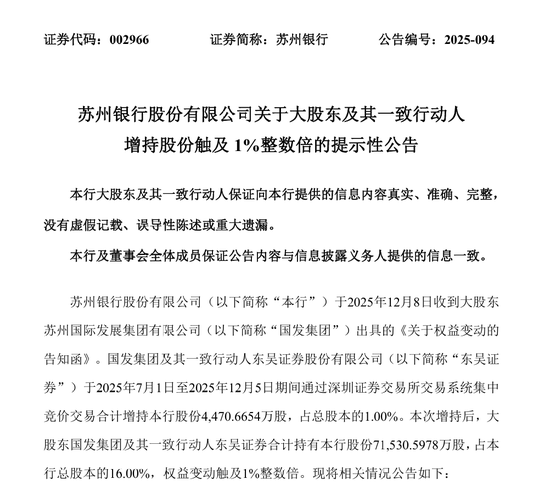
Core Viewpoint - The capital replenishment of small and medium-sized banks is entering a "sprint period" as they increasingly rely on methods such as capital increase and targeted fundraising to address capital adequacy pressures, with a new wave of capital replenishment accelerating [1][4]. Group 1: Recent Developments in Capital Increases - On December 8, Suzhou Bank announced that its major shareholder, Suzhou International Development Group, would increase its holdings by 44.7 million shares, accounting for 1.00% of the total share capital, between July 1, 2025, and December 5, 2025 [1]. - Hunan Bank has completed its capital increase, receiving approval to raise its registered capital by 1 billion RMB, increasing from approximately 7.75 billion RMB to about 8.75 billion RMB, a nearly 13% increase [3][8]. - Hunan Bank issued 1 billion shares to nine specific entities, raising a total of 4.01 billion RMB, with a net amount of 4.009 billion RMB after deducting issuance costs [3][8]. Group 2: Capital Adequacy and Regulatory Context - As of the end of Q3 2025, the capital adequacy ratio for commercial banks (excluding foreign bank branches) was 15.36%, with tier one capital adequacy at 12.36% and core tier one capital adequacy at 10.87% [4][9]. - The capital adequacy ratios for city commercial banks and rural commercial banks were 12.40% and 13.20%, respectively, which are lower than the average levels of 17.99% for large commercial banks and 13.48% for joint-stock commercial banks [4][9]. Group 3: Role of Local State-owned Capital - Local state-owned capital has become a significant force in the current wave of capital increases among small and medium-sized banks, with Hunan Bank's issuance entirely directed to state-owned entities [10][11]. - The involvement of local state-owned capital not only provides immediate financial support but also contributes to long-term capital generation effects, as local governments often promote such investments [5][11].

国联发展成为锡商银行第一大股东
Zheng Quan Ri Bao Zhi Sheng· 2025-08-11 16:39
Core Viewpoint - The recent approval by the National Financial Supervision and Administration of China allows Wuxi Xishang Bank to change its major shareholder from Hongdou Group to Wuxi Guolian Development Group, a state-owned enterprise, which is expected to enhance the bank's governance and operational management [1][2]. Group 1: Shareholder Changes - Wuxi Guolian Development will acquire 500 million shares from Hongdou Group, resulting in a 25% ownership stake in Wuxi Xishang Bank [1]. - This marks a significant shift as Guolian Development, a state-owned capital investment and operation enterprise, becomes the largest shareholder, replacing Hongdou Group, which has been the largest shareholder since the bank's establishment [2]. Group 2: Bank Performance - For the year 2024, Wuxi Xishang Bank reported revenues of 1.185 billion yuan, a decline of over 26% year-on-year, while net profit reached 420 million yuan, an increase of 8.39% [1]. - The bank's non-performing loan ratio rose to 1.25% by the end of 2024, an increase of 0.57 percentage points compared to the end of 2023 [1]. Group 3: Industry Context - Wuxi Xishang Bank is the third private bank to welcome local state-owned shareholders, following Jiangxi Yumin Bank and Anhui Xin'an Bank [3]. - The involvement of local state-owned capital in private banks is seen as a strategy to enhance risk management and support regional economic services, especially as many private banks face challenges related to size and strength [3].