垂直供电技术

Search documents
七大预测揭开AI供电革命拐点!英飞凌白皮书前瞻下一代技术
Hua Er Jie Jian Wen· 2025-12-24 05:55
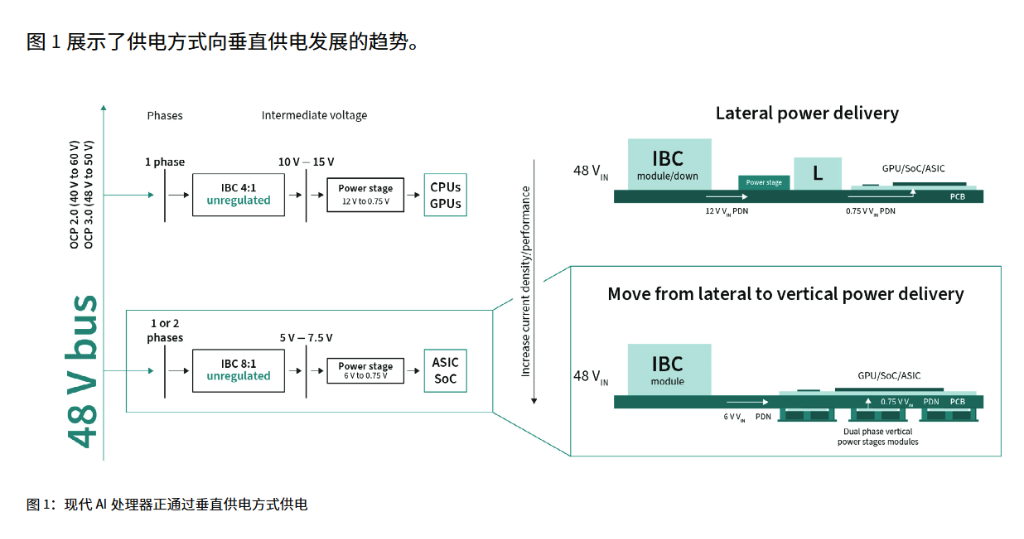
Core Insights - The AI-driven power revolution is reshaping the entire power supply system from chips to the grid, with significant implications for data center operators, equipment manufacturers, and investors [1] Group 1: Key Predictions - Prediction 1: Vertical power supply will dominate future processor architectures, with total current consumption expected to rise to 10,000 amperes within ten years due to the increasing size of chips and reduced supply voltage [2] - Prediction 2: High-voltage direct current (DC) power supply architecture will replace the 48V ecosystem as single rack power exceeds 1 megawatt, necessitating new modules like electronic fuses and hot-swappable features [7] - Prediction 3: AI rack power consumption will enter the megawatt era, with total power in a single IT rack projected to exceed 1 megawatt as more GPUs are integrated [10] Group 2: Power Supply Developments - Prediction 4: Power supply rack power levels will exceed 100 kilowatts, with each rack potentially housing multiple power supply units to support the transition to 1 megawatt IT racks [12] - Prediction 5: New data center power demands will reach gigawatt levels, driven by the increasing power consumption of modern GPUs and dense AI compute nodes [14] - Prediction 6: Distribution systems will shift towards DC microgrids, which are seen as a promising architecture for future AI data centers, utilizing solid-state transformer technology [16] Group 3: Renewable Energy Integration - Prediction 7: Renewable energy will become a critical constraint for AI development, with nearly 50% of the power used by global data centers coming from renewable sources [18] - To support the operation of gigawatt-scale data centers, approximately 8 square kilometers of solar fields will be required [19]


龙磁科技20250825
2025-08-25 14:36
Summary of the Conference Call Company and Industry Overview - The conference call primarily discusses **Long Magnetic Technology** and the **AI chip inductors and capacitors industry**. The industry is experiencing exponential growth driven by the demand for electronic components in AI technologies, particularly in AI servers and autonomous vehicles [2][3]. Key Points and Arguments Industry Demand and Trends - The demand for electronic components such as inductors and capacitors in AI servers is significantly higher than in traditional servers, with requirements for miniaturization, high capacity, and high frequency [2][3]. - The AI chip inductor and capacitor industry is in a rapid development phase, benefiting from the explosive growth of AI technology. For instance, the number of electronic components required for autonomous vehicles is over ten times that of non-autonomous vehicles, and AI servers require 12 times more inductors and capacitors than traditional servers [3]. - The high barriers to entry in this market mean that only a few suppliers dominate, leading to high profit margins and a focus on R&D capabilities [3]. Company Performance - Long Magnetic Technology reported record high performance in the first half of 2025, with significant revenue and net profit growth from its overseas base, particularly in Vietnam, where revenue increased from 69 million yuan to 90 million yuan year-on-year [2][14]. - The overall gross margin improved to 33.87%, up 3.3 percentage points from the previous year, despite increased sales and management expenses [14]. Technological Advancements - The power supply process for servers involves multiple conversions, with the most critical step being the reduction from 12V to 1V, which requires high stability and performance [5]. - Infineon's new vertical power supply solution improves efficiency by 5%, significantly impacting data center operating costs [5]. - Vertical power supply technology is expected to become mainstream in the next two years, enhancing efficiency and reducing space requirements for high-power applications [8][11]. Product Innovations - The new TRVR (TLVR) chip inductors have stronger voltage regulation capabilities and smaller sizes, with a value increase of 2-3 times compared to previous generations [2][9]. - The high-end AI inductor market is projected to reach $4-5 billion by 2026, with Long Magnetic Technology holding a significant share in the automotive power supply sector [3][18]. Market Competition - Long Magnetic Technology holds approximately 60-70% of the global market share in automotive power supplies, while its AI inductor business is still in the early stages of customer engagement and small-scale delivery [19][20]. - The company faces competition from international giants like TDK and Murata but leverages cost advantages and superior service to attract customers [39]. Future Outlook - The global AI power consumption is expected to grow from 1.5% to 4.5% of total power consumption within three years, indicating a substantial increase in demand for high-performance components [10][11]. - Long Magnetic Technology aims to expand its market presence in AI inductors and automotive inductors, which are anticipated to become new growth points [24][32]. - The company plans to increase its total production capacity to 60,000 tons, with the Vietnam base expected to continue driving significant revenue growth [33][23]. Additional Important Insights - The vertical power supply technology is recognized as a new trend, with companies like Google already implementing it, leading to increased demand for related components [42]. - The challenges in high-power material development include material simulation and processing technology, which require advanced R&D capabilities [13]. - Long Magnetic Technology's ability to use proprietary materials gives it a competitive edge in the market, allowing for better responsiveness to customer needs [34]. This summary encapsulates the key insights from the conference call, highlighting the growth potential and competitive landscape of Long Magnetic Technology and the AI chip inductor and capacitor industry.