城市GDP

Search documents
中国城市GDP20强出炉
Sou Hu Cai Jing· 2026-02-04 15:06
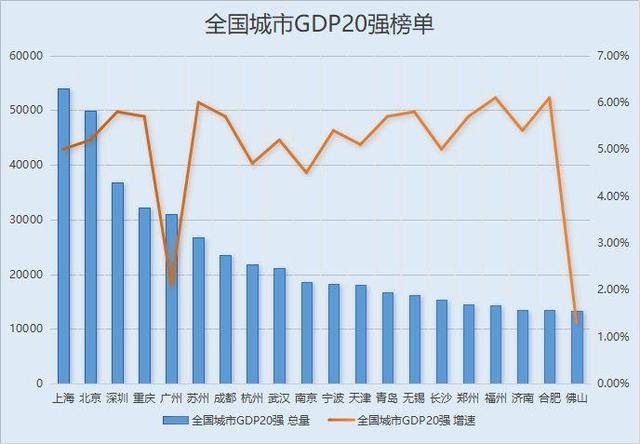
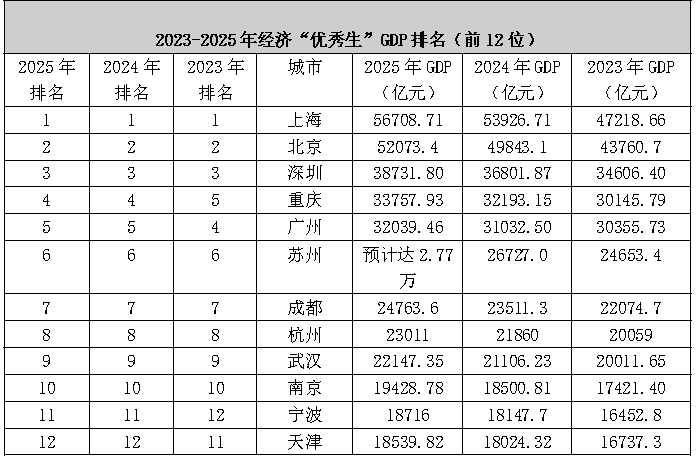
Group 1 - The core viewpoint of the article highlights the ranking of cities in terms of GDP, with Shanghai and Beijing being the only two cities surpassing 5 trillion yuan, while three cities exceed 3 trillion yuan [1][3] - Shanghai leads with an economic total of 56,708.71 billion yuan, followed by Beijing at 52,073.4 billion yuan, and Shenzhen, Chongqing, and Guangzhou with GDPs of 38,731.8 billion yuan, 33,757.93 billion yuan, and 32,039.46 billion yuan respectively [3] - By 2025, Hefei's economic total is projected to reach 1.42 trillion yuan, tying with Jinan for the 18th position [1][3] Group 2 - The Yangtze River Delta region has 10 cities with GDPs exceeding 1 trillion yuan, including Shanghai, Nanjing, Suzhou, Wuxi, Nantong, Changzhou, Hangzhou, Ningbo, Wenzhou, and Hefei [3] - The Guangdong-Hong Kong-Macau Greater Bay Area has 4 cities with GDPs over 1 trillion yuan: Guangzhou, Shenzhen, Foshan, and Dongguan [3] - The Beijing-Tianjin-Hebei region includes 3 cities with GDPs exceeding 1 trillion yuan: Beijing, Tianjin, and Tangshan [3] Group 3 - Hefei's industrial output value above designated size increased by 17.6% year-on-year, marking a four-year high [3] - The output value of emerging industries in Hefei grew by 16.6% year-on-year, accounting for 60.4% of the industrial total, an increase of 2.7 percentage points [3] - Hefei's total import and export volume reached 455.18 billion yuan, with a year-on-year growth of 20.2%, accelerating by 14.5 percentage points compared to the previous year [3]

城记 | 南京或率先“撞线” 南京、宁波、天津等多城冲刺2万亿元台阶
Xin Hua Cai Jing· 2026-01-31 04:24
Core Viewpoint - Nanjing is projected to achieve a GDP of 19,428.78 billion yuan in 2025, with a year-on-year growth of 5.2%, maintaining its position among China's top ten cities in terms of economic output and aiming to surpass the 20 trillion yuan mark by 2026 [1][5]. Economic Performance - In 2020, Nanjing's GDP was 14,817.95 billion yuan, growing by 4.6%, which allowed it to surpass Tianjin and enter the top ten cities for the first time [2]. - The GDP rankings for 2024 show Nanjing at 18,500.81 billion yuan, placing it tenth, ahead of cities like Ningbo and Tianjin [2][6]. - Nanjing's GDP growth rate for 2024 was 4.5%, slightly below the national average of 5.0% and Jiangsu province's average of 5.8% [6]. Future Projections - By 2025, Nanjing's GDP is expected to increase to 19,428.78 billion yuan, while the gap with Ningbo is projected to widen to 712.78 billion yuan [3]. - Nanjing is on track to potentially join the "20 trillion yuan club" by 2026, with a target set for GDP growth of over 5% [5][6]. Competitors in the "Two Trillion Club" - Other cities like Ningbo, Tianjin, and Qingdao are also targeting the 20 trillion yuan GDP milestone, with Ningbo projected to reach 18,716 billion yuan in 2025 [7]. - Cities such as Zhengzhou and Fuzhou are also making strategic plans to reach the 20 trillion yuan GDP goal, indicating a competitive landscape [7][8].
前三季度GDP20强城市预测:深圳远超广州,苏州超2万亿,郑州低迷
Sou Hu Cai Jing· 2025-10-18 19:14
Core Insights - The ranking of China's top 20 cities by GDP for the first three quarters of 2025 shows a stable top-tier structure with emerging breakthroughs, highlighting the robust momentum of the Chinese economy [1] Group 1: Economic Performance of Major Cities - Shanghai leads the nation with a GDP of 4.05 trillion yuan, while Beijing maintains a steady growth at 3.84 trillion yuan, solidifying the dual leadership in China's economic landscape [1] - Shenzhen demonstrates strong growth with a GDP of 2.75 trillion yuan, surpassing Guangzhou's 2.33 trillion yuan, and achieving a growth rate of 5.96%, which is 0.68 percentage points higher than Guangzhou [1] - Suzhou, as an industrial powerhouse, breaks the 2 trillion yuan mark with a nominal growth rate of 8.29%, showcasing its economic strength [3] Group 2: Growth Rates and Emerging Cities - Chengdu leads the new first-tier cities with a growth rate of 9.59%, while Hangzhou achieves a remarkable growth of 11.56% driven by its digital economy initiatives [6] - Jinan and Hefei also show strong growth, with Jinan achieving an 8.86% increase and Hefei at 6.76%, indicating a diverse economic base in these emerging cities [6] - Zhengzhou's growth is relatively slow at 3.23%, but it is expected to benefit from the automotive electronics industry as new production ramps up [5] Group 3: Sectoral Contributions - Shenzhen's high-tech manufacturing sector contributes over 40% to its GDP, with significant growth in artificial intelligence and new energy industries forming billion-level industrial clusters [1] - Suzhou's industrial output exceeds 4.5 trillion yuan, with leading sectors like biomedicine, nanotechnology, and artificial intelligence growing by 15% [3] - Ningbo benefits from port economy advantages, with cross-border e-commerce imports and exports surging by 38% year-on-year [6] Group 4: Overall Economic Outlook - The forecast reflects the deep resilience of the Chinese economy, with top cities accelerating their transition to innovation-driven growth and mid-tier cities leveraging specialized industrial clusters [7] - As the traditional peak season approaches in the fourth quarter, cities are poised to make significant strides towards achieving their annual economic targets [7]