基金分红避税

Search documents
基金公司以“高比例分红”为卖点,助机构投资者避税,监管出手
Mei Ri Jing Ji Xin Wen· 2026-01-16 11:49
Core Viewpoint - Recent regulatory documents have reported that some fund companies are using dividend tax incentives to assist institutional investors in tax evasion, leading to strict penalties for the violating institutions [1][2][9] Group 1: Regulatory Actions - Regulatory scrutiny has focused on three specific behaviors of fund companies that facilitate tax evasion through dividend strategies [2][9] - The regulatory body has emphasized the importance of compliance and has previously reprimanded executives for similar practices [9][10] Group 2: Tax Planning Strategies - Institutions often incorporate dividend income into corporate revenue as a tax planning strategy, as dividends are not subject to corporate income tax, unlike capital gains [8][10] - Many investment institutions are increasingly considering high-dividend products as essential for their asset allocation [8][10] Group 3: Industry Trends - Despite concerns over some improper dividend practices, the trend towards regular dividends remains strong, with over 400 funds having distributed dividends since the beginning of the year [11][12] - The number of funds implementing dividends has increased, with 7,674 funds distributing a total of 2,424.78 billion yuan in 2025, although the instances of single high-dividend distributions have decreased [10][11] Group 4: Innovations in Dividend Mechanisms - Fund companies are accelerating the pace of dividend distributions, with many now incorporating dividend mechanisms directly into fund contracts, enhancing the regularity and predictability of dividends [11][12] - The introduction of structured dividend policies, such as minimum annual distributions and specific timing for dividends, is becoming more common, which may enhance product attractiveness [12]

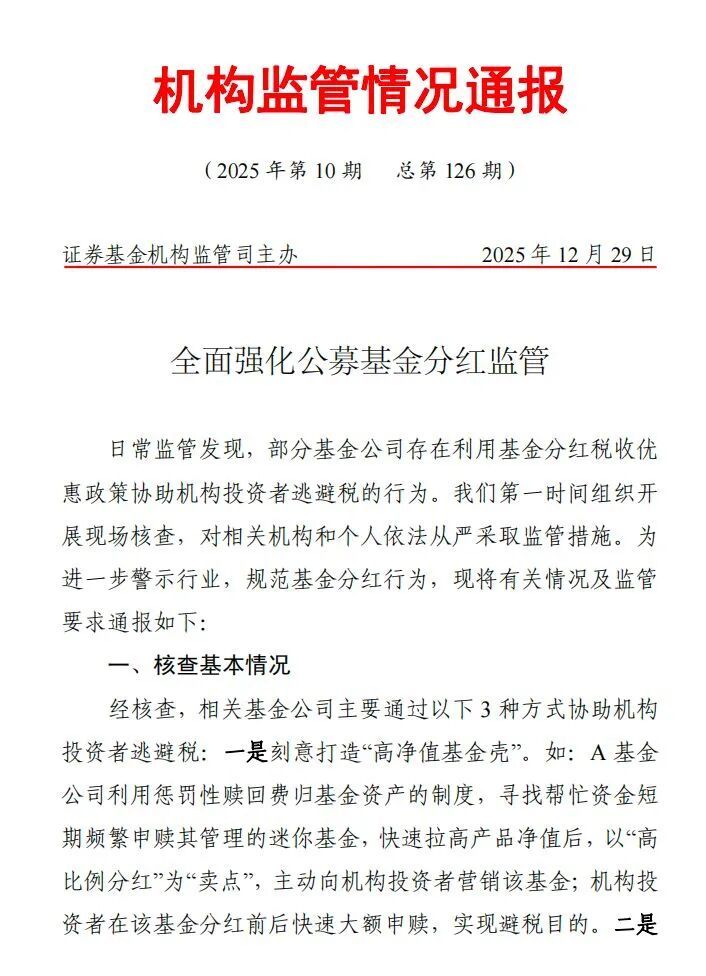
部分基金公司以“高比例分红”为“卖点”,协助机构投资者避税,监管出手:对违规机构从严惩处!
Mei Ri Jing Ji Xin Wen· 2026-01-16 11:05
Core Viewpoint - Recent regulatory documents have reported that some fund companies are using dividend tax incentives to assist institutional investors in tax evasion, leading to strict penalties for the violating institutions [1][4]. Group 1: Regulatory Findings - The regulatory review identified three main methods used by fund companies to help institutional investors evade taxes: creating "high-net-worth fund shells," leaking dividend information, and implementing dividends based on specific client requests [3][4]. - The review highlighted that some fund companies deliberately inflate fund net values to market high dividend payouts, which institutional investors exploit for tax evasion [4][5]. Group 2: Industry Response and Trends - Despite the identified violations, the overall trend in the industry remains towards healthy dividend practices, supported by policy encouragement and innovative dividend mechanisms from fund managers [2][8]. - The number of funds implementing dividends has increased, with 7,674 funds distributing dividends in 2025, up from 6,805 in 2024, indicating a shift towards more compliant dividend distributions [8]. Group 3: Dividend Mechanisms and Strategies - Many funds are now incorporating dividend mechanisms directly into their contracts, ensuring that dividends are a standardized practice rather than an ad-hoc decision [9][10]. - The introduction of minimum dividend frequency requirements and specific payout ratios in fund contracts is becoming common, enhancing the attractiveness of these products [10]. Group 4: Future Outlook - Analysts predict that both equity and bond funds will continue to see stable and optimized dividend distributions, with a focus on sustainable practices that align with actual earnings [11].

基金分红,迎来强监管
Feng Huang Wang· 2026-01-15 11:43
Core Viewpoint - The regulatory authorities are intensifying oversight on public fund dividends to prevent tax evasion through the misuse of tax incentives, highlighting three cases of violations related to fund dividend practices [1][5]. Regulatory Requirements - The regulatory body has outlined three key requirements for enhancing dividend oversight: 1. Strengthening full-process management to ensure that fund dividend actions are legal and compliant [4][10]. 2. Strictly controlling dividend amounts to curb artificial inflation of net asset values before dividends [4][10]. 3. Rigorously managing dividend information to prohibit any form of information leakage [4][10]. Violations Identified - The report identifies three main types of violations related to tax evasion through fund dividends: 1. Creating "high net worth fund shells" by artificially inflating fund values through frequent redemptions, allowing institutional investors to redeem large amounts before dividends [5][6]. 2. Deliberately leaking dividend information to entice institutional investors to make quick purchases before dividends [6]. 3. Implementing dividends based on specific client requests for tax evasion purposes [6]. Penalties and Corrective Actions - The report states that regulatory measures include: 1. Mandating corrections and suspending related business for three months for certain fund companies, holding responsible executives accountable [8]. 2. Issuing warnings and holding direct responsible personnel accountable for other fund companies [8]. 3. Identifying five individuals who leaked dividend information as unsuitable candidates for their roles [8]. Industry Trends - According to Wind data, in 2025, over 3,600 funds are expected to distribute dividends totaling 242.418 billion yuan, a 7.44% increase from the previous year [4][10]. - The public fund industry's annual dividend total has been rising since 2022, with 180 funds distributing dividends five times or more last year, 84 of which were bond funds [11].
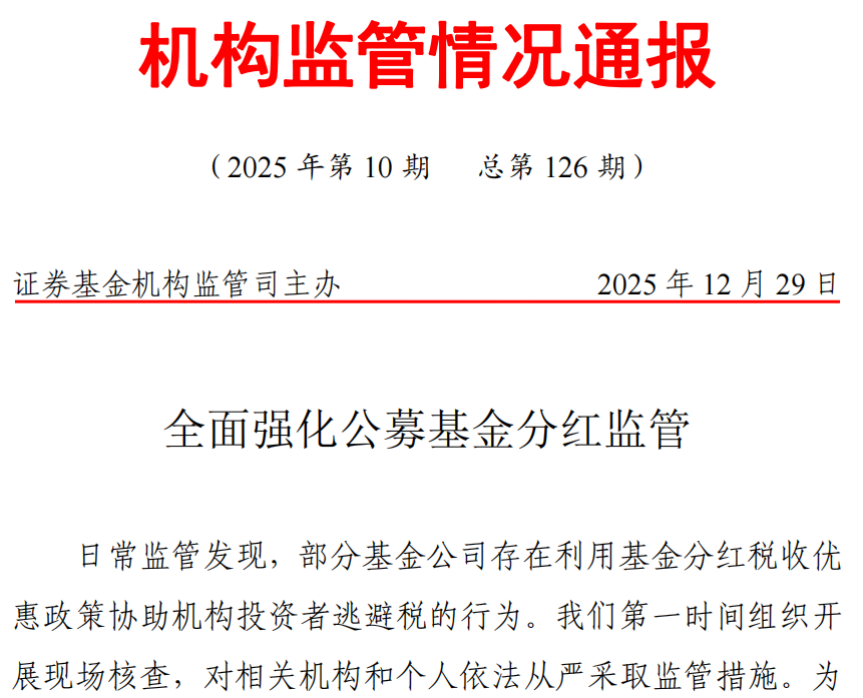
基金分红,迎来强监管
财联社· 2026-01-15 11:18
Core Viewpoint - The article discusses the recent regulatory measures imposed on the public fund industry regarding dividend distribution, highlighting the need to prevent tax evasion through misuse of tax benefits associated with fund dividends [1][3]. Regulatory Measures - The regulatory body emphasizes the need for enhanced oversight of public fund dividend distributions to prevent abuse of tax benefits [3]. - Three main regulatory requirements are outlined: 1. Strengthening the entire process management to ensure compliance with legal standards for fund dividends [4][11]. 2. Strictly controlling the amount of dividends to prevent artificial inflation of net asset values before distribution [4][11]. 3. Prohibiting any form of leakage of dividend information to protect the interests of fund shareholders [12][11]. Industry Trends - According to Wind data, in 2025, over 3,600 funds implemented dividends totaling 2,424.18 billion yuan, marking a 7.44% increase from the previous year [5][12]. - The total annual dividend amount in the public fund industry has been steadily increasing since 2022, with 180 funds distributing dividends five times or more last year, 84 of which were bond funds [15][5]. - Despite a decline in the amount of dividends from bond funds, over 2,790 bond funds distributed dividends totaling 1,690.26 billion yuan, accounting for nearly 60% of the total fund dividends [13]. Violations and Penalties - The article identifies three main types of violations related to tax evasion through fund dividends: 1. Creating "high net worth fund shells" to attract institutional investors for tax evasion [6]. 2. Leaking dividend information to entice institutional investors into short-term transactions [6]. 3. Implementing dividends based on specific client requests for tax avoidance [6]. - Regulatory actions include suspending related business for three months and holding responsible personnel accountable for these violations [9][7].