债券型基金

Search documents
2025年中国开放式基金与ETF资金流全景:规模高速扩张,主被动冰火两重天
Morningstar晨星· 2026-03-26 02:12
Core Viewpoint - The domestic public fund asset management scale in China has rapidly expanded, reaching a new high of 17.7 trillion yuan by December 31, 2025, representing a 20% increase compared to the end of 2024 [1][2]. Group 1: Overall Fund Flow and Performance - The overall fund inflow for non-money market funds in 2025 significantly slowed, with total inflow of approximately 1.02 trillion yuan, about half of the inflow in 2024 [3][4]. - The bond fund category continued to attract the largest net inflow, while mixed funds experienced continuous net outflows for three consecutive years [3][4]. - The first quarter of 2025 saw a tight funding environment, leading to significant outflows from pure bond funds, while the second quarter rebounded due to favorable monetary policy [4][6]. Group 2: Active vs. Passive Fund Management - In 2025, active funds experienced a net outflow of 250.9 billion yuan, while passive funds achieved a net inflow of 1.2749 trillion yuan, indicating a reliance on passive funds for overall inflow [8][10]. - The asset management scale of passive funds increased from less than 20% at the beginning of 2023 to 40.7% by the end of 2025, reflecting a significant growth trend [13][14]. Group 3: Fund Categories Performance - The active bond category attracted a net inflow of 903.9 billion yuan in 2025, significantly outperforming other categories, while pure bond categories saw substantial outflows [17][18]. - The stock fund category experienced a notable decline in inflows, with large-cap growth stocks facing the largest net outflow of 127.1 billion yuan [19][20]. - Commodity funds, particularly those investing in gold, saw a record inflow of 1.273 billion yuan in 2025, driven by rising gold prices [25][26]. Group 4: QDII Fund Performance - QDII funds saw a total inflow of 183.8 billion yuan in 2025, a significant increase from 2024, with industry stocks being the largest inflow category due to strong performance from specific ETFs [27][28]. Group 5: Competitive Landscape of Non-Money Market Funds - The top three fund companies, E Fund, Huaxia Fund, and GF Fund, dominate the non-money market fund space, with the top 10 companies accounting for 47% of the total scale by the end of 2025 [30][31]. - Despite overall growth, 11 of the top 20 fund companies experienced a decline in fund flows in 2025, highlighting competitive pressures within the industry [30][31].


【金工】新能源主题基金净值表现占优,公募FOF产品发行火热——基金市场与ESG产品周报20260316(祁嫣然/马元心)
光大证券研究· 2026-03-16 23:06
Market Performance Overview - In the week from March 9 to March 13, 2026, oil prices continued to rise, while domestic equity market indices showed mixed performance, with the ChiNext Index increasing by 2.51% [4] - The coal, power equipment, and construction decoration industries had the highest gains, while the defense, petrochemical, and comprehensive industries experienced the largest declines [4] Fund Product Issuance - The domestic new fund market saw an expansion in issuance, with a total of 30 new funds established, amounting to 36.088 billion units. This included 7 FOF funds, 8 mixed funds, 13 equity funds, and 2 bond funds [5] - Overall, 40 new funds were issued, categorized as 19 equity funds, 8 mixed funds, 6 FOF funds, 6 bond funds, and 1 international (QDII) fund [5] Fund Product Performance Tracking - The long-term industry theme fund index showed that the new energy theme fund outperformed with a net value increase of 4.22%, while other industry theme funds experienced declines. As of March 13, 2026, the net value changes for various theme funds were as follows: new energy (4.22%), consumption (-0.23%), financial real estate (-0.58%), balanced industry (-0.80%), rotation industry (-0.96%), pharmaceuticals (-1.09%), cyclical (-1.23%), TMT (-1.69%), and defense industry (-5.59%) [6] ETF Market Tracking - In the week, stock ETFs experienced a net outflow of 8.586 billion yuan, with a median return of -0.29%. Hong Kong stock ETFs had a median return of -1.01% and a net outflow of 3.528 billion yuan. Cross-border ETFs saw a median return of -0.54% with a net inflow of 337 million yuan, while commodity ETFs had a median return of -0.73% and a net inflow of 5.606 billion yuan [7] - Comprehensive theme ETFs maintained net inflows, while other types of broad-based ETFs experienced net outflows, with large-cap theme ETFs seeing a significant outflow of 12.486 billion yuan. The new energy theme ETFs had notable net inflows totaling 9.482 billion yuan [8] ESG Financial Product Tracking - This week, 23 new green bonds were issued, with a total issuance scale of 21.065 billion yuan. The domestic green bond market has steadily developed, with a cumulative issuance scale of 5.31 trillion yuan and a total of 4,592 bonds issued as of March 13, 2026 [9] - The domestic fund market currently has 210 ESG funds with a total scale of 157.031 billion yuan. In terms of performance, the median net value changes for active equity, passive equity index, and bond ESG funds were -0.84%, +1.58%, and +0.01%, respectively. Funds focused on green energy, low-carbon environmental protection, and low-carbon economy themes performed well [9]

基金市场一周观察(20260309-20260313):权益市场分化,大盘成长风格占优
CMS· 2026-03-15 08:03
1. Report Industry Investment Rating There is no information provided regarding the report industry investment rating in the given content. 2. Core Viewpoints of the Report - This week, the A - share market was generally differentiated, with the ChiNext Index leading the gains and the large - cap growth style outperforming. The North Securities 50 Index had a relatively large decline. In terms of industries, coal and construction led the gains, while national defense and military industry, petroleum and petrochemicals, and comprehensive finance lagged behind [2][6]. - The average return of all - market active equity funds was - 0.86%. Funds with better performance were mostly heavily invested in industries such as power equipment and new energy, and basic chemicals. For industry - themed funds, the average returns of all sectors were negative this week, with the consumer sector funds having relatively leading average returns and the TMT sector funds having relatively lagging average returns [2][14][15]. - The bond market generally declined this week, with the credit bond market slightly rising. The average return of short - term bond funds was 0.03%, and that of medium - and long - term bond funds was - 0.01%. The average return of bond funds with equity exposure was negative, and the convertible bond market declined, with the average return of convertible bond funds being negative [2][27]. - During the statistical period, the average returns of low - risk, medium - risk, and high - risk FOF funds in the sample in the past week were 0.29%, 0.98%, and 1.46% respectively [2][41]. - During the statistical period, the average increases of equity - oriented, index - type, and other - type QDII funds were 1.77%, 1.35%, and 1.63% respectively, while the average decline of bond - type QDII funds was 0.62%. This week, REITs funds declined by an average of 0.51% [2][42][44]. 3. Summary by Relevant Catalogs 3.1 Market Review - The A - share market was differentiated this week. The ChiNext Index led the gains, the large - cap growth style outperformed, and the North Securities 50 Index had a large decline. As of the close this week, the Shanghai - Shenzhen 300 Index closed at 4669 points, up 0.19%; the Shanghai Composite Index closed at 4095 points, down 0.7%; the Shenzhen Component Index closed at 14281 points, up 0.76%; the ChiNext Index closed at 3310 points, up 2.51%. In the Hong Kong stock market, the Hang Seng Index fell 1.13%, and the Hang Seng Tech Index rose 0.62% [6]. - In terms of industries, coal and construction led the gains, with increases of over 4%, while national defense and military industry, petroleum and petrochemicals, and comprehensive finance lagged behind [9]. 3.2 Key Fund Tracking 3.2.1 Active Equity - **Fund Performance**: As of Q4 2025, there were 4140 ordinary stock - type funds, partial - stock hybrid funds, high - position flexible allocation funds, and balanced hybrid funds (with the latest stock position > 50%) that had been established for more than one year. The average return of the all - market funds in the sample this week was - 0.86%. Funds with better performance were mostly heavily invested in industries such as power equipment and new energy, and basic chemicals. For industry funds, the average returns of all sectors in the sample were negative this week, with the consumer sector funds having relatively leading average returns and the TMT sector funds having relatively lagging average returns [13][14][15]. - **Position Estimation**: This week, the stock positions of ordinary stock - type and partial - stock hybrid funds both rebounded. Compared with the previous week, the position of ordinary stock - type funds increased by 0.69 percentage points, and that of partial - stock hybrid funds increased by 0.53 percentage points. In terms of industry and sector allocation, compared with the previous week, active partial - stock funds increased their allocation to finance, growth, and cyclical sectors and reduced their allocation to stable and consumer sectors. In terms of sub - industries, compared with the previous week, the allocation to industries such as automobiles, banks, and real estate increased, while the allocation to industries such as pharmaceutical biology, electronics, and food and beverages decreased [20]. 3.2.2 Bond - type Funds - **Bond Market Performance**: The bond market generally declined this week, with the credit bond market slightly rising. The ChinaBond Total Wealth Index closed at 246.85, down 0.19% from last week; the ChinaBond Treasury Bond Index closed at 246.18, down 0.34% from last week; the ChinaBond Credit Bond Index closed at 226.65, up 0.03% from last week. The overall return of bond funds with equity exposure was negative this week. The CSI Convertible Bond Index closed at 508.67, with a weekly change of - 1.1%, and the trading volume was 337.4 billion yuan, a change of - 21.443 billion yuan from last week. As of the end of this week, the median market price of convertible bonds was 137.5 yuan, a change of - 1.96 yuan from last week; the median conversion premium rate was 23.20%, a change of - 2.67% from last week [27][28]. - **Fund Performance Overview**: The average return of short - term bond funds this week was 0.03%, and the median was 0.03%; the average return of medium - and long - term bond funds was - 0.01%, and the median was 0.02%. The average return of first - tier bond funds was - 0.13%, and the median was - 0.04%; the average return of second - tier bond funds was - 0.22%, and the median was - 0.13%. The average return of partial - bond hybrid funds was - 0.23%, and the median was - 0.13%; the average return of low - position flexible allocation funds was - 0.28%, and the median was - 0.16%. The average return of convertible bond funds was - 1.72%, and the median was - 1.77% [31][35][38][39]. 3.2.3 FOF Funds The FOF funds were classified into low - risk, medium - risk, and high - risk categories. The average returns of low - risk, medium - risk, and high - risk FOF funds in the sample in the past week were 0.29%, 0.98%, and 1.46% respectively [41]. 3.2.4 QDII Funds During the statistical period, the average increases of equity - oriented and index - type QDII funds were 1.77% and 1.35% respectively, the average increase of other - type QDII funds was 1.63%, and the average decline of bond - type QDII funds was 0.62% [42]. 3.2.5 REITs Funds This week, REITs funds declined by an average of 0.51%. Among them, the Huitianfu Jiuzhoutong Pharmaceutical Warehousing and Logistics REIT led the gains, rising 1.86% in the past week; the Huatai Jiangsu Expressway REIT had the strongest liquidity, with a trading volume of 88.7516 million yuan in the past week [44][45].
2月基金月报 | 股债向好,公募基金多数收涨
Morningstar晨星· 2026-03-12 01:05
Macro Economic Overview - The manufacturing PMI in February recorded 49.0%, down 0.3 percentage points from January's 49.3%, indicating continued pressure on the manufacturing sector, influenced by declines in production index, employment index, and supplier delivery time index [3] - In January, the CPI rose by 0.2% year-on-year, while the PPI fell by 1.4%. Compared to December, the CPI growth rate narrowed due to a decrease in food prices, and the decline in both living and production materials slowed, contributing to a smaller year-on-year drop in PPI [3] A-Share Market Performance - The A-share market showed a fluctuating upward trend in February, with major indices recording gains. The Shanghai Composite Index and Shenzhen Component Index rose by 1.14% and 2.05%, respectively [4] - 23 out of 31 Shenwan industry sectors saw increases, with the comprehensive, steel, and building materials sectors rising over 8%. Conversely, the banking, non-bank financial, and media sectors fell by over 3% [4] - The steel sector's strong performance was driven by the implementation of the "Steel Industry Stabilization Growth Work Plan (2025-2026)", which is expected to optimize industry structure and enhance concentration [4] Bond Market Performance - The bond market strengthened in February, supported by policy and market sentiment recovery. The central bank's actions, including reverse repos, helped maintain liquidity and boost the bond market [5][6] - The yield on 5-year and 10-year government bonds fell by 3 basis points and 4 basis points to 1.54% and 1.78%, respectively, while the 1-year government bond yield rose by 2 basis points to 1.32% [6] - The overall return of the bond market, as reflected by the China Bond Index, increased by 0.17% in February [6] Fund Performance - The Morningstar China Open-End Fund Index recorded a 0.72% increase in February, with all fund types showing positive returns. The stock and bond markets' strong performance led to gains in various fund indices [14] - Among equity funds, small-cap mixed funds outperformed large-cap funds, with average returns of 3.34%, 3.12%, and 2.55% for small-cap mixed, mid-cap balanced, and mid-cap growth funds, respectively [16] - Fixed-income funds collectively rose, with convertible bond funds, active bond funds, and ordinary bond funds achieving average returns of 0.33%, 0.25%, and 0.19%, respectively [17]

【金工】行业主题基金净值回调,周期主题、商品ETF资金大幅净流入——基金市场与ESG产品周报20260309(祁嫣然/马元心)
光大证券研究· 2026-03-09 23:07
Market Performance Overview - In the week from March 2 to March 6, 2026, oil prices surged while domestic equity market indices experienced a pullback [4] - The oil and petrochemical, coal, and public utilities sectors saw the highest gains, while media, non-ferrous metals, and computer sectors faced the largest declines [4] Fund Product Issuance - A total of 12 new funds were established in the domestic market this week, with a combined issuance of 13.464 billion units [5] - The new funds included 3 bond funds, 6 equity funds, 2 mixed funds, and 1 fund of funds (FOF) [5] - Overall, 45 new funds were issued across various types, including 19 equity funds, 9 FOFs, 8 bond funds, 8 mixed funds, and 1 international (QDII) fund [5] Fund Product Performance Tracking - The net value of industry-themed funds declined across the board this week, with financial and real estate-themed funds performing relatively better [6] - As of March 6, 2026, the net value changes for various themed funds were as follows: financial and real estate -1.10%, cyclical -1.66%, industry rotation -2.30%, pharmaceuticals -2.43%, consumer -2.59%, balanced industry -2.62%, new energy -2.72%, national defense and military -3.54%, and TMT -4.53% [6] ETF Market Tracking - This week, stock ETFs saw a net inflow of funds, with significant increases in cyclical theme ETFs, while mid-cap and large-cap broad-based ETFs experienced notable reductions [7] - The median return for stock ETFs was -2.37%, with a net inflow of 1.424 billion yuan [7] - Hong Kong stock ETFs had a median return of -3.89% and a net inflow of 3.039 billion yuan, while cross-border ETFs had a median return of -2.30% and a net inflow of 1.031 billion yuan [7] - Commodity ETFs had a median return of -0.33% and a substantial net inflow of 13.181 billion yuan [7][8] - Broad-based ETFs maintained net inflows, while other categories experienced net outflows, particularly mid-cap theme ETFs, which saw a total outflow of 17.252 billion yuan [7] ESG Financial Product Tracking - This week, 13 new green bonds were issued, with a total issuance scale of 20.777 billion yuan [9] - The domestic green bond market has steadily developed, with a cumulative issuance scale of 5.29 trillion yuan and a total of 4,569 bonds issued as of March 6, 2026 [9] - The domestic market currently has 210 ESG funds with a total scale of 154.846 billion yuan [9] - In terms of fund performance, the median net value changes for active equity, passive equity index, and bond ESG funds were -2.46%, -0.69%, and +0.10%, respectively, with clean energy, low-carbon environmental protection, and green electricity-themed funds performing better [9]

——基金市场与ESG产品周报20260309:行业主题基金净值回调,周期主题、商品ETF资金大幅净流入-20260309
EBSCN· 2026-03-09 05:49
- The report does not contain any quantitative models or factors related to quantitative analysis[1][2][3]

择时短期模型偏中性,后市或中性震荡:【金工周报】(20260302-20260306)-20260308
Huachuang Securities· 2026-03-08 09:44
- The report discusses multiple quantitative timing models for A-shares, including the "Volume Model" (neutral), "Feature Institutional Model" (bearish), "Feature Volume Model" (bearish), "Smart Algorithm Model for CSI 300" (neutral), and "Smart Algorithm Model for CSI 500" (neutral) [1][10][67] - For mid-term A-share models, the "Limit Up and Down Model" is neutral, while the "Up and Down Return Difference Model" is bullish for most broad-based indices. The "Calendar Effect Model" remains neutral [1][11][68] - The long-term A-share model, "Momentum Model," is neutral [1][12][69] - Comprehensive A-share models, such as "Comprehensive Weapon V3 Model" and "Comprehensive Guozheng 2000 Model," are bearish [1][13][70] - For Hong Kong stocks, the mid-term "Turnover to Volatility Model" is bearish, while the "Up and Down Return Difference Model" and its similar variant are neutral [1][14][71] - The report emphasizes that timing strategies are built on multi-cycle and multi-strategy systems, including short-term, mid-term, and long-term models. These models incorporate factors like price-volume, acceleration, trend, momentum, and limit up/down to achieve a balance between defensive and aggressive strategies [8] - The backtesting results for the "Double Bottom Pattern" show a weekly decline of -2.25%, underperforming the Shanghai Composite Index by -1.32%. Since December 31, 2020, the cumulative return of this pattern is 24.42%, outperforming the Shanghai Composite Index by 5.67% [41][50] - The "Cup and Handle Pattern" experienced a weekly decline of -2.18%, underperforming the Shanghai Composite Index by -1.25%. Since December 31, 2020, the cumulative return of this pattern is 21.94%, outperforming the Shanghai Composite Index by 3.19% [41][45]
”税费改革五部曲“系列报告之四:公募基金三十年:发展脉络与机构配置策略
Changjiang Securities· 2026-03-04 09:45
Group 1 - The report highlights the evolution of the public fund industry over the past 30 years, emphasizing the role of regulatory policies in promoting high-quality development through tax incentives and fee reforms [4][15][17] - The bond fund sector has grown significantly since the introduction of the first bond fund in 2002, filling a critical gap in the market for low-risk investment options [7][20][21] - The report notes that the asset allocation behavior of major institutional investors such as banks, insurance companies, and wealth management firms shows significant differences, with banks primarily favoring bond funds, while insurance companies have a more diversified approach [9][59] Group 2 - The transition to net asset value management initiated by the asset management regulations in 2018 has created a specific development window for amortized cost bond funds, which have seen limited new approvals since then [8][25][28] - The report discusses the structural changes in the bond market, particularly the shift in holdings from policy financial bonds to credit bonds, reflecting the changing needs of institutional investors [10][35] - The analysis of recent market adjustments indicates a trend of funds flowing from short-term and medium-term pure bond funds to mixed secondary bond funds, with a notable shift from interest rate bonds to credit bonds and convertible bonds [10][21][35] Group 3 - The report provides insights into the differentiated fund allocation strategies among banks, with a significant concentration in bond funds, particularly medium to long-term pure bond funds, which account for 87.70% of their total fund holdings [43][44] - Insurance funds exhibit a more diversified allocation, with 58% of their holdings in equity funds and 31% in bond funds, reflecting their operational characteristics and regulatory guidance [59] - The report identifies three distinct categories of customized funds, highlighting their characteristics and the concentration of holdings by single institutions, which can lead to liquidity risks [55][58]

37.77万亿!公募基金规模连续10个月创新高
Sou Hu Cai Jing· 2026-02-28 00:29
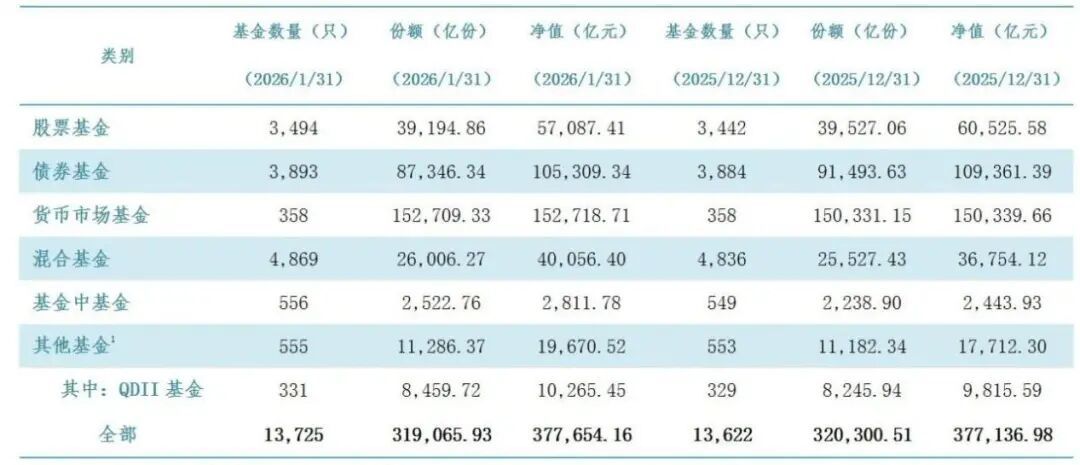
Core Insights - The public fund industry in China has reached a record high in total assets, amounting to 37.77 trillion yuan as of the end of January 2026, marking the tenth consecutive month of growth [1][2][4]. Fund Size and Growth - The total net asset value of public funds managed by 165 institutions, including 150 fund management companies, has increased significantly [2]. - Mixed, money market, and other funds have been the main contributors to this growth, with each category seeing an increase of over 100 billion yuan [1][4]. - Fund of Funds (FOF) has shown remarkable growth, with a 15.05% increase in share and a 12.68% increase in scale, reaching 2,522.76 billion shares and 2,811.78 billion yuan respectively [5][7]. Fund Performance by Type - Stock funds have experienced a decline, with a reduction of over 3,400 billion yuan, while bond funds also saw a decrease of over 4,000 billion yuan due to the "stock-bond seesaw" effect [1][8]. - The total share of public funds reached 31.91 trillion shares, a slight decrease of 0.39% compared to December 2025, but the overall scale still grew by 0.14% [3][4]. Specific Fund Categories - Mixed funds have shown strong performance, with a scale increase of 8.98%, reaching 40,056.40 billion yuan [7][8]. - Money market funds also saw a growth of 1.58%, with a scale of 152,718.71 billion yuan [7][8]. - The significant decline in stock ETFs, which dropped by 6,036.23 billion yuan, has negatively impacted the overall stock fund size [8].
37.77万亿,公募基金规模,连续10个月创新高
Zhong Guo Ji Jin Bao· 2026-02-27 23:13
Core Insights - The public fund industry in China has reached a record high in total assets, amounting to 37.77 trillion yuan as of the end of January 2026, marking the tenth consecutive month of growth [2][4][5]. Fund Size and Growth - The total size of public funds has seen a continuous increase, with significant contributions from mixed, money market, and other funds, all achieving growth in the range of hundreds of billions [2][7]. - The Fund of Funds (FOF) has experienced a remarkable increase, with a 15.05% rise in shares and a 12.68% increase in scale, reaching 2,522.76 billion shares and 2,811.78 billion yuan respectively [9][11]. Fund Type Performance - Stock funds have faced a decline, with a reduction of over 3,400 billion yuan, while bond funds also decreased by more than 4,000 billion yuan due to the "stock-bond seesaw" effect [3][12]. - Mixed funds have shown strong performance, with a scale increase of 8.98%, reaching 40.06 trillion yuan, driven by net value growth [12]. - Money market funds have also seen a slight increase of 1.58%, with a total scale of 152.72 trillion yuan [11]. Market Dynamics - The public fund market has been buoyed by favorable market conditions and an influx of new capital, contributing to the sustained growth in fund sizes [1][7]. - Major commercial banks, such as China Merchants Bank and China Construction Bank, have played a significant role in promoting FOF products, leading to their rapid growth [9][11].