复交三原则

Search documents
图解:来给个别日本政客补补课!
人民网-国际频道 原创稿· 2025-11-19 02:52
Core Points - The Chinese government emphasizes that the four political documents between China and Japan clearly define the Taiwan issue, which Japan has committed to uphold with international legal validity, leaving no room for ambiguity or misinterpretation [1] - China urges Japan to cease provocative actions and to reflect its commitments to China through concrete actions [1] Summary by Sections Historical Context - The establishment of diplomatic relations between China and Japan was formalized with the signing of the Joint Communiqué in 1972, which includes three references to the Taiwan issue, affirming Japan's recognition of the People's Republic of China as the sole legitimate government of China and acknowledging Taiwan as an inseparable part of Chinese territory [3] - The 1978 Treaty of Peace and Friendship further solidified the principles outlined in the Joint Communiqué, establishing legal norms for Sino-Japanese relations [4] Commitments and Agreements - In 1998, both countries issued a joint declaration reaffirming Japan's commitment to adhere to the stance on Taiwan as stated in the Joint Communiqué, explicitly ruling out any official relations with Taiwan [6] - The 2008 Joint Declaration on Comprehensive Promotion of Strategic Mutual Benefit reiterated Japan's commitment to the position on Taiwan as outlined in the Joint Communiqué [7]

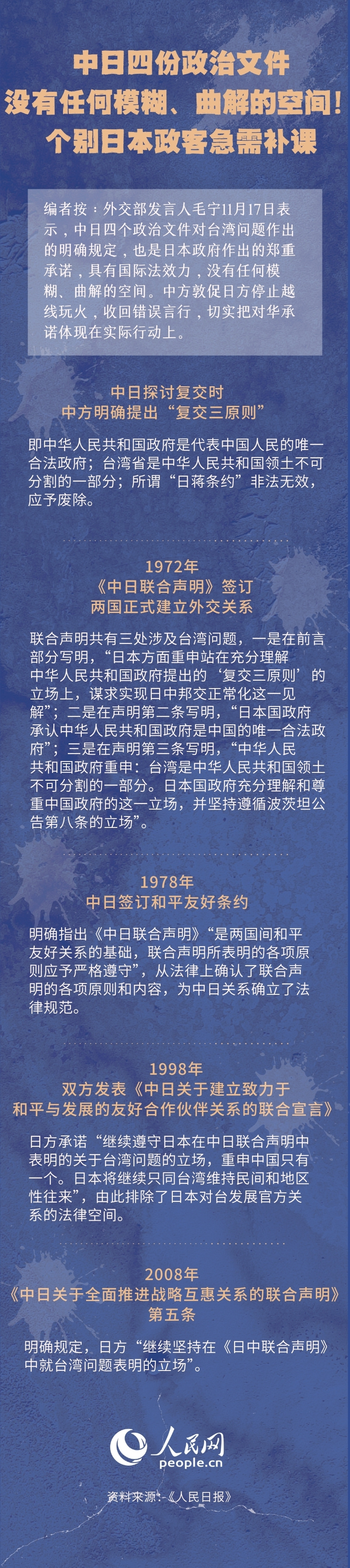
中日四个政治文件对台湾问题作出明确规定,没有任何模糊、曲解的空间
Ren Min Ri Bao· 2025-11-17 22:20
Group 1 - The core viewpoint of the article emphasizes that Japan's political commitments regarding Taiwan, as outlined in four political documents, are legally binding and must be adhered to without ambiguity or misinterpretation [1][3]. - The Chinese government urges Japan to cease provocative actions and to reflect its commitments to China in practical terms, highlighting the importance of historical responsibility in bilateral relations [3]. Group 2 - The 1972 Sino-Japanese Joint Communiqué established diplomatic relations and included three key points regarding Taiwan, affirming Japan's recognition of the People's Republic of China as the sole legitimate government of China and acknowledging Taiwan as an inseparable part of Chinese territory [2]. - The 1978 Treaty of Peace and Friendship reiterated the importance of the Joint Communiqué as the foundation for Sino-Japanese relations, legally confirming its principles [2]. - The 1998 Joint Declaration on establishing a friendly cooperative partnership emphasized Japan's commitment to adhere to the Taiwan-related positions stated in the Joint Communiqué, thereby eliminating any legal basis for official relations with Taiwan [2].
外交部:中日四个政治文件对台湾问题作出明确规定,没有任何模糊、曲解的空间
Xin Hua She· 2025-11-17 12:41
Group 1 - The core viewpoint is that the four political documents between China and Japan clearly stipulate the Taiwan issue, which Japan has committed to, and these commitments hold international legal validity without ambiguity [1][2][3] - China urges Japan to stop provocative actions and to reflect its commitments to China in practical actions [1][3] - The statements made by Japanese politicians regarding Taiwan are seen as serious violations of the spirit of the four political documents, fundamentally damaging the political foundation of China-Japan relations [1][2] Group 2 - The 1972 Sino-Japanese Joint Communiqué established diplomatic relations and included three key points regarding Taiwan, affirming Japan's recognition of the People's Republic of China as the sole legitimate government of China [2] - The 1978 Treaty of Peace and Friendship between China and Japan confirmed the principles of the Joint Communiqué as the legal basis for Sino-Japanese relations [2] - The 1998 Joint Declaration emphasized Japan's commitment to adhere to the stance on Taiwan as outlined in the Joint Communiqué, thereby eliminating any legal space for official relations with Taiwan [2][3]
视频丨外交部:中日四个政治文件没有任何模糊、曲解的空间
Yang Shi Xin Wen· 2025-11-17 08:59
Core Viewpoint - The Chinese government firmly opposes recent statements made by Japanese politicians regarding Taiwan, asserting that such remarks violate the foundational political agreements between China and Japan and undermine bilateral relations [1][3]. Group 1: Historical Context - The normalization of diplomatic relations between China and Japan was established through the 1972 Joint Communiqué, which includes three key points regarding Taiwan [2]. - The 1978 Treaty of Peace and Friendship further solidified the principles outlined in the Joint Communiqué, confirming their legal standing in bilateral relations [2]. - In 1998, a joint declaration reaffirmed Japan's commitment to the stance on Taiwan as stated in the Joint Communiqué, limiting Japan's official relations with Taiwan [2]. Group 2: Current Stance and Responses - The Chinese Foreign Ministry has reiterated its position on the erroneous remarks made by Japanese Prime Minister Kishi Nobuo, emphasizing that these statements contradict the spirit of the four political documents between China and Japan [1][3]. - The Chinese government calls on Japan to adhere to its historical commitments regarding Taiwan and to cease provocative actions that could escalate tensions [3].
外交部:敦促日方停止越线玩火 收回错误言行
证券时报· 2025-11-17 08:42
Core Viewpoint - The article emphasizes China's firm stance against Japan's recent remarks regarding Taiwan, asserting that such statements violate the political foundation of China-Japan relations and calling for Japan to adhere to its historical commitments [2][4]. Group 1: China's Position on Taiwan - China has reiterated its position on Taiwan, stating that the remarks made by Japanese Prime Minister Kishi Nobuo are a serious violation of the spirit of the four political documents between China and Japan, fundamentally damaging the political foundation of bilateral relations [2][4]. - The "Three Principles for Resuming Diplomatic Relations" proposed by China include the recognition of the People's Republic of China as the sole legitimate government representing the Chinese people, the assertion that Taiwan is an inseparable part of China, and the invalidation of the so-called "Japan-Taiwan Treaty" [2][4]. - The 1972 China-Japan Joint Communiqué established diplomatic relations and included three key points regarding Taiwan, emphasizing Japan's understanding and respect for China's position on Taiwan [2][3]. Group 2: Historical Agreements and Commitments - The 1978 Treaty of Peace and Friendship between China and Japan legally confirmed the principles outlined in the 1972 Joint Communiqué, establishing a legal framework for China-Japan relations [3]. - In 1998, both countries issued a joint declaration reaffirming Japan's commitment to adhere to the Taiwan-related positions stated in the 1972 Joint Communiqué, thereby eliminating any legal space for official relations with Taiwan [3]. - The 2008 Joint Declaration on Comprehensive Promotion of Strategic Mutual Benefit reiterated Japan's commitment to the Taiwan issue as stated in the 1972 Joint Communiqué, highlighting the binding nature of these commitments under international law [4]. Group 3: Recent Developments and Reactions - China has lodged a strong protest and serious diplomatic representations to Japan regarding the provocative remarks made by Prime Minister Kishi Nobuo, demanding immediate reflection and correction of these statements [5][6]. - The recent remarks have severely damaged the political foundation of China-Japan relations and have led to a deterioration of public sentiment between the two nations, necessitating a reevaluation of the conditions for joint public opinion surveys [6]. - Japan's recent actions have also drawn criticism from neighboring countries, prompting calls for Japan to reflect on its historical aggressions and to pursue a peaceful path in its international relations [7].
个别日本政客称中方“反应过度” 外交部回应
Zhong Guo Xin Wen Wang· 2025-11-17 08:10
Core Viewpoint - The Chinese Foreign Ministry has reiterated its firm stance against recent remarks by Japanese politicians regarding Taiwan, emphasizing that such statements violate the foundational political agreements between China and Japan and harm bilateral relations [1][2]. Group 1: Historical Context - The 1972 Sino-Japanese Joint Communiqué established diplomatic relations and included three key points regarding Taiwan, affirming Japan's understanding of China's "Three Principles" for normalization [2]. - The 1978 Treaty of Peace and Friendship between China and Japan legally confirmed the principles outlined in the Joint Communiqué, establishing a framework for peaceful relations [2]. - In 1998, both countries issued a joint declaration reaffirming Japan's commitment to the stance on Taiwan as stated in the Joint Communiqué, limiting Japan's official relations with Taiwan [2]. Group 2: Political Commitments - The 2008 Joint Declaration on Comprehensive Promotion of Strategic Mutual Benefit explicitly stated Japan's continued adherence to the position on Taiwan as outlined in the Joint Communiqué [3]. - The commitments made in the four political documents regarding Taiwan are binding under international law, leaving no room for misinterpretation or distortion [3]. - The Chinese government urges Japan to respect historical commitments and to cease provocative actions regarding Taiwan [3].
外交部:敦促日方停止越线玩火,收回错误言行
21世纪经济报道· 2025-11-17 07:56
Core Viewpoint - The Chinese government has reiterated its firm stance against Japanese Prime Minister Kishi Nobuo's remarks on Taiwan, emphasizing that such statements violate the spirit of the four political documents between China and Japan and fundamentally damage the political foundation of bilateral relations [1][3]. Summary by Sections Historical Context - The 1972 Sino-Japanese Joint Communiqué established diplomatic relations, with three key points regarding Taiwan: Japan acknowledges the PRC as the sole legitimate government of China, recognizes Taiwan as an inseparable part of China, and understands the illegality of the so-called "Japan-Taiwan Treaty" [2]. Legal Framework - The 1978 Treaty of Peace and Friendship between China and Japan confirmed the principles of the Joint Communiqué as the legal basis for Sino-Japanese relations, mandating strict adherence to these principles [2]. - In 1998, both countries issued a joint declaration reaffirming Japan's commitment to the stance on Taiwan as outlined in the Joint Communiqué, thereby eliminating any legal space for official relations with Taiwan [2]. Current Stance - The 2008 Joint Declaration on Comprehensive Promotion of Strategic Mutual Benefit reiterated Japan's commitment to the stance on Taiwan as per the Joint Communiqué [3]. - The Chinese government insists that all Japanese political parties and leaders must adhere to Japan's commitments regarding Taiwan, urging Japan to act responsibly towards history and bilateral relations by retracting erroneous statements and actions [3].