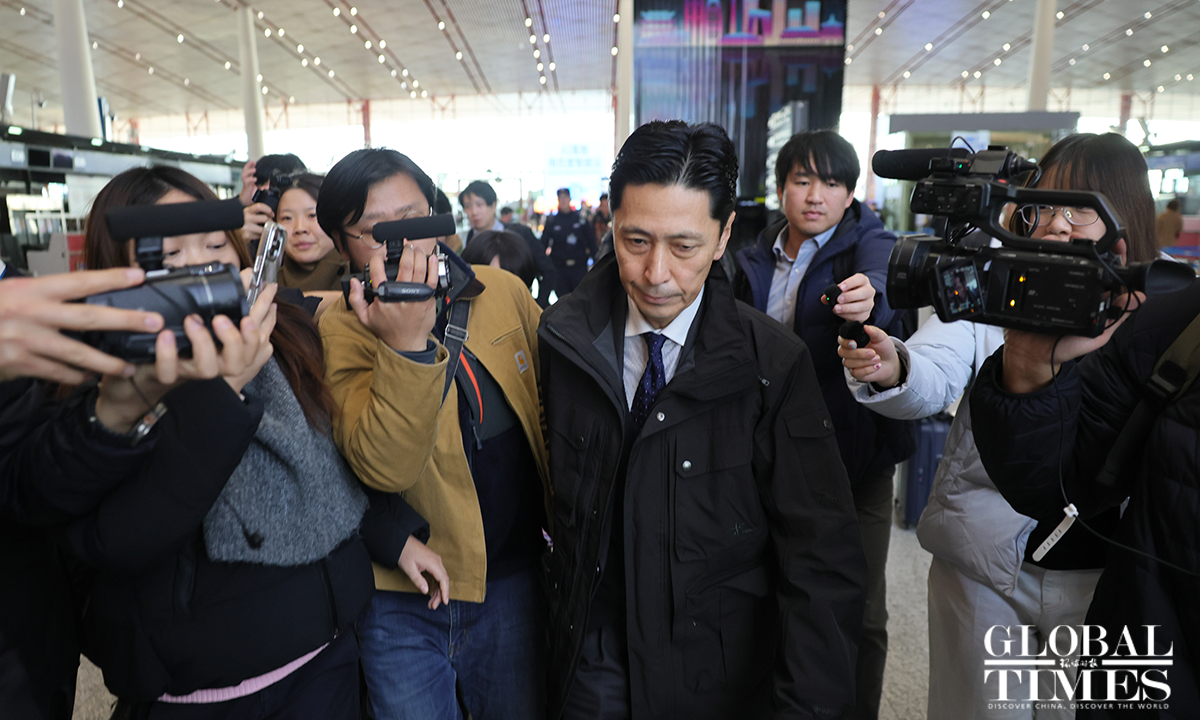
中日四个政治文件

Search documents
外交部:无论日本领导人是谁,都必须恪守中日四个政治文件
Ren Min Ri Bao· 2026-02-09 08:07
Core Viewpoint - The Chinese government maintains a firm stance against interference in its internal affairs and emphasizes the importance of adhering to established political agreements with Japan, regardless of the political leadership in Japan [1]. Group 1: China's Position on Japan - The Chinese government does not interfere in the internal affairs of other countries and opposes any actions that infringe upon its core interests or violate international law [1]. - China's policy towards Japan is described as clear, stable, and consistent, indicating a long-term approach to bilateral relations [1]. - The Chinese government insists that Japan must adhere to the four political documents between China and Japan, as well as Japan's pacifist constitution, fulfilling its commitments and international obligations [1].
外交部:无论日本领导人是谁都必须恪守中日四个政治文件
Yang Shi Xin Wen· 2026-02-09 07:32
Core Viewpoint - The Chinese government emphasizes its non-interference policy in other countries' internal affairs while firmly opposing any actions that infringe upon China's core interests and violate international law [1] Group 1: China's Position on Japan - The Chinese government maintains a clear, stable, and consistent policy towards Japan, regardless of the Japanese leadership or ruling party [1] - China insists that Japan must adhere to the four political documents between China and Japan, as well as fulfill its commitments under the Japanese Constitution and international obligations [1]
视频丨专家:所谓“旧金山和约”非法无效 高市再次冲击中日政治基础
Yang Shi Xin Wen Ke Hu Duan· 2025-11-29 06:14
Core Viewpoint - Japanese Prime Minister Fumio Kishida's remarks regarding Taiwan have drawn strong backlash from China, highlighting ongoing tensions between Japan and China over historical agreements and territorial claims [1][3]. Group 1: Japan's Position - Fumio Kishida stated that Japan, under the San Francisco Peace Treaty, has relinquished all rights and does not hold a position on Taiwan's legal status [1]. - Kishida's comments have been criticized for ignoring the Cairo Declaration and the Potsdam Proclamation, which affirm China's sovereignty over Taiwan [3][7]. Group 2: China's Response - Chinese Foreign Ministry spokesperson Guo Jia Kun emphasized that Taiwan's return to China is a significant outcome of World War II and has been resolved since 1945 [3]. - Guo criticized Kishida for highlighting the San Francisco Peace Treaty while neglecting its illegitimacy and the implications of the Cairo Declaration and Potsdam Proclamation [3][7]. Group 3: Historical Context - The San Francisco Peace Treaty was signed under specific historical circumstances, excluding major WWII parties like China and the Soviet Union, which raises questions about its validity [5]. - The treaty is viewed as invalid because it contradicts previous agreements that confirmed China's sovereignty over Taiwan, thus challenging the post-war international order [7].

专家:所谓“旧金山和约”非法无效 高市再次冲击中日政治基础
Yang Shi Xin Wen Ke Hu Duan· 2025-11-29 02:18
Core Viewpoint - Japanese Prime Minister Fumio Kishida's remarks regarding Taiwan have drawn strong backlash from China, emphasizing that Taiwan's status was resolved post-World War II and challenging the legitimacy of the San Francisco Peace Treaty [1][3][5] Group 1: Historical Context - The San Francisco Peace Treaty was signed under specific historical circumstances, notably during the Cold War and the Korean War, excluding major WWII parties like China and the Soviet Union from negotiations [3] - The treaty is viewed as invalid because it contradicts earlier agreements such as the Cairo Declaration and the Potsdam Proclamation, which affirmed China's sovereignty over Taiwan [5] Group 2: Political Implications - Kishida's focus on the San Francisco Peace Treaty undermines the political foundation established by four key documents that govern Sino-Japanese relations, indicating a disregard for international law and post-war agreements [1][5] - The repeated mention of the San Francisco Peace Treaty by Kishida is seen as a direct challenge to the established consensus between China and Japan regarding Taiwan, further straining diplomatic relations [3][5]
中方:从来没有接受过“旧金山和约”
券商中国· 2025-11-28 12:49
Core Viewpoint - The Chinese government has never recognized the "San Francisco Peace Treaty" regarding Taiwan's sovereignty and maintains that Taiwan is an inseparable part of China, as stated in the 1972 Sino-Japanese Joint Communiqué [1]. Group 1 - The Chinese side's position is that it has never accepted any territorial and sovereignty arrangements made in the "San Francisco Peace Treaty" as it was not a contracting party [1]. - The 1972 Sino-Japanese Joint Communiqué clearly states that the Japanese government recognizes the People's Republic of China as the sole legitimate government of China, and the PRC reiterates that Taiwan is an inseparable part of its territory [1]. - The four political documents between China and Japan provide a clear foundation for their relationship, particularly regarding issues like Taiwan [1].
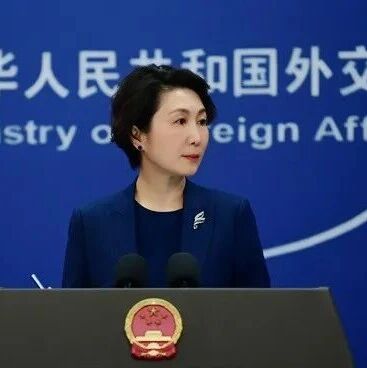
距中国台湾仅110公里,日本宣布在敏感区域部署进攻性武器,外交部:这一动向极其危险!G20峰会上,高市早苗尴尬陪笑
Mei Ri Jing Ji Xin Wen· 2025-11-24 09:00
Group 1 - Japan's Defense Minister Koizumi Shinjiro announced the deployment of medium-range air defense missiles at a Self-Defense Forces base in the Ryukyu Islands, which is located 110 kilometers from Taiwan [1][2] - There has been a significant increase in the cancellation of flights from China to Japan, with a reported 56% rise in cancellations from November 24 to December 31 compared to the same period last month [1] - Domestic airlines have seen a 29% decrease in ticket bookings to Japan for the next 60 days compared to bookings made on November 15 [1] Group 2 - China's Foreign Ministry spokesperson Mao Ning criticized Japan's deployment of offensive weapons near Taiwan, labeling it as a dangerous move that escalates regional tensions [2] - Mao emphasized that Japan's recent security policy adjustments, including increased defense budgets and the pursuit of offensive weapons, are concerning and deviate from Japan's post-war pacifist principles [2][5] - The spokesperson reiterated China's commitment to safeguarding its territorial sovereignty and warned against the resurgence of Japanese militarism [2][6] Group 3 - The Foreign Ministry stated that the current conditions do not support holding a trilateral meeting between China, Japan, and South Korea due to Japan's recent statements regarding Taiwan [4] - China has urged Japan to take its concerns seriously and to retract its erroneous statements regarding Taiwan, emphasizing the need for Japan to adhere to its commitments under international agreements [3][6]
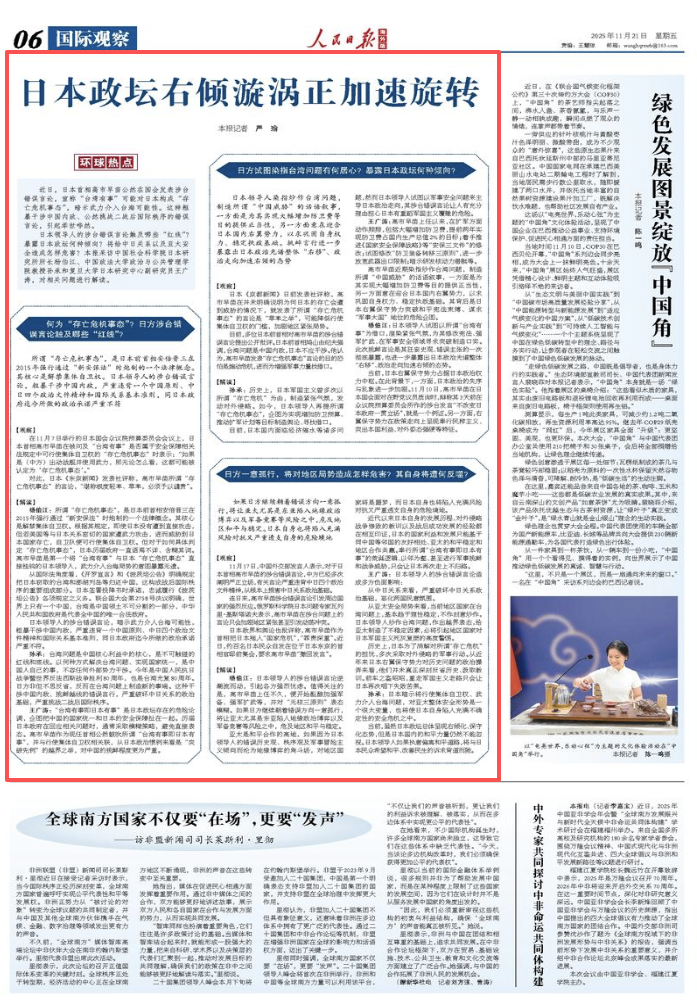
日本政坛右倾漩涡正加速旋转
Ren Min Ri Bao Hai Wai Ban· 2025-11-21 10:13
Core Viewpoint - The recent remarks by Japanese Prime Minister Fumio Kishida regarding Taiwan represent a significant escalation in Japan's stance on regional security, suggesting a potential military intervention in the Taiwan Strait, which has drawn widespread condemnation and raised concerns about the implications for Sino-Japanese relations and regional stability [1][2][3]. Group 1: Legal and Political Context - The term "survival crisis situation" was introduced by former Prime Minister Shinzo Abe in 2015, allowing Japan to exercise collective self-defense even without direct attacks on Japan [2][3]. - Kishida's comments directly link Taiwan's situation to Japan's national security, marking a departure from previous Japanese government practices that avoided explicit statements on this issue [4][5]. Group 2: Implications for Sino-Japanese Relations - The remarks violate the One China principle and Japan's previous political commitments, potentially undermining the political foundation of Sino-Japanese relations [3][9]. - The rhetoric of "Taiwan's issues equate to Japan's issues" reflects a dangerous trend in Japanese politics, aiming to intertwine China's national unification with Japan's security concerns [4][5]. Group 3: Domestic Political Dynamics in Japan - Kishida's statements may serve to justify increased defense spending and appeal to right-wing factions within Japan, indicating a shift towards a more militarized political stance [5][7]. - The overall political landscape in Japan is shifting rightward, with Kishida's government facing criticism for potentially escalating tensions in the region [6][8]. Group 4: Regional Security Concerns - Continued provocative statements from Japan could lead to heightened geopolitical tensions in the Asia-Pacific region, risking a military arms race and destabilizing the area [9][10]. - The historical context of Japan's militaristic past raises alarms about the potential for repeating previous mistakes, as current political rhetoric may incite fears of a resurgence of militarism [11].
日本政坛右倾漩涡正加速旋转(环球热点)
Ren Min Ri Bao Hai Wai Ban· 2025-11-20 22:56
Core Viewpoint - Japanese Prime Minister Fumio Kishida's recent remarks in the National Diet regarding Taiwan have sparked global outrage, suggesting that a "crisis" in Taiwan could pose an existential threat to Japan, indicating a potential for military intervention in the Taiwan Strait [1][2][3] Group 1: Definition and Implications of "Existential Crisis" - The term "existential crisis" was introduced by former Prime Minister Shinzo Abe in 2015 through the "New Security Law," which allows for collective self-defense even if Japan is not directly attacked [2][3] - Kishida's comments directly link the situation in Taiwan to Japan's security framework, marking a significant shift in Japan's political stance and raising concerns about military involvement in Taiwan [3][4] Group 2: Political Trends in Japan - The remarks reflect a broader trend of rightward shift in Japanese politics, with Kishida's government attempting to justify increased defense spending and military expansion under the guise of a "China threat" narrative [5][6][7] - Historical parallels are drawn to Japan's militaristic past, with concerns that such rhetoric could lead to a resurgence of militarism and aggressive foreign policy [7][8] Group 3: Regional and International Reactions - Kishida's statements have drawn criticism from various quarters, including former Japanese leaders and international observers, who warn that such rhetoric could destabilize the region and provoke military tensions [9][10] - The Chinese government has firmly rejected these comments, emphasizing that Taiwan is a core interest and any external interference is unacceptable [9][10][11] Group 4: Potential Consequences - Continued provocative statements from Japan could lead to increased geopolitical tensions in the Asia-Pacific region, potentially igniting an arms race and undermining regional stability [9][10][11] - The domestic political landscape in Japan may also be affected, as public sentiment could shift against militaristic policies, contrasting with the government's current trajectory [11][12]
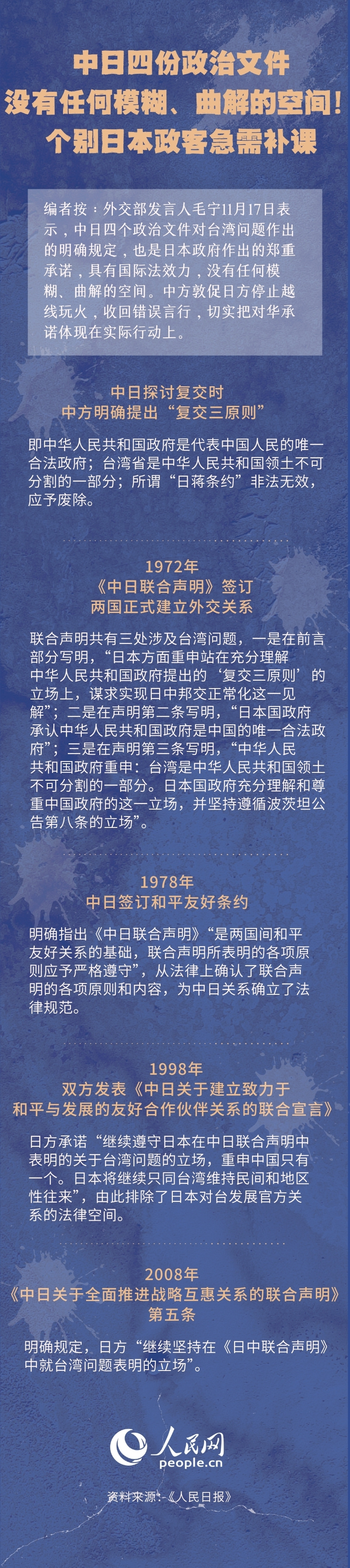
图解:来给个别日本政客补补课!
人民网-国际频道 原创稿· 2025-11-19 02:52
Core Points - The Chinese government emphasizes that the four political documents between China and Japan clearly define the Taiwan issue, which Japan has committed to uphold with international legal validity, leaving no room for ambiguity or misinterpretation [1] - China urges Japan to cease provocative actions and to reflect its commitments to China through concrete actions [1] Summary by Sections Historical Context - The establishment of diplomatic relations between China and Japan was formalized with the signing of the Joint Communiqué in 1972, which includes three references to the Taiwan issue, affirming Japan's recognition of the People's Republic of China as the sole legitimate government of China and acknowledging Taiwan as an inseparable part of Chinese territory [3] - The 1978 Treaty of Peace and Friendship further solidified the principles outlined in the Joint Communiqué, establishing legal norms for Sino-Japanese relations [4] Commitments and Agreements - In 1998, both countries issued a joint declaration reaffirming Japan's commitment to adhere to the stance on Taiwan as stated in the Joint Communiqué, explicitly ruling out any official relations with Taiwan [6] - The 2008 Joint Declaration on Comprehensive Promotion of Strategic Mutual Benefit reiterated Japan's commitment to the position on Taiwan as outlined in the Joint Communiqué [7]
【环时深度】高市涉台挑衅言论法理谬误重重
Huan Qiu Shi Bao· 2025-11-18 22:59
Core Viewpoint - The article discusses the recent provocative statements made by Japanese Prime Minister Sanae Takaichi regarding Taiwan, which are seen as a serious challenge to China's core interests and a violation of established political agreements between China and Japan [1][3][5]. Summary by Sections Political Context - The diplomatic discussions between China and Japan on November 18 highlighted China's stern demand for Japan to retract its erroneous statements regarding Taiwan, which are viewed as a blatant interference in China's internal affairs [1]. - Takaichi's remarks are characterized as a significant deviation from Japan's historical commitments and the political consensus established through four key political documents between the two nations [3][5]. Historical Agreements - The four political documents, including the 1972 Sino-Japanese Joint Statement, affirm that Taiwan is an inseparable part of China and that Japan recognizes the People's Republic of China as the sole legitimate government of China [3][5]. - The 1978 Treaty of Peace and Friendship and subsequent agreements reiterate Japan's commitment to these principles, emphasizing that there is no room for misinterpretation regarding Taiwan's status [5][6]. Legal Implications - The article emphasizes that Takaichi's statements contradict the legal obligations Japan has under international law, particularly the principles outlined in the Sino-Japanese agreements [6][9]. - Experts argue that Japan's claims of "position differences" regarding Taiwan are unfounded, as the issue is clearly defined in both international law and bilateral agreements [6][7]. Military and Security Concerns - Takaichi's reference to a "survival crisis situation" stems from Japan's new security laws, which allow for military action even without direct threats, thus undermining Japan's post-war pacifist constitution [7][8]. - The new security framework has raised concerns about Japan's potential military interventions, which could lead to a significant shift in its defense posture and regional stability [8][11]. International Relations - The article critiques Takaichi's statements as a challenge to the post-war international order and fundamental principles of international law, such as non-interference in domestic affairs [9][10]. - The historical context of Taiwan's status is reinforced by international agreements, including the Cairo Declaration and the Potsdam Proclamation, which affirm Taiwan's return to China [9][10]. Domestic Reactions - There is a growing concern within Japan regarding the rise of right-wing ideologies that threaten the country's pacifist stance and historical narrative [11][12]. - Calls for a return to a peaceful national identity are echoed by various commentators, emphasizing the need for Japan to adhere to its commitments to peace and stability in the region [12].