外商直接投资格局重塑

Search documents
麦肯锡:中国企业全球化加速,外企重塑在华战略
Guo Ji Jin Rong Bao· 2025-11-28 04:38
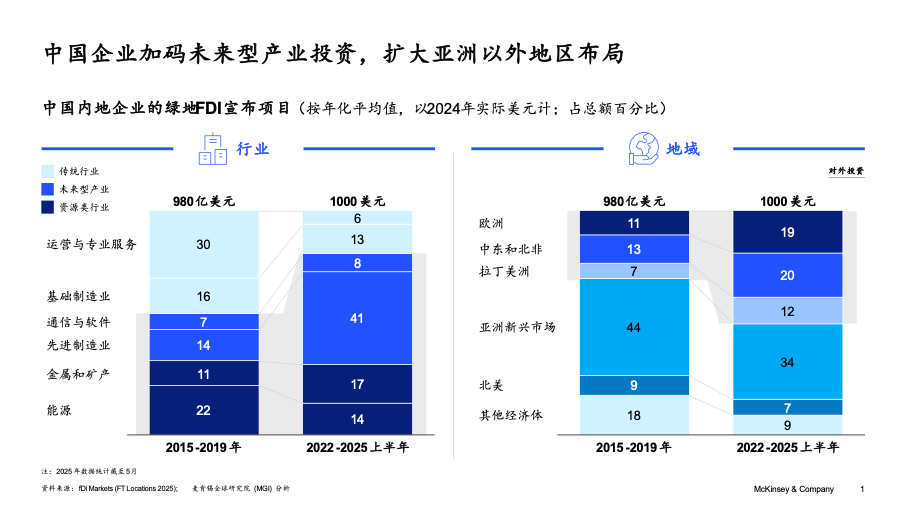
Core Insights - McKinsey's recent media day in Shanghai focused on strategies for companies to succeed in the future Chinese market and navigate global expansion [1] Group 1: Foreign Investment Trends - Global capital flows are undergoing structural changes, with China transitioning from a major recipient of foreign direct investment (FDI) to a key global investor [2] - Chinese companies are increasing capital deployment in Europe, Latin America, and the Middle East and North Africa by over two-thirds [2] - Since 2022, China's annual greenfield investment has decreased by 65% compared to pre-pandemic levels, while outbound investment in future industries and resources has grown by 54% [2] Group 2: Automotive Industry Developments - Chinese automotive companies have shifted from "market for technology" to "technology for the world," gaining approximately 30% market share from multinational joint ventures in the domestic market [5] - By 2030, it is expected that 3 to 5 Chinese companies will be among the top ten global automakers, with Chinese brands projected to capture 10% to 20% of core overseas markets [6] - In 2025, two Chinese automakers are anticipated to enter the global top ten in sales, with 2023 expected to see record-high annual exports, surpassing Japan and Germany [6] Group 3: Pharmaceutical Industry Evolution - China's innovative drug development has seen significant growth, with about one-third of global innovative drug pipelines originating from China [11] - Chinese pharmaceutical companies need to evolve from developing globally competitive products to establishing a global presence [11] - Three strategic upgrades are necessary for Chinese pharmaceutical firms: transitioning from specialized talent to global and diverse talent, from efficient decision-making to a balance of agility and stability, and from following innovation to leading innovation [12] Group 4: Manufacturing Sector Opportunities - China has evolved from a "world factory" to a strategic market and innovation hub for global advanced industrial enterprises [15] - Leading Chinese manufacturers are integrating digitalization, AI, and IoT technologies to maintain competitive advantages [15] - For multinational companies, deep engagement in China's vibrant industrial ecosystem is essential for enhancing global competitiveness [15] Group 5: Consumer Market Dynamics - The middle class in China is expected to grow, with high-income households projected to reach 259 million by 2030, accounting for 62% of urban families [16] - Despite declining consumer confidence, retail sales in China grew by 4.6% year-on-year in the first eight months of 2025, with significant increases in home appliance and electric vehicle sales [16] - E-commerce platforms are evolving from a fresh food-centric model to a comprehensive category approach, driving growth through new consumption scenarios [19]