中国投资战略转型

Search documents
麦肯锡预计:2030年中国有3—5家车企有望跻身全球前十
Zhong Guo Jing Ying Bao· 2025-12-02 09:04
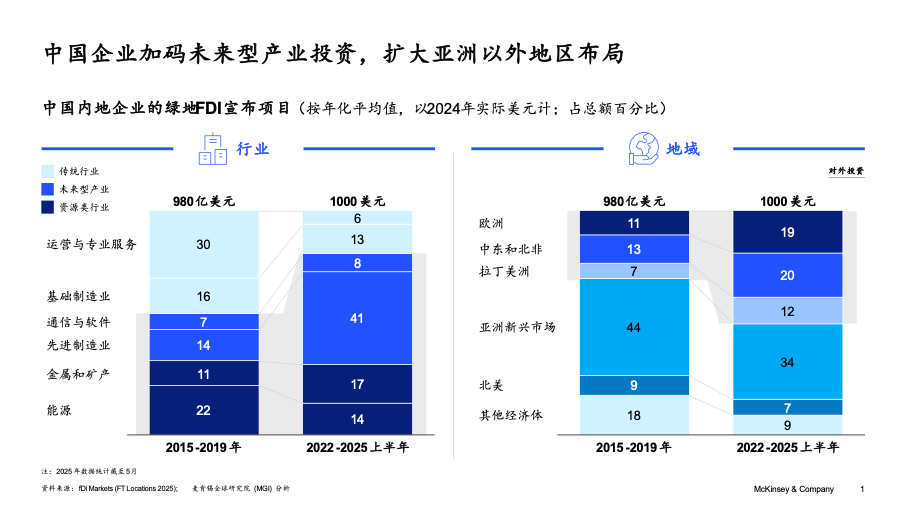
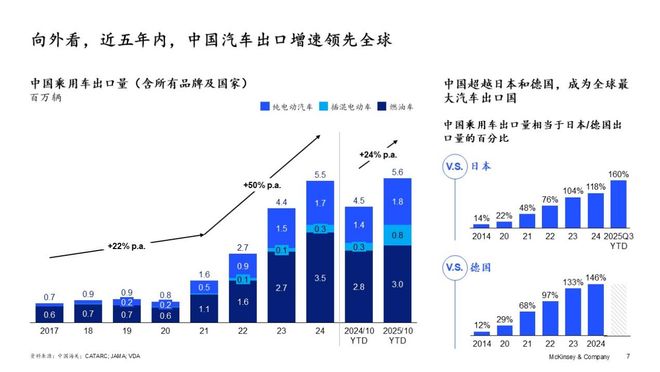
Core Insights - China is transitioning from a major recipient of foreign direct investment (FDI) to a key global investor, with a 54% increase in outbound investment in future-oriented industries and resources since 2022 [2][3] - The automotive sector is expected to see record exports, with predictions that China will become the world's largest automobile exporter, surpassing Japan and Germany [4][5] Group 1: Investment Trends - Since 2022, China's annual greenfield investment has decreased by 65% compared to pre-pandemic levels, while outbound investment in future-oriented sectors has increased by 54% [2] - Chinese companies are focusing their investment strategies on electric vehicles, batteries, and critical minerals, marking a shift from being a net recipient to a net investor [3] Group 2: Automotive Industry Growth - Over the past five years, Chinese brands have gained approximately 30% market share in the domestic market from multinational joint venture brands, establishing a strong foundation for global expansion [4] - By 2025, two Chinese automakers are expected to enter the global top ten in sales, with exports projected to reach around 6 million vehicles this year, exceeding last year's total [5] Group 3: Globalization and Strategic Adjustments - Multinational companies must redefine their strategies in China, shifting from production bases to innovation hubs and capital collaboration platforms [6] - Chinese enterprises are encouraged to accelerate their globalization efforts, moving from product exports to systemic exports, emphasizing the need for a balance between heritage and innovation [6][7] Group 4: Market Dynamics and Opportunities - The Chinese market is becoming a critical testing ground for companies, with success in this market increasingly seen as a benchmark for global competitiveness [7] - The evolving consumer landscape in China presents new growth opportunities for companies willing to embrace change and innovation [7]

制胜中国新篇章:破局与重塑
麦肯锡· 2025-11-29 01:01
Group 1: Macro Economic Insights - Recent research by McKinsey Global Institute indicates a structural reshaping of global capital flows, with China transitioning from a major recipient of foreign direct investment (FDI) to a key global investor, particularly in Europe, Latin America, and the Middle East and North Africa, with capital deployment growth exceeding two-thirds [3] - Since 2022, China's average annual greenfield investment has decreased by 65% compared to pre-pandemic levels, while outward investment in future-oriented industries and resources has increased by 54% [3][8] Group 2: Automotive Industry - Over the past decade, China's automotive industry has shifted from "market for technology" to "technology going global," with Chinese brands capturing approximately 30% of the domestic market share from multinational joint ventures [9] - By 2030, it is predicted that 3-5 Chinese companies will be among the top ten global automakers, with Chinese brands expected to hold a 10%-20% market share in key overseas markets [9] - In 2025, two Chinese automakers are projected to enter the global top ten in sales, with 2023 expected to see China surpass Japan and Germany as the world's largest automobile exporter [9][15] Group 3: Life Sciences Industry - China's innovative drug development has seen significant growth, with about one-third of global innovative drug pipelines originating from China, including a substantial portion in cutting-edge therapies [18] - Chinese pharmaceutical companies are transitioning from developing globally competitive innovative products to establishing a global presence, with 23 drugs receiving breakthrough therapy designation from the FDA and 11 approved for market entry in the U.S. [24] - To become truly global enterprises, Chinese pharmaceutical companies must upgrade their strategies across three dimensions: talent globalization, decision-making agility, and source innovation [25] Group 4: Industrial Sector - China has evolved from being a "world factory" to an essential strategic market and innovation hub for global advanced industrial enterprises, with leading companies leveraging digitalization, AI, and IoT technologies [27] - The penetration rate of AI in lighthouse factories has increased from approximately 20% to over 80% in the past five years, with generative AI further enhancing technological applications [27] Group 5: Consumer Market - The middle class in China is expected to grow significantly, with high-income households projected to reach 259 million by 2030, accounting for 62% of urban families [34] - Despite challenges, consumer resilience is evident, with retail sales in China growing by 4.6% year-on-year in the first eight months of 2025, driven by strong sales in home appliances and electric vehicles [34][37] - E-commerce platforms are evolving from a fresh-food-centric model to a comprehensive category approach, activating new consumption scenarios and driving industry growth [37] Group 6: Strategic Considerations for Long-term Success - To become a "century-old enterprise," companies must balance operational flexibility with long-term strategic foresight, fostering deep trust and loyalty among stakeholders [41] - Companies need to address succession planning challenges, particularly in China, where reliance on charismatic founders complicates leadership transitions [41] - Businesses must make critical strategic choices to navigate the dual challenges of "breaking through" and "restructuring" in the Chinese market, emphasizing the importance of ecological integration and global perspectives for sustainable development [42]

麦肯锡:中国企业全球化加速,外企重塑在华战略
Guo Ji Jin Rong Bao· 2025-11-28 04:38
Core Insights - McKinsey's recent media day in Shanghai focused on strategies for companies to succeed in the future Chinese market and navigate global expansion [1] Group 1: Foreign Investment Trends - Global capital flows are undergoing structural changes, with China transitioning from a major recipient of foreign direct investment (FDI) to a key global investor [2] - Chinese companies are increasing capital deployment in Europe, Latin America, and the Middle East and North Africa by over two-thirds [2] - Since 2022, China's annual greenfield investment has decreased by 65% compared to pre-pandemic levels, while outbound investment in future industries and resources has grown by 54% [2] Group 2: Automotive Industry Developments - Chinese automotive companies have shifted from "market for technology" to "technology for the world," gaining approximately 30% market share from multinational joint ventures in the domestic market [5] - By 2030, it is expected that 3 to 5 Chinese companies will be among the top ten global automakers, with Chinese brands projected to capture 10% to 20% of core overseas markets [6] - In 2025, two Chinese automakers are anticipated to enter the global top ten in sales, with 2023 expected to see record-high annual exports, surpassing Japan and Germany [6] Group 3: Pharmaceutical Industry Evolution - China's innovative drug development has seen significant growth, with about one-third of global innovative drug pipelines originating from China [11] - Chinese pharmaceutical companies need to evolve from developing globally competitive products to establishing a global presence [11] - Three strategic upgrades are necessary for Chinese pharmaceutical firms: transitioning from specialized talent to global and diverse talent, from efficient decision-making to a balance of agility and stability, and from following innovation to leading innovation [12] Group 4: Manufacturing Sector Opportunities - China has evolved from a "world factory" to a strategic market and innovation hub for global advanced industrial enterprises [15] - Leading Chinese manufacturers are integrating digitalization, AI, and IoT technologies to maintain competitive advantages [15] - For multinational companies, deep engagement in China's vibrant industrial ecosystem is essential for enhancing global competitiveness [15] Group 5: Consumer Market Dynamics - The middle class in China is expected to grow, with high-income households projected to reach 259 million by 2030, accounting for 62% of urban families [16] - Despite declining consumer confidence, retail sales in China grew by 4.6% year-on-year in the first eight months of 2025, with significant increases in home appliance and electric vehicle sales [16] - E-commerce platforms are evolving from a fresh food-centric model to a comprehensive category approach, driving growth through new consumption scenarios [19]