多元蛋白解决方案

Search documents
净亏损扩大 “植物肉第一股”别样肉客押注植物蛋白
Bei Jing Shang Bao· 2025-11-13 14:57
Core Viewpoint - Beyond Meat, known as the "first plant-based meat stock," reported a 14.37% decline in revenue for the first three quarters of 2025, with net losses widening, and projected fourth-quarter sales below market expectations [2][4][5] Financial Performance - For the first three quarters, Beyond Meat achieved revenue of $214 million, down 14.37% year-over-year, and a net loss of $193 million compared to a net loss of $115 million in the same period last year [4] - In Q3 alone, revenue was $70.22 million, a 13.32% decrease year-over-year, with a net loss of $111 million, significantly larger than the $26.58 million loss in the same quarter last year [4] - The revenue decline was attributed to a 10.3% decrease in product sales volume and a 3.5% drop in average selling price [4] - The U.S. retail channel saw a net revenue decline of 18.4% to $28.54 million, with a 12.6% drop in sales volume [4] Market Outlook - Beyond Meat's projected net revenue for Q4 2025 is between $60 million and $65 million, lower than the market expectation of $70.03 million [5] - Analysts suggest that the weak demand for plant-based meat may stem from its inability to meet mainstream market needs, as indicated by the product lifecycle theory [5][7] Industry Context - Since 2021, the enthusiasm in the capital market for plant-based meat has waned, with many companies exiting the sector [7] - The plant-based meat industry faces significant uncertainty, with consumer acceptance and business models still needing maturation [7][8] Strategic Transformation - To address current challenges, Beyond Meat is pursuing a transformation plan, including cost reduction and strategic growth initiatives [8][9] - The company has completed key transformation steps, including debt restructuring and increasing liquidity [8] - Beyond Meat aims to shift its focus from meat imitation to traditional plant proteins, launching products like "Beyond Ground" that do not mimic meat [9] - This strategic pivot is seen as aligning with health trends and enhancing profit margins by leveraging existing supply chains [9]


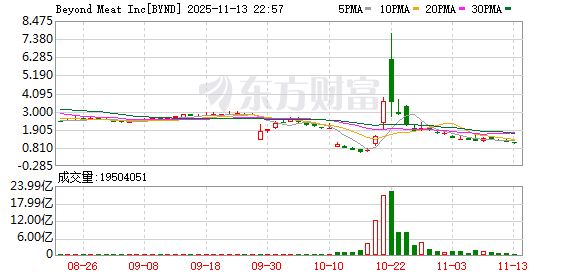
净亏损扩大,“植物肉第一股”别样肉客押注植物蛋白
Bei Jing Shang Bao· 2025-11-13 13:07
Core Viewpoint - Beyond Meat, known as the "first plant-based meat stock," reported a 14.37% decline in revenue for the first three quarters of 2025, with net losses widening, prompting a strategic shift to expand beyond plant-based meat products [1][3][6] Financial Performance - For the first three quarters, Beyond Meat achieved revenue of $214 million, down 14.37% year-over-year, and a net loss of $193 million, compared to a net loss of $115 million in the same period last year [3][6] - In Q3 alone, revenue was $70.22 million, a 13.32% decrease year-over-year, with a net loss of $111 million, significantly larger than the $26.58 million loss in the same quarter last year [3][6] - The decline in revenue is attributed to a 10.3% decrease in product sales volume and a 3.5% drop in average selling price [3][4] Market Dynamics - The U.S. market has seen the most significant decline, with net revenue from U.S. retail channels dropping 18.4% to $28.54 million and sales volume decreasing 12.6% [3][4] - The overall demand for plant-based meat appears weak, as the products struggle to meet mainstream market needs, remaining largely in niche segments [4][7] Strategic Shift - Beyond Meat is transitioning its focus from meat imitation to traditional plant proteins, as evidenced by the launch of "Beyond Ground," which contains only plant-based ingredients and no meat analogs [8][9] - The company aims to become a "global protein company" by diversifying its product offerings and enhancing its operational efficiency [8][9] Industry Context - The plant-based meat sector is facing significant challenges, with many companies exiting the market due to unmet consumer expectations regarding taste, price, and nutrition [7][8] - Analysts suggest that the capital market's enthusiasm for plant-based meat has waned, shifting towards more diverse protein solutions with technological barriers [7][8]