多病共存

Search documents
血液生物标志物与老年“多病共存”风险相关
Xin Lang Cai Jing· 2026-01-13 12:33
Core Insights - An international study involving the Karolinska Institute in Sweden has identified a set of common blood biomarkers that are closely related to the risk of "multimorbidity" and the accumulation of diseases in the elderly [1][2] - The research analyzed the health status of over 2,200 individuals aged 60 and above in Stockholm over a period of 15 years, revealing that 7 out of 54 biomarkers were associated with multimorbidity [1] - The findings suggest that future blood tests could help doctors identify at-risk populations for early health management and intervention [2] Group 1 - The study found that biomarkers such as growth differentiation factor 15, glycated hemoglobin, cystatin C, leptin, and insulin are related to the overall burden of chronic diseases and common disease combinations [1] - Gamma-glutamyl transferase and albumin were primarily associated with the speed of disease progression [1] - The research also validated its findings using health data from 522 individuals in the U.S., which yielded consistent results [1] Group 2 - The researchers emphasized that the findings reveal statistical correlations rather than direct causation of multimorbidity by specific biomarkers [1] - The study indicates that metabolic disorders, stress responses, and energy regulation abnormalities may be significant biological factors driving the occurrence and development of multimorbidity in the elderly [1] - Future research will track how these blood biomarkers change over time and whether lifestyle or medication can influence the related pathological processes [2]
追踪27万人30年:怎么活到100岁?
Hu Xiu· 2025-08-18 01:02
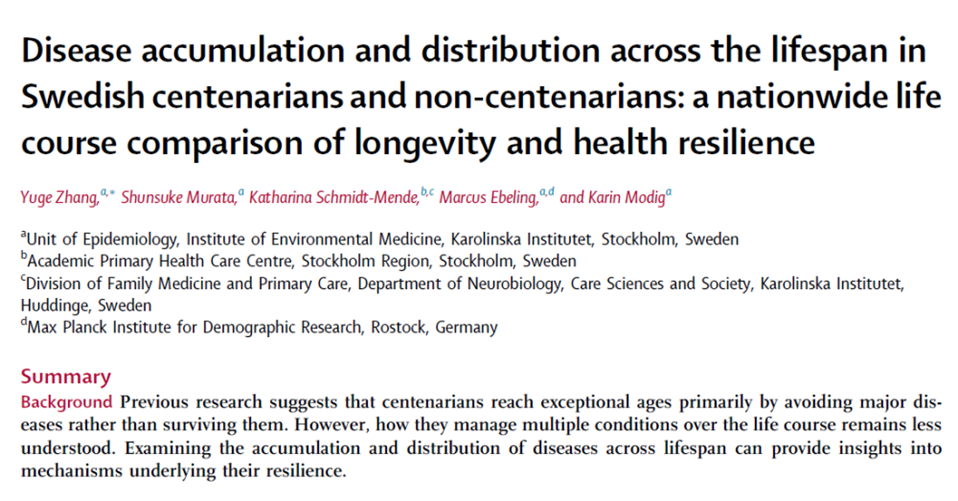
Core Insights - The study conducted by scientists from Karolinska Institute in Sweden tracked the life trajectories of 274,108 individuals over 30 years, revealing that centenarians significantly delay and simplify the onset of diseases [3][4][19]. Group 1: Key Findings on Longevity - Centenarians exhibit a pattern of delayed disease onset, leading to a compressed period of illness in their later years [6][64]. - The health trajectory of centenarians shows a lower disease burden starting from age 70, compared to their peers who live to 75-95 years [20][24]. - The average number of diseases diagnosed at age 85 for future centenarians is 1.2, while for those who will die at 90, it is 2.4, indicating a significant difference in health status [24][25]. Group 2: Disease Patterns - Cardiovascular diseases (CVD) are the primary health threat for older adults, but centenarians have a much lower burden from these diseases, with only 24.8% of their disease burden attributed to CVD at age 70, compared to 51.6% for those who will die at 75 [32][33]. - Centenarians show a remarkable immunity to neuropsychiatric diseases, with an average of only 0.006 diagnoses at age 80, compared to 0.060 for their peers [36][37]. - Cancer appears more frequently in the disease burden of centenarians, but this is attributed to a "survivor effect," as they live longer and face cancer risks later in life [40][44]. Group 3: Disease Co-occurrence - Centenarians tend to experience diseases in isolation rather than in combination, with only 0.9% of them having both cardiovascular and musculoskeletal diseases at age 80, compared to 2.8% of non-centenarians [50][51]. - This ability to isolate diseases helps centenarians avoid the complications associated with multimorbidity, which is common in those with shorter lifespans [47][49]. Group 4: Gender Differences in Longevity - While the overarching principles of longevity apply to both genders, specific health challenges differ; men face more urinary system diseases, while women contend with musculoskeletal diseases [54][55]. - Targeted health management strategies can be developed based on these gender-specific challenges [56][57]. Group 5: The Ultimate Theory of Longevity - The study emphasizes the concept of "compression of morbidity," aiming to minimize the time spent suffering from diseases and functional decline to the final years of life [58][59]. - Centenarians enjoy a longer "healthspan," experiencing fewer health issues for a more extended period before facing significant illness [63][64].