大模型推理速度优化

Search documents
DeepSeek 有新消息!
Mei Ri Jing Ji Xin Wen· 2026-02-27 09:06
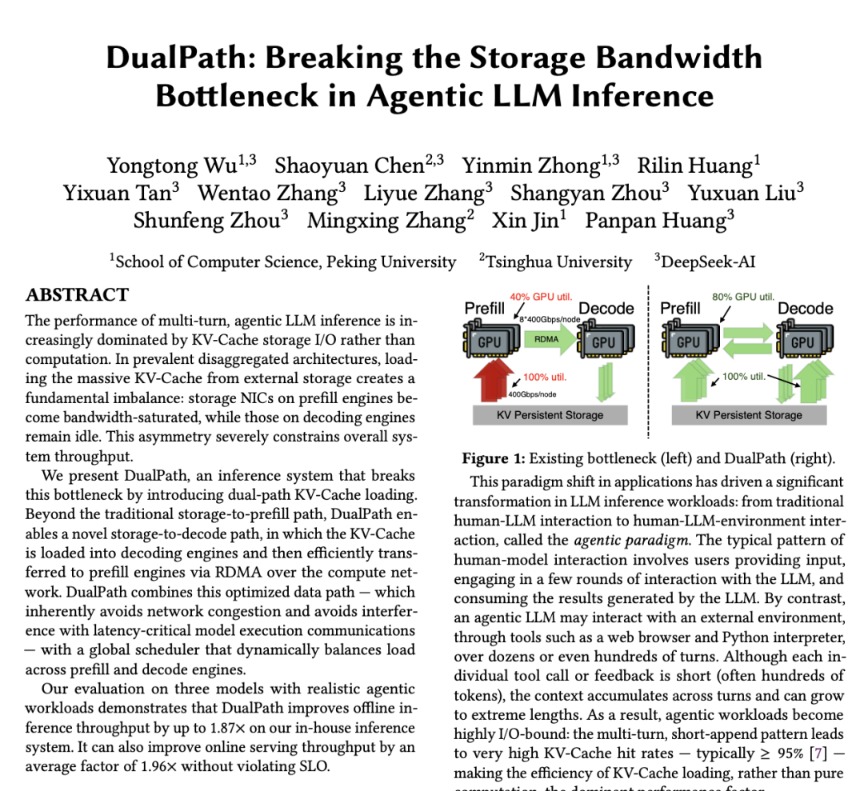
Core Insights - The article discusses a new research paper co-authored by DeepSeek, Peking University, and Tsinghua University, focusing on optimizing inference speed for large language models (LLMs) in AI agents [3][4] - The paper introduces an innovative inference system called DualPath, which enhances the performance of LLMs by implementing a "dual-path reading KV-Cache" mechanism, resulting in a 1.87 times increase in offline inference throughput and a 1.96 times increase in the number of AI agent operations per second [3][4] Group 1 - The transition of large models from single-turn dialogue systems to intelligent agent systems capable of multi-turn interactions is highlighted, necessitating a significant change in inference workloads [3] - The existing systems face bottlenecks due to bandwidth limitations, where the preprocessing engine monopolizes the network bandwidth, leaving the content generation engine underutilized [4] - DualPath addresses this issue by redesigning the KV-Cache loading logic, effectively utilizing idle bandwidth resources to significantly enhance speed [4] Group 2 - DeepSeek's approach to performance optimization is noted as a response to hardware limitations, with some industry professionals viewing it as a less innovative but necessary step [5] - There are ongoing rumors regarding the release timeline of DeepSeek V4, with speculation ranging from February to March, and recent reports indicating testing of a new model called "Sealion-lite" with a context window of 1 million tokens [5] - DeepSeek has provided early access to the updated V4 version to domestic manufacturers like Huawei, while competitors like NVIDIA have not received similar access [5] Group 3 - User feedback indicates a perceived decline in DeepSeek's empathetic communication style, with recent updates leading to a more rigid interaction approach [6] - The competitive landscape for AI assistants in China is intensifying, with major players like ByteDance, Baidu, and Alibaba rapidly iterating their products, alongside pressure from international competitors like ChatGPT and Claude [6]


DeepSeek又一论文上新
Di Yi Cai Jing Zi Xun· 2026-02-27 07:58
Core Viewpoint - The DeepSeek team has released a new academic paper focusing on optimizing inference speed for large language models (LLMs), which is crucial for the practical application of AI agents [4][5]. Group 1: Research and Innovation - The paper, co-authored with Peking University and Tsinghua University, introduces an innovative inference system called DualPath, designed to enhance the performance of LLMs under agent workloads [4]. - The DualPath system employs a "dual-path reading KV-Cache" mechanism, redistributing storage network load, resulting in an offline inference throughput increase of 1.87 times and an average increase of 1.96 times in the number of agent operations per second for online services [4][5]. Group 2: Industry Context and Expectations - The introduction of DualPath addresses the significant changes in inference workloads as LLMs evolve from simple dialogue systems to complex agent systems capable of multi-turn interactions, which can reach dozens or even hundreds of rounds [4]. - There is a growing expectation for the release of DeepSeek's next flagship model, DeepSeek V4, with various rumors about its launch timeline ranging from early February to March [6]. - Recent leaks suggest that DeepSeek is testing a V4 Lite model, codenamed "Sealion-lite," which supports a context window of 1 million tokens and native multimodal inference [6]. Group 3: Market Reactions and Concerns - Despite the technical advancements presented in the paper, there is a sentiment in the industry that such optimizations are seen as a necessity due to GPU shortages, with some viewing it as "dirty work" rather than innovative [5]. - Concerns have been raised among investment institutions that the release of the new model could lead to significant market volatility, similar to the previous year's model launch [6].