
大模型API服务

Search documents
清程极智:大模型 API 正通过提升个人效率,穿透商业服务全链路
Xin Lang Cai Jing· 2026-02-10 03:19
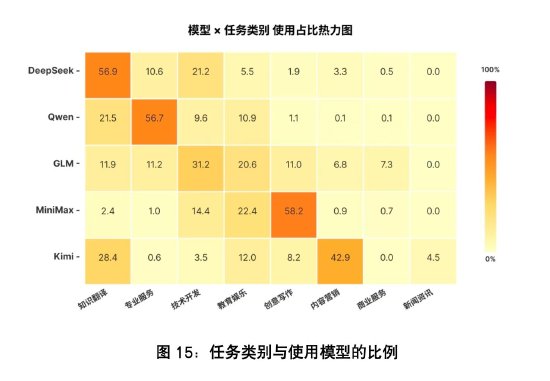
Core Insights - The report by Qingcheng Jizhi and Huqing Puzhi AI Incubator analyzes the application of large model API services in content creation, code development, and professional services, highlighting their impact on daily work routines and productivity [1][3]. Group 1: Code Development - Developers face significant time consumption in tasks such as code completion, bug debugging, and multi-file understanding, which exhibit "short input, medium output" characteristics, posing challenges for model context stability and response speed [1][3]. - GLM and DeepSeek series model APIs are becoming the preferred efficiency tools for developers due to their coding capabilities and long context advantages [1][5]. - API usage shows a unique "nighttime double peak" distribution, with high activity between 21-23 and 1-2 AM, indicating programmers' focused work hours [5]. Group 2: Content Creation and Marketing - Large models have become essential tools for content creation, assisting in rapid generation of copy and proposals, as well as in content marketing through expansion and stylization [5]. - Kimi and MiniMax series models are particularly favored in these scenarios, significantly reducing repetitive creative tasks and enhancing the novelty of marketing content [5]. Group 3: Professional Services and Office Automation - In professional services, such as legal and financial document processing, the focus is on stability and speed, with tasks often involving short to medium input and medium output interactions [2][5]. - Qwen and MiniMax series models are preferred for automating office processes, improving efficiency and accuracy in high-frequency, low-creative tasks like contract review and data analysis [2][5]. - The report emphasizes that individual success is foundational to corporate success, with enhanced personal efficiency driving overall business performance [6].

清程极智推出一站式AI评测与API服务智能路由平台 AI Ping
Cai Jing Wang· 2026-02-02 06:22
Core Insights - The launch of AI Ping by Qingcheng Jizhi marks a significant advancement in AI infrastructure, focusing on the evaluation and API service of large models, transitioning from "can it be used" to "how to operate it stably and at scale" [1][2] Group 1: AI Infrastructure Evolution - The core task of AI infrastructure is shifting from training and inference of large models to enabling efficient and stable usage of models in real business scenarios [1] - The key to achieving "intelligent circulation" lies in building intelligent routing capabilities, which include model routing for task-specific model selection and service routing for performance and cost optimization among API providers [1][2] Group 2: Product and Service Development - Qingcheng Jizhi's CEO highlighted the evolution of AI infrastructure focus from model training to application stability and efficiency, with ongoing technical practices in training, inference, and application [2] - AI Ping aims to provide a complete link covering evaluation, access, routing, and optimization, focusing on real business scenarios and monitoring key performance indicators like latency and stability across over 30 Chinese large model API service providers [2] Group 3: Industry Collaboration and Reports - The launch event saw the initiation of the "Intelligent and Sustainable Large Model API Service Ecosystem Plan" with over 20 API service providers, aimed at enhancing service evaluation and industry collaboration [3] - A report titled "2025 Large Model API Service Industry Analysis" was released, analyzing the supply structure and usage characteristics of API services, indicating a shift in competitive factors from price to delivery quality [3] - The report demonstrated that implementing intelligent routing can significantly enhance performance and optimize costs while ensuring availability, providing a validated engineering path for scalable and long-term use of large model API services [3][4]
18个月,中国Token消化狂飙300倍!别乱烧钱了,清华系AI Infra帮你腰斩API成本
机器之心· 2026-02-02 06:14
Core Viewpoint - The article discusses the launch of AI Ping, a product designed to enhance the efficiency and transparency of large model API services in China, addressing the complexities and uncertainties in the current market landscape [10][12][70]. Group 1: Market Context and Growth - The number of large models in China has surpassed 1,500, with downstream developers rapidly increasing their usage, leading to a projected daily token consumption of approximately 1 trillion by early 2025, marking a growth of over 300 times in just a year and a half [5]. - The current state of large model API services in China is highly fragmented and complex, with significant variations in performance across different service providers and models [9][10]. Group 2: AI Ping Overview - AI Ping combines evaluation and routing mechanisms to eliminate uncertainties in large model API services, aiming to provide users with stable and predictable productivity [12][13]. - The platform has integrated 30 major service providers and covers 555 model interfaces, offering a rare unified standard for continuous evaluation and public display of large model services [24]. Group 3: Performance Evaluation and Routing - AI Ping employs a comprehensive evaluation system that focuses on user-experience metrics such as TTFT (first token latency), TPS (throughput), cost, and accuracy, ensuring fair and consistent assessments [36][37]. - The system's routing capabilities allow for dynamic selection of models and service providers based on real-time performance data, optimizing for cost and efficiency [46][49]. Group 4: Impact on Developers and Service Providers - Developers using AI Ping can focus on core tasks rather than the complexities of model selection and service provider management, significantly reducing internal friction and enhancing productivity [63][66]. - The evaluation framework encourages service providers to improve their performance, shifting competition from price wars to engineering optimization and computational governance [69]. Group 5: Future Infrastructure - The article emphasizes that intelligent routing is a critical infrastructure for the future of AI, enabling seamless access to models and services without requiring users to understand the underlying complexities [72].

大模型应用迈入规模化运营新阶段 清程AI Ping构建API服务新生态
Huan Qiu Wang· 2026-01-30 07:33
Core Insights - The article discusses the transition of large model applications from exploration to stable and scalable operation, emphasizing the importance of model API service performance, stability, and efficiency in the industry [1][5][10] Industry Developments - Haidian District is accelerating the construction of a modern industrial system focused on artificial intelligence, aiming to support enterprises in collaborative exploration around common industry needs [3] - The shift in AI infrastructure focus from model training and inference to efficient and stable application in real business scenarios is highlighted, with an emphasis on building intelligent routing capabilities [3][5] Company Initiatives - Qingcheng Jizhi has launched the AI Ping platform, a one-stop AI evaluation and API service intelligent routing platform, to support the infrastructure for large model applications [5][10] - The platform aims to provide a complete link from evaluation to optimization, monitoring key performance indicators of different model APIs for informed decision-making by enterprises [7][10] Collaborative Efforts - A collaborative initiative involving over 20 large model API service providers was launched to promote the development of a sustainable model API service ecosystem, focusing on evaluation and industry communication [8][9] - The AI Ping platform has already covered over 30 Chinese large model API service providers, facilitating comparative analysis of service capabilities [7][9] Performance Analysis - The 2025 Large Model Service Performance Ranking will be published based on evaluation data from AI Ping, providing a reference for the industry [8] - A report analyzing the supply structure and usage characteristics of large model API services indicates that the core competitive factors have shifted from price to delivery quality, with key metrics including response latency and stability [10]
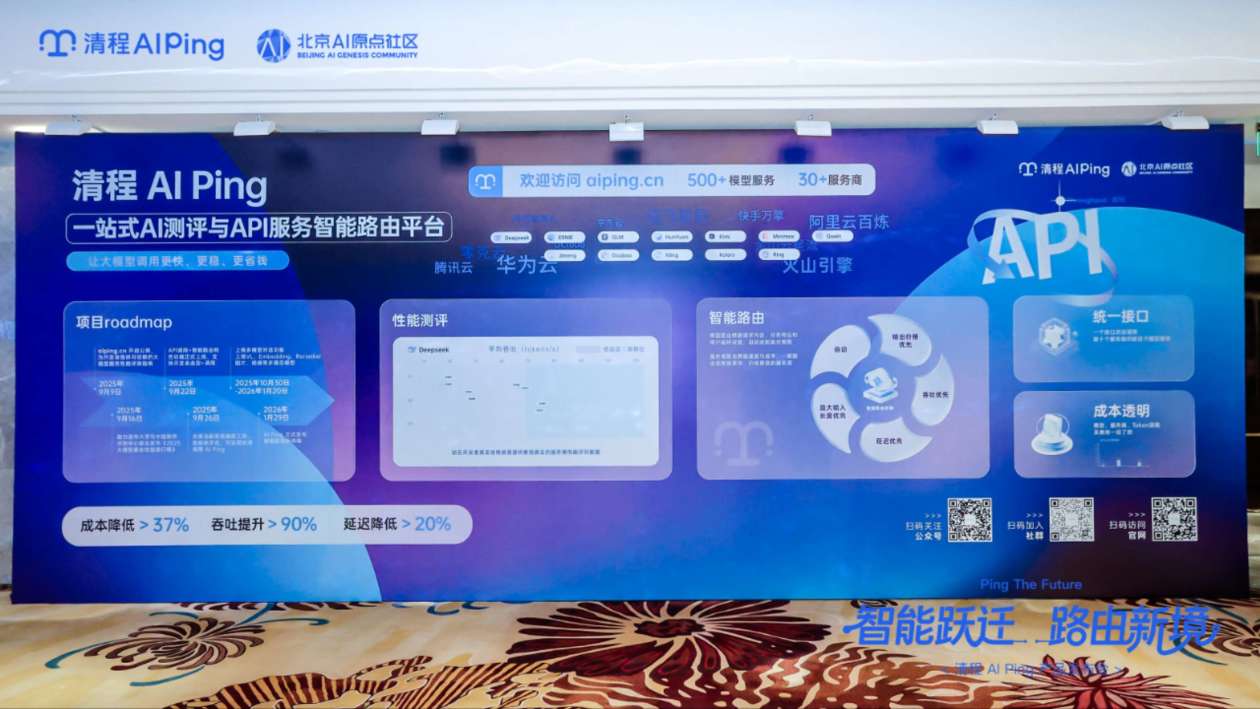
大模型持续演进 清程AI Ping发布智能路由平台
Zheng Quan Ri Bao Wang· 2026-01-30 05:10
Core Insights - The article discusses the launch of AIPing, a one-stop API evaluation and intelligent routing platform by Qingcheng Jizhi Technology, aimed at enhancing the stability, efficiency, and cost-effectiveness of large model applications in AI [1][2]. Group 1: Product Launch and Features - AIPing focuses on the usage phase of large model services, providing capabilities for service evaluation, unified access, and intelligent routing, creating a complete link from evaluation to optimization [3]. - The platform currently covers over 30 Chinese large model API service providers, allowing for comparative analysis of key performance indicators such as latency, stability, throughput, and cost-effectiveness [3]. Group 2: Industry Context and Support - The event gathered representatives from government, research institutions, cloud vendors, and application enterprises to discuss the evolution of AI infrastructure [1]. - The government is committed to supporting enterprises in collaborative innovation to drive the reuse of core technologies and value release within the AI industry [1]. Group 3: Future Directions and Reports - A report titled "2025 Large Model API Service Capability" was released, highlighting that the core competition in API services is shifting from price to delivery quality, emphasizing the importance of intelligent routing for optimizing performance and cost [4]. - Experts from various companies agree that the large model service sector is entering a phase of refined operations, where evaluation systems, intelligent routing, and unified management will be critical infrastructure for future development [4].