
大脑活动模式

Search documents
梦中清醒,是大脑的第三种状态吗?
3 6 Ke· 2025-12-15 02:49
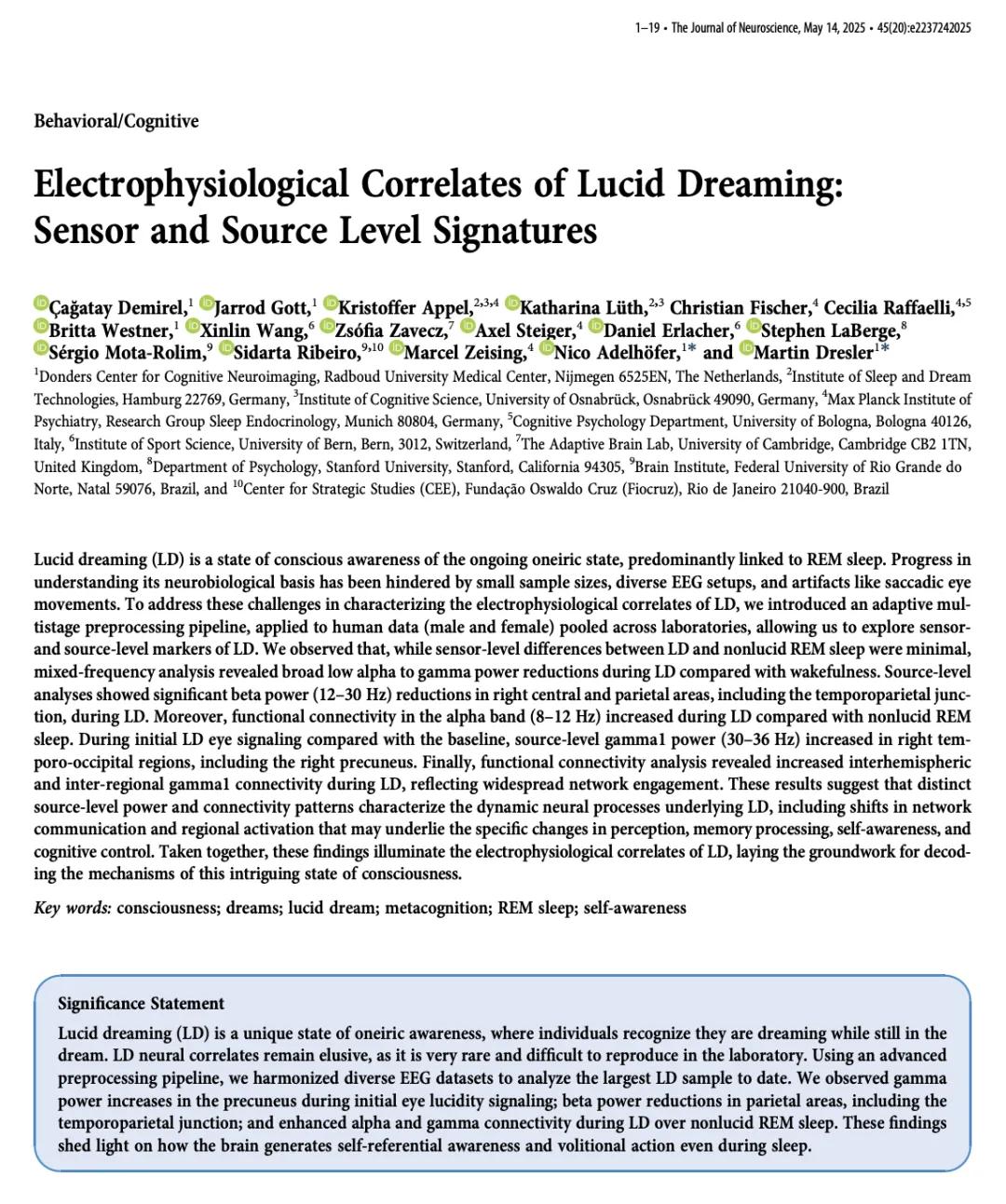
Core Insights - The research led by Çağatay Demirel from Radboud University Medical Center reveals that lucid dreaming is a distinct state of consciousness, separate from waking and REM sleep, characterized by unique brain activity patterns [1][4]. Group 1: Research Findings - The study indicates that lucid dreaming allows individuals to manipulate their dreams consciously, similar to the effects of psychedelic substances like LSD [5][6]. - Lucid dreaming is associated with increased beta waves in the right temporal and parietal lobes, which are linked to self-awareness and cognitive control [5]. - The research utilized the largest database in sleep studies to differentiate brain activity patterns across waking, REM sleep, and lucid dreaming states [4]. Group 2: Implications of Findings - The findings suggest that lucid dreaming may enhance self-awareness and cognitive control more than psychedelic experiences, which often diminish self-referential processing [6]. - The study opens new avenues for understanding consciousness and the potential therapeutic applications of lucid dreaming [4][6].

英媒:研究发现,乐观者大脑活动模式惊人相似
Huan Qiu Shi Bao· 2025-07-24 22:50
Core Insights - A new study from Kobe University reveals that optimists exhibit remarkably similar brain activity patterns when envisioning the future, suggesting a shared neural framework for organizing future thoughts [1][2] - The research indicates that this "synchronized" brain activity may explain why optimists tend to achieve greater success in social interactions, as their brains operate in a more intuitive and connected manner [1] Group 1: Research Findings - The study involved 87 participants who completed a questionnaire on optimism and underwent MRI scans while imagining various future scenarios, including positive, neutral, and negative situations [1] - Results showed that more optimistic participants displayed more consistent brain activity patterns in the medial prefrontal cortex, which is associated with future-oriented thinking [1][2] Group 2: Comparison with Pessimists - In contrast, pessimists exhibited greater variability in brain activity within the same region, potentially due to the complexity and diversity of issues they consider when faced with negative scenarios [2] - The researchers suggest that optimists frame their future thinking around socially accepted goals, while pessimists may diverge from this "mainstream framework," leading to differentiated thought processes [2] Group 3: Expert Commentary - Professor Lisa Bortolotti from the University of Birmingham commented that optimists tend to imagine negative events in less vivid and specific terms, resulting in a reduced negative impact [2] - Bortolotti emphasized that optimism does not distort reality but alters how individuals are affected by it, suggesting that while blind optimism can be detrimental, a constructive form of optimism can enhance the likelihood of success [2]