天空地一体化监测体系

Search documents
新华视点|生态绘新卷 各地绘就绿色发展好风光
Xin Hua Wang· 2025-11-19 12:44
Group 1: Ecological Development Initiatives - The article emphasizes the importance of ecological protection and development, showcasing various regions' efforts to achieve a win-win scenario for both [1] - In Wuxi, Jiangsu, the "Taihu Light" mobile factory operates 24/7, utilizing advanced technology for ecological restoration and water quality improvement [4][7] - The presence of migratory birds in Taihu serves as a direct indicator of the success of ecological governance efforts in the region [5][7] Group 2: Wetland and Biodiversity Conservation - In Dali, Yunnan, the Erhai Wetland has been optimized to enhance water quality and restore biodiversity, covering a total area of 68,800 acres [10][12] - The local government has implemented measures to protect and transform wetland areas, contributing to ecological balance and diverse landscapes [12] Group 3: Ecotourism and Education - In Hunchun, Jilin, the Northeast Tiger and Leopard National Park attracts tourists through educational initiatives that highlight local wildlife and conservation efforts [14] - The city has engaged in activities to convert ecological advantages into development momentum, promoting awareness and education about the region's biodiversity [14] Group 4: Agricultural Innovation - In Yulin, Shaanxi, the apple industry has flourished in previously barren areas, showcasing the potential of ecological agriculture [16] - The expansion of apple cultivation from the Guanzhong Plain to desert edges reflects ongoing ecological civilization efforts and the principle of harmonious coexistence with nature [18] Group 5: Technological Integration in Conservation - The establishment of the Giant Panda National Park in Sichuan has seen the implementation of a "sky-ground" integrated monitoring system to enhance ecological protection efficiency [20] - This system includes 60 infrared cameras across key ecological areas, successfully collecting over 18,000 image data points to support conservation efforts [22][24]


到今年年底,北京将建设城市生物多样性保护示范区 20 处
Xin Jing Bao· 2025-05-22 09:30
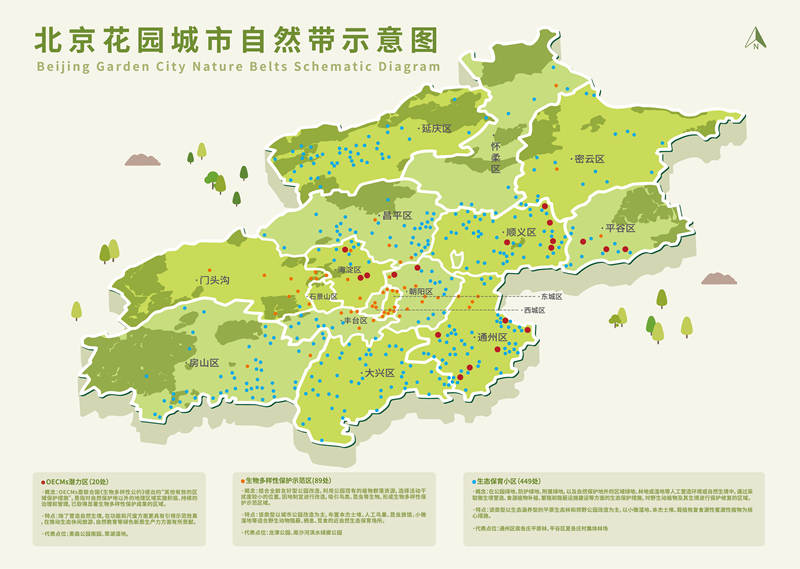
Core Points - Beijing aims to achieve a forest coverage rate of 45% by the end of this year and establish 20 urban biodiversity protection demonstration zones [1] - The city has a current forest coverage rate of 44.95% and over 91% coverage of park green space within a 500-meter radius [3] - A total of 558 natural belts have been created in Beijing, forming an ecological network to support urban wildlife [4] Group 1 - The city is actively applying for the Baihua Mountain Nature Reserve to become a UNESCO Biosphere Reserve, exploring new models for biodiversity protection [3] - The "Sky-Ground Integration" monitoring system has been established, utilizing over 1,500 infrared cameras and 1,600 sensors to capture nearly one million biodiversity images [3][5] - The natural belts include over 2,600 deadwood piles, 700 small wetlands, and 7,800 artificial bird nests, enhancing local biodiversity [5] Group 2 - The city has recorded 620 species of terrestrial wild animals, with an increase of 8 species compared to 2024, all of which are birds [6] - The Nanhaizi Milu Park has successfully "exported" 668 milu deer nationwide, establishing 47 relocated populations [6] - Cultural events and activities, such as the "Beijing Family Gardening Carnival," have generated over 1.8 billion yuan in sales, promoting ecological value [6] Group 3 - A cross-regional collaborative protection model has been established among Beijing, Tianjin, Hebei, Shanxi, and Inner Mongolia, enhancing forest fire prevention and wildlife rescue efforts [7] - The inter-regional cooperation has fortified a 28,000 square kilometer ecological barrier in North China [7]