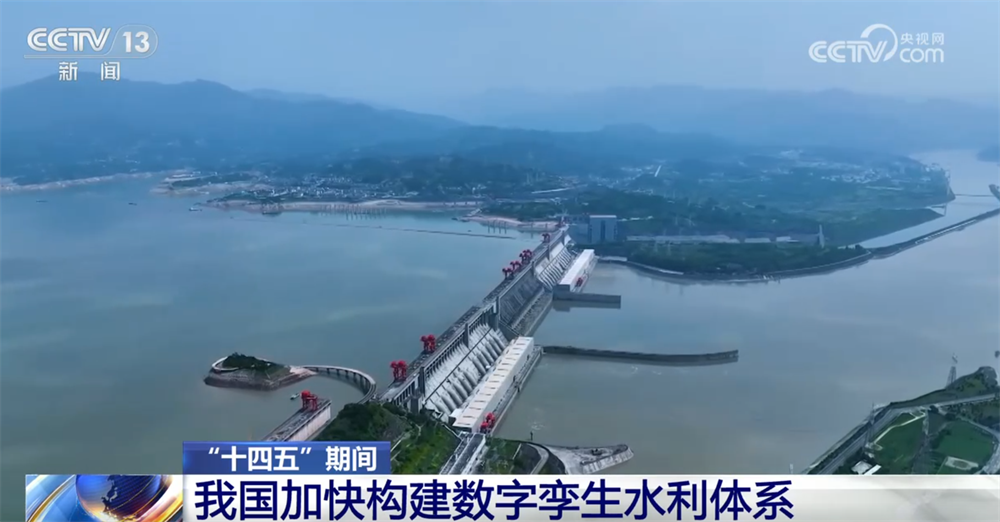
天空地水工一体化监测感知系统

Search documents
科技日报:“十四五”时期我国数字孪生水利体系框架基本形成
Shui Li Bu Wang Zhan· 2025-12-22 06:37
Core Viewpoint - The Ministry of Water Resources of China has made significant progress in building a digital twin water conservancy system, which provides strong technical support for high-quality water conservancy development and national water security [1] Group 1: Digital Twin Water Conservancy System - The digital twin water conservancy system framework has been basically formed, consisting of digital twin watersheds, digital twin water networks, and digital twin water conservancy projects [1] - The integration of big data, cloud computing, and artificial intelligence with water conservancy operations allows for intelligent simulation and scheduling, enhancing disaster prevention and water resource management [1] Group 2: Implementation and Achievements - A total of 94 pilot tasks for digital twin watershed construction have been completed, resulting in replicable cases, while 14 provincial-level water network pilot areas are advancing in phases [1] - Key projects such as the digital twin of the Three Gorges, South-to-North Water Diversion, and others have been put into practical application [1] Group 3: Integrated Monitoring System - The Ministry is accelerating the construction of an integrated monitoring and perception system that covers all elements of water management, utilizing 34 remote sensing satellites, over 180 rain radar, and more than 136,000 ground hydrological stations [2] - This system enables intelligent monitoring and perception of the entire process of water governance and management [2] Group 4: Disaster Prevention and Water Resource Management - Digital twin technology has provided critical support for scientific and precise scheduling of watershed engineering systems during significant flood events, such as the major floods in the Haihe and Pearl River basins [2] - In the context of reduced water inflow during the main flood season in the Yangtze River basin, the technology helped achieve a record high of 108.1 billion cubic meters of water storage in 58 controlling reservoirs [2] - The digital twin South-to-North Water Diversion project has ensured safety in engineering, water supply, and water quality, while the digital twin irrigation areas have improved water resource allocation and irrigation efficiency [2]
智慧治水!构建“天空地水工”一体化监测感知 | 高质量完成“十四五”规划
Yang Shi Wang· 2025-09-29 08:32
Core Viewpoint - The construction of a digital twin water conservancy system has significantly improved flood forecasting capabilities in China, extending the flood prediction period from 3 days to 10 days, which supports effective flood management and disaster response [2][5]. Group 1: Digital Twin Water Conservancy System - The digital twin water conservancy system enhances the "four pre" functions: forecasting, early warning, simulation, and planning [3]. - A comprehensive monitoring and sensing system integrating "sky, land, water, and engineering" has been established to provide real-time information for risk monitoring and prevention in water conservancy projects [3]. Group 2: Flood Management and Capacity - The flood storage capacity of the seven major rivers in China has reached 2,104 billion cubic meters, enabling the country to defend against the largest floods since the founding of the People's Republic of China [7][9]. - Since the beginning of the 14th Five-Year Plan, 3,981 rivers have experienced floods exceeding warning levels, with 223 rivers recording the largest floods on record [9]. Group 3: Water Resource Management - During the 14th Five-Year Plan, the total water consumption in China achieved zero growth despite an average economic growth rate of 5.5% [12]. - The water usage per unit of GDP and per unit of industrial added value is projected to decrease by 17.7% and 23.6%, respectively, by 2024 compared to 2020 [16]. Group 4: Water Conservation Initiatives - The government is promoting water-saving actions across key industries and enhancing irrigation modernization, particularly in the Yellow River basin and the South-to-North Water Diversion project areas [14][18]. - The area of water-saving irrigation has reached 6.38 million acres, with the effective utilization coefficient of irrigation water in farmland increasing to 0.58 [16].

加快构建“预报+预警+预演+预案”数字孪生水利体系 水利治理管理成效显著
Yang Shi Wang· 2025-09-11 02:44
Core Viewpoint - During the "14th Five-Year Plan" period, China is accelerating the construction of a digital twin water conservancy system, enhancing water management and governance capabilities through advanced monitoring and forecasting technologies [1][4]. Group 1: Monitoring and Detection Systems - China has established a comprehensive monitoring and perception system consisting of 31 remote sensing satellites, over 4,000 drones, more than 100 rain radar stations, 133,000 ground water monitoring stations, and over 300,000 safety monitoring points for water conservancy projects [4]. - The system integrates various technologies, including infrared cameras and laser radars on drones, to detect issues such as dam leakage and piping [1][4]. Group 2: Flood Prevention and Management - The country is advancing the "four-preparation" capabilities for flood prevention across seven major river basins, providing strong support for resisting regional flooding [4]. - The development of models such as the "cloud-rain" precipitation forecasting model and hydrodynamic flood propagation model aims to extend the forecasting period and improve accuracy [7]. Group 3: Disaster Defense Systems - The Yellow River Water Resources Commission is working on a disaster defense system by comparing physical parameters and experimental results between the prototype Yellow River and the digital twin Yellow River [6].