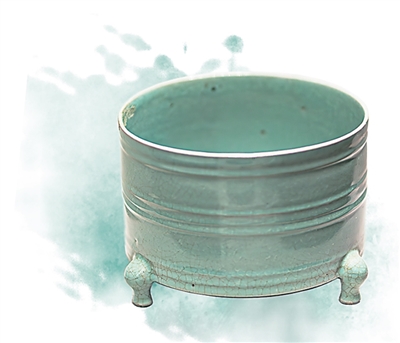
天青色

Search documents
天青色等烟雨 其实是个美丽的误会
Xin Lang Cai Jing· 2026-02-01 20:19
Core Viewpoint - The article explores the significance and artistic pursuit of the color "Tianqing" (Sky Blue) in Chinese culture, particularly its historical context and the challenges in producing this unique hue in ceramics. Group 1: Historical Context - The pursuit of "Tianqing" can be traced back to the Zhou Dynasty, specifically to Emperor Chai Rong, who ordered the creation of Tianqing glaze, which was described as a color reminiscent of the sky after rain [2]. - The exact location of the Chai kiln remains unknown, preventing the observation of the original "Tianqing" color [3]. - Emperor Song Huizong Zhao Ji continued this artistic pursuit, inspired by a dream of the clear blue sky after rain, leading to the creation of Ru kiln ceramics, which are highly valued for their aesthetic and collectible qualities [4]. Group 2: Artistic and Technical Challenges - The production of "Tianqing" porcelain is complex, involving numerous steps such as clay preparation, shaping, drying, glazing, and firing, with the most challenging aspect being the attainment of the desired glaze color [4][5]. - Craftsmen had to rely on their experience and intuition to determine the right conditions for firing, particularly the humidity before rain, which is crucial for achieving the perfect "Tianqing" hue [5]. - The firing temperature must be controlled around 1220 degrees Celsius, with strict cooling speed requirements to ensure the proper crystallization of materials, making the production of "Tianqing" a meticulous process [5]. Group 3: Misconceptions and Cultural Impact - The "Tianqing" color is often confused with the blue of blue-and-white porcelain, which became popular during the Yuan Dynasty, highlighting a cultural misunderstanding [6]. - This confusion has allowed "Tianqing" to gain recognition through the romantic imagery associated with "blue-and-white porcelain," further embedding it in cultural narratives [6].
“等烟雨”的“天青色”有多美(答读者问·传统文化)
Ren Min Ri Bao· 2025-11-09 22:20
Core Insights - The article explores the beauty of "Tianqing color" as inspired by the lyrics of the song "Blue and White Porcelain," linking traditional Chinese culture with ceramic craftsmanship [2][3] - "Tianqing color" is described as a deep blue hue that appears after rain, characterized by its visual properties and natural optical principles [3][4] Summary by Sections - **Cultural Significance**: The phrase "Tianqing color waits for smoke and rain" reflects a moment of clarity in nature, capturing the essence of a pure and deep blue sky after a rainstorm, which serves as a model for porcelain production [2][3] - **Artistic Pursuit**: The pursuit of "Tianqing color" is highlighted in the Song Dynasty's Ru kiln ceramics, known for their jade-like warmth and subtle blue tones, representing the pinnacle of celadon art [3] - **Color Mechanism**: The article explains that true "Tianqing color" is rare in Ru kiln ceramics, as most exhibit a greenish tone due to the color formation mechanisms involving both chemical and physical processes [4] - **Production Challenges**: It is noted that while "Tianqing color" is inspired by specific weather conditions, the production of ceramics is not suitable during rainy weather due to high humidity affecting kiln temperature and atmosphere stability [4]