太空快递

Search documents
“太空快递”来了?全国首个民营飞船成功“上天”!背后公司创始人:正积极开发“中型货运飞船”低成本产品
Xin Lang Cai Jing· 2025-12-16 14:02
Core Insights - The successful launch of the Di'er No. 5 space experiment module marks a new phase for private spaceflight in China, laying the groundwork for broader space scientific research, technology validation, and cargo transportation [1][10] - The focus of the capital market and industry is shifting from mere technological breakthroughs to the commercial viability of private space enterprises, indicating a transition from storytelling to actual business operations [1][10] Group 1: Launch and Significance - The Di'er No. 5 was successfully launched by the Kuaizhou-11 rocket from the Jiuquan Satellite Launch Center, achieving its mission objectives [1][3] - This launch is seen as a validation of the commercial viability of small cargo spacecraft, establishing a standardized space service system independent of state-led large missions [3][14] Group 2: Market Opportunities - With the completion of the Chinese Tiangong space station and its transition to regular operations, there is an emerging demand for small, low-cost, and frequent cargo services, presenting an optimal entry point for private enterprises [4][15] - Private commercial spacecraft are likened to a flexible "space express," catering to the growing market demand for rapid round trips and in-orbit services, distinguishing them from state-operated heavy-lift missions [5][15] Group 3: Business Model and Customer Engagement - The launch demonstrated the ability of the company to provide mature customer service, having carried over 300 kilograms of payload for multiple clients, including 34 experimental payloads from various sectors [8][19] - The evolving customer ecosystem in commercial spaceflight is shifting towards seeking specific solutions rather than just payload delivery, indicating a rich and diverse application landscape [20] Group 4: Policy and Economic Context - The success of the Di'er No. 5 is attributed to a combination of policy support, capital investment, and regional economic development, marking 2025 as a pivotal year for commercial spaceflight [21][22] - The establishment of regulatory frameworks and the involvement of private enterprises in standard-setting reflect a maturing industry poised for high-quality and orderly development [21][22]


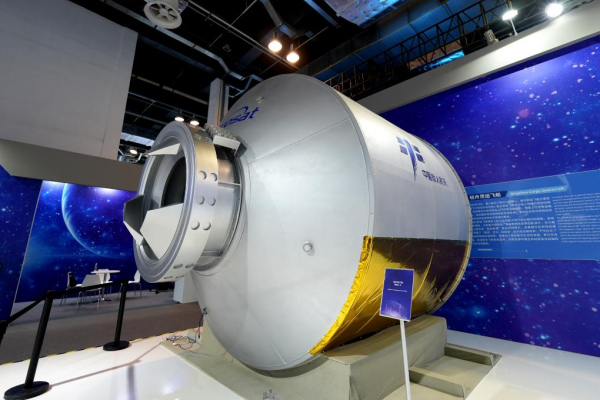
【新华社】“太空快递员”!轻舟货运飞船完成多项关键技术验证
Xin Hua She· 2025-12-11 02:06
Core Insights - The new generation cargo spacecraft "Qingzhou" has completed several key technology validations and is set for its maiden flight next year, specifically designed for the Chinese space station [2][3] - "Qingzhou" is characterized by its low cost, high reliability, high adaptability, and high intelligence, making it a powerful addition to the space logistics system [2][3] Summary by Sections Design and Capacity - The spacecraft weighs approximately 5 tons and features a four-layer cargo rack layout with 40 standard cargo slots, accommodating various payloads including supplies for astronauts and scientific equipment [2] - The total cargo volume reaches 27 cubic meters, with a usable volume of 9 cubic meters, catering to diverse transportation needs for the space station [2] Smart Features - Equipped with an intelligent cargo management system, "Qingzhou" allows for smart identification, positioning, and management of goods, enabling astronauts to quickly locate items through voice interaction, significantly enhancing delivery efficiency [3] - The spacecraft includes a modular "space refrigerator" with individual 60-liter cold chain boxes that can be combined for a maximum total capacity of 300 liters, ensuring stable preservation during transport [3] Economic and Operational Efficiency - The integrated single-cabin design of "Qingzhou" reduces its size and improves space utilization, while also being compatible with multiple rocket types for rapid launches [3] - The current transportation cost is approximately 100,000 yuan per kilogram, with potential reductions expected through mass production and deeper commercial partnerships [3] - "Qingzhou" can perform both delivery and retrieval functions, allowing it to dispose of waste from the space station by burning it up in the atmosphere, thus achieving a closed-loop transportation system [3] Strategic Importance - The addition of "Qingzhou" as a backup for cargo transport will significantly enhance the safety and reliability of material supply for the Chinese space station [3][4] - The development unit has previously achieved success with projects like the Beidou navigation satellite and dark matter particle detection satellite, marking a new breakthrough in modular spacecraft and rapid response technology [3]