太空计划

Search documents
爆粗口!马斯克炮轰美高官
Huan Qiu Shi Bao· 2025-10-22 09:16
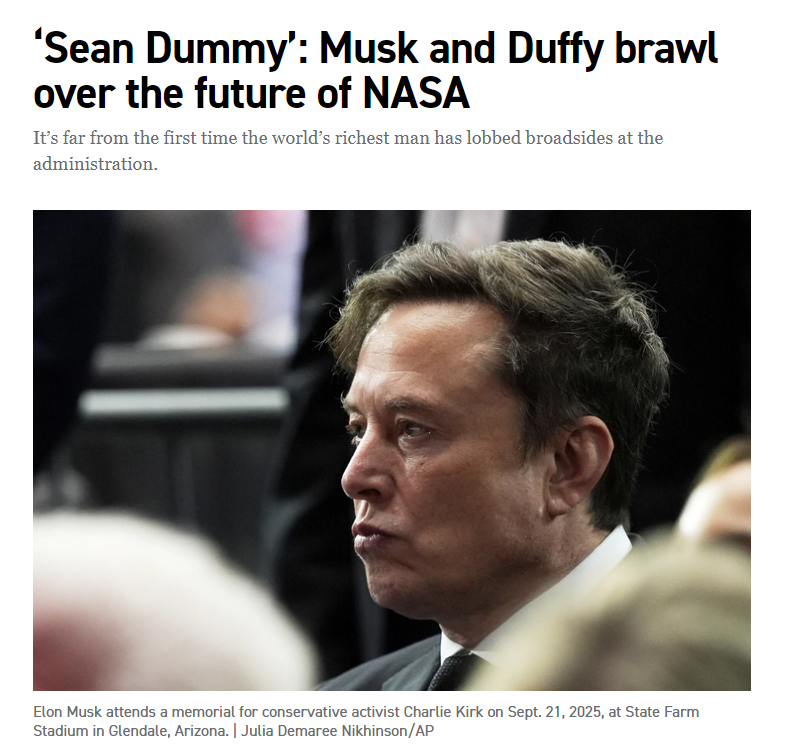
Core Points - The U.S. Transportation Secretary and acting NASA Administrator Sean Duffy is reportedly planning to merge NASA into the U.S. Department of Transportation, which could place NASA under Duffy's direct control and negatively impact Elon Musk's business interests with SpaceX [1][3] - Duffy has criticized SpaceX for falling behind on its lunar mission contract, leading him to open the lunar lander contract to competitors like Blue Origin [3] - Elon Musk has publicly attacked Duffy on social media, calling him "dumb Sean" and questioning his qualifications to lead NASA due to his background in rock climbing [6] Group 1 - Sean Duffy's plan to merge NASA into the U.S. Department of Transportation could significantly alter the agency's operational structure and its relationship with private companies like SpaceX [1][3] - Duffy's criticism of SpaceX's performance on lunar contracts has prompted a shift in contract opportunities towards other competitors, indicating a potential shift in the competitive landscape of space contracts [3] - Musk's strong public reaction against Duffy highlights the tension between government officials and private sector leaders in the aerospace industry, which could influence future collaborations and contracts [6] Group 2 - The ongoing leadership struggle for NASA, with Duffy and Isaacman both lobbying for the position of permanent administrator, reflects the high stakes involved in U.S. space policy and governance [3][6] - The urgency for a permanent NASA administrator is underscored by upcoming significant missions, including a delayed crewed lunar flight, which necessitates stable leadership [6]

刚刚!马斯克,突爆大消息!
券商中国· 2025-07-20 03:34
Core Viewpoint - The Trump administration is heavily reliant on SpaceX for its advanced technology and government contracts, particularly in defense and NASA operations, making it difficult to sever ties with the company [2][3][7]. Group 1: Government Contracts and Dependency - The U.S. government recognizes the critical nature of SpaceX's contracts, which are essential for the Department of Defense and NASA, limiting alternative options for rocket launches and satellite services [2][5][10]. - An early assessment indicates SpaceX's dominant position as a leading rocket launcher and satellite internet provider, with a focus on profitable government contracts during the review process [4][8]. - The review of SpaceX's contracts was initiated after Trump suggested cutting ties, but officials concluded that most contracts are vital for national interests [3][5]. Group 2: SpaceX's Market Position - SpaceX holds a monopoly in the commercial launch industry, responsible for over 90% of U.S. satellite launches, and its Falcon rockets are crucial for government payloads [11][12]. - The company continues to expand its Starlink satellite internet service, which is utilized by various government agencies, while also securing classified contracts through its Starshield division [12]. Group 3: Safety Concerns - SpaceX's Starbase facility has a significantly higher injury rate compared to other aerospace manufacturing facilities, raising safety concerns [13][14]. - The high total recordable incident rate (TRIR) at Starbase does not automatically trigger contract termination but indicates potential safety issues that need addressing [15][16].