
猎鹰火箭

Search documents
太空行业深度报告:SpaceX:构建全球太空基建与算力生态的“超级巨头”
Guolian Minsheng Securities· 2026-03-30 15:02
Investment Rating - The report maintains a "Buy" rating for the space industry, specifically for SpaceX [1]. Core Insights - SpaceX is transitioning from a launch service provider to a space infrastructure operator, driven by advancements in Starship and the emergence of space computing [8]. - The valuation of SpaceX has evolved to reflect a three-layer asset model: cash flow assets from launch services, global network assets from Starlink, and optionality from future space computing capabilities [20][22]. - The report highlights the industrialization of rocket capabilities, emphasizing the cost reduction and scalability achieved through innovations like 3D printing [7][43]. Summary by Sections 1. SpaceX: Valuation and Vision - SpaceX's valuation history shows significant growth through three phases: commercial launches, satellite services, and now space infrastructure [17][19]. - The current valuation of $1.5 trillion is attributed to the combination of cash flow from launch services, network assets from Starlink, and future growth potential from Starship [22]. 2. Rocket Technology and Advanced Manufacturing - SpaceX's rocket technology has evolved from Falcon to Starship, with a focus on reusability and cost efficiency [29][31]. - The integration of 3D printing technology has significantly reduced manufacturing costs and production times, enabling a shift from low-frequency custom production to industrial-scale manufacturing [43][46]. 3. Starlink: From Global Connectivity to Space Computing - Starlink is evolving from a broadband service to a space computing platform, with plans to deploy a million satellites to support AI computing needs [58][62]. - The report outlines three key challenges for Starlink's transition to a space computing center: building a scalable satellite platform, creating a low-latency network, and ensuring reliable operation in extreme space environments [61][69]. 4. Investment Recommendations - The report suggests focusing on high-performance satellite energy systems and advanced communication hardware suppliers as potential investment opportunities [11]. - It also recommends monitoring developments in next-generation aerospace manufacturing technologies and satellite applications that benefit from the diversification of satellite internet services [11].
A股,强势反弹!超4800股上涨
证券时报· 2026-02-03 10:06
Core Viewpoint - The article highlights a strong rebound in the stock markets, particularly in the Asia-Pacific region, with significant gains in various sectors, especially commercial aerospace and space photovoltaic concepts, driven by technological advancements and market demand [1][2][3]. Group 1: Market Performance - Major Asia-Pacific stock indices saw significant increases, with Japan's Nikkei 225 rising by 3.92% to close at 54,720.66 points, and South Korea's composite index surging by 6.84% to 5,288.08 points [1]. - The A-share market also experienced a robust rebound, with the Shanghai Composite Index up 1.29% to 4,067.74 points, and the Shenzhen Component Index rising by 2.19% [2]. - The total trading volume in the Shanghai and Shenzhen markets was approximately 2.57 trillion yuan, a decrease of over 40 billion yuan from the previous day [2]. Group 2: Commercial Aerospace Sector - The commercial aerospace concept saw a significant surge, with stocks like Robotech and Dike shares hitting the 20% limit up, while other companies like XW Communication and Light Library Technology rose over 10% [4][6]. - SpaceX's recent acquisition of xAI aims to integrate resources across AI, rockets, and space internet, indicating a strategic move to enhance its capabilities in the commercial aerospace sector [5][6]. Group 3: Space Photovoltaic Concept - The space photovoltaic sector was notably active, with stocks such as Aotewi and Haiyou New Materials reaching the 20% limit up, and Jieput's stock price increasing by approximately 19% to a historical high [8][10]. - The demand for space photovoltaic technology is expected to grow significantly, driven by the industrialization of satellite manufacturing and the need for efficient power systems in low Earth orbit satellites [10]. Group 4: CPO Concept - The CPO (Chip-on-Board) concept experienced a substantial rise, with stocks like Juguang Technology increasing over 18% and Tianfu Communication rising by over 13%, both reaching new highs [12][14]. - Analysts predict that the domestic demand during the "14th Five-Year Plan" period, combined with high overseas demand and technological upgrades, will positively impact the performance of leading optical module companies [14].








SpaceX为何要收购xAI? 马斯克内部信全文曝光
Sou Hu Cai Jing· 2026-02-03 01:16
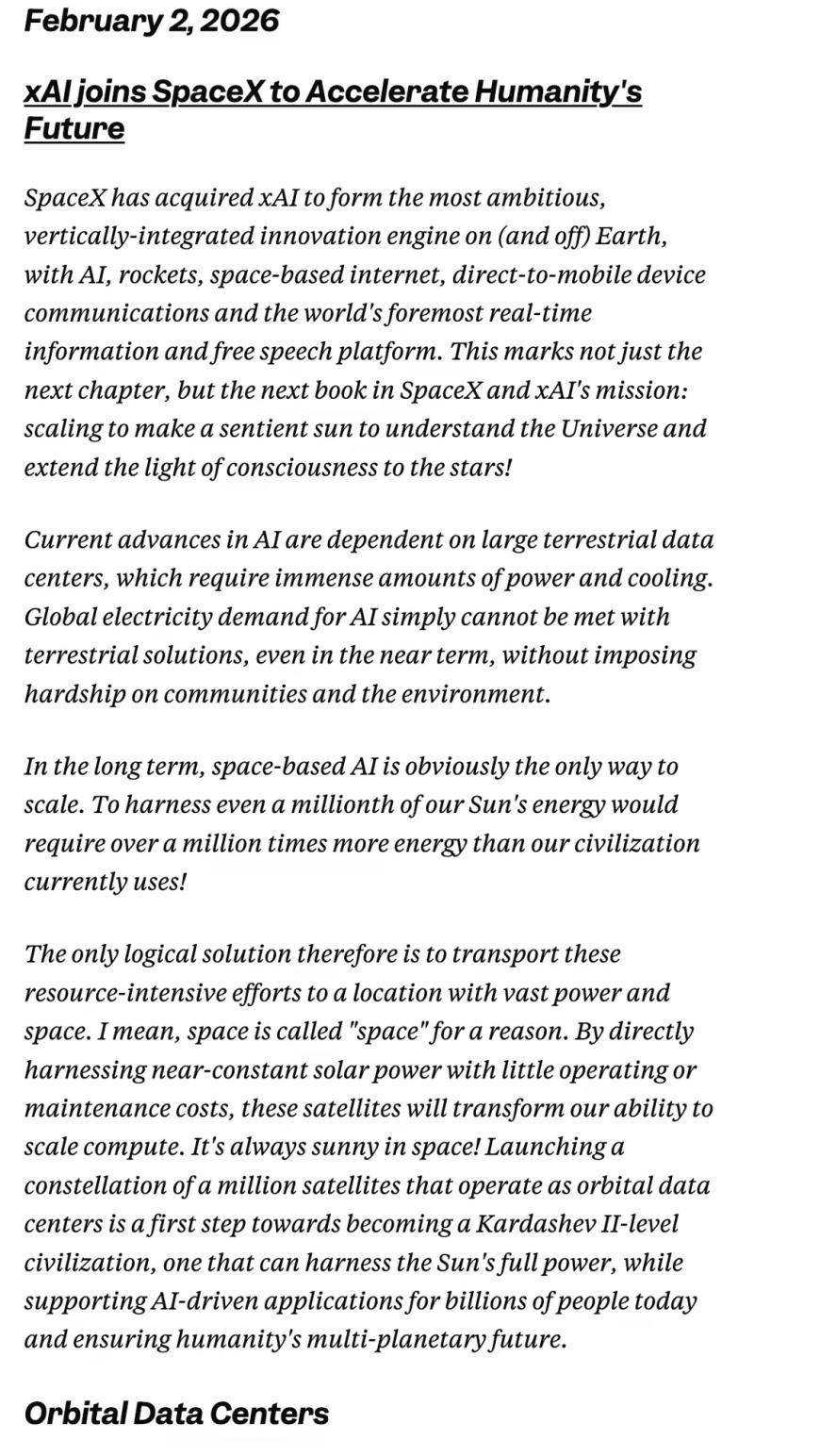
Core Viewpoint - Elon Musk announced the acquisition of xAI by SpaceX, aiming to integrate AI, rocket technology, satellite internet, and mobile communication to create a highly ambitious and vertically integrated innovation engine on Earth and beyond [1][2]. Group 1: Acquisition and Integration - SpaceX has completed the acquisition of xAI, which will accelerate the future of humanity by merging AI with rocket technology and satellite internet [1]. - The integration aims to deploy data centers in space, marking a new chapter for both SpaceX and xAI [1][3]. Group 2: Space-Based AI and Energy Utilization - The long-term solution for AI's energy demands is space-based AI, which can utilize solar energy at a scale far exceeding current civilization's consumption [2][3]. - A constellation of one million satellites is proposed to operate as orbital data centers, representing a step towards a Type II Kardashev civilization that can harness the sun's total energy [3][4]. Group 3: Satellite Launch and Infrastructure - SpaceX's Starship will significantly enhance satellite launch capabilities, with the potential to deliver 200 tons per launch, enabling the deployment of millions of tons of satellites annually [4][5]. - The projected output of AI computing power from these satellites could reach 1 terawatt annually, transforming the landscape of AI capabilities [4][5]. Group 4: Future Prospects and Technological Advancements - The cost-effectiveness of generating AI computing power in space is expected to drive unprecedented innovation in training AI models and processing data [5]. - Establishing a permanent base on the Moon could facilitate scientific research and industrial production, further supporting the development of space-based infrastructure [5].
机械行业研究:商业航天系列三:为何要重视空天的“寒武纪”?
SINOLINK SECURITIES· 2026-02-01 05:45
Investment Rating - The report suggests a positive outlook for the commercial space industry, indicating that 2026 is expected to be a pivotal year for reusable rockets, with significant investment opportunities anticipated [2][6]. Core Insights - The report emphasizes the importance of rocket capacity as a critical factor in the space industry, highlighting that the rocket segment is likely to benefit from long-term valuation premiums and will be the first to reflect changes in downstream demand [1][2]. - The competition for satellite frequency resources is intensifying, with a significant increase in demand for launch capacity as various companies aim to secure orbital resources [10][12]. - The report identifies key companies in the industry, including Aerospace Power, Feiwo Technology, Western Materials, and others, which are positioned to capitalize on the growth in the commercial space sector [3][5]. Summary by Sections Section 1: Satellite Expansion, Rocket IPO Acceleration, and Reusable Rocket Trials - The urgency to secure frequency resources is increasing, with nearly all usable L, S, and C band frequencies being occupied, necessitating rapid action to lock in spectrum resources [10][11]. - The IPO progress of commercial rocket companies is accelerating, with notable advancements from Blue Arrow Aerospace and others, which are expected to lead to increased rocket production capacity [15][17]. - 2026 is projected to mark the beginning of the era of reusable rockets in China, with both commercial companies and state-owned enterprises planning to launch reusable rocket projects [16][17]. Section 2: Focus on the "Cambrian Explosion" of the Aerospace Chain - Feiwo Technology is highlighted for its dual focus on 3D printing of rocket engines and structural components, benefiting from the rising demand in the wind power sector, leading to significant revenue and profit growth [21][26]. - Western Materials is positioned as a leader in rare metal materials, with its subsidiary focusing on niobium alloys for rocket engines, filling a domestic gap in the aerospace sector [29][35]. - Aerospace Power serves as a core platform for liquid propulsion technology, although it is currently facing revenue and profit pressures due to market conditions [37][39].
马斯克的SpaceX与xAI据悉讨论合并,瞄准太空AI目标
Xin Lang Cai Jing· 2026-01-29 23:25
Core Viewpoint - SpaceX and xAI are in discussions to merge ahead of a significant IPO planned for later this year, integrating Musk's various ventures under one umbrella [1][7]. Group 1: Merger Details - The proposed merger will allow xAI shares to be exchanged for SpaceX shares, with Musk establishing two entities in Nevada to facilitate the transaction [1][2]. - Some xAI executives may opt for cash instead of SpaceX stock as part of the deal, but the final agreement has not yet been signed, leaving the timing and structure uncertain [2][7]. Group 2: Company Valuations - SpaceX is currently the highest-valued private company globally, with an estimated valuation of $800 billion, while xAI was valued at $230 billion in November 2022 [2][8]. - SpaceX plans to go public in June 2023, with an expected valuation of around $1.5 trillion [2][8]. Group 3: AI and Space Data Centers - Musk is constructing a supercomputer named "Colossus" in Memphis, Tennessee, for AI training, with SpaceX agreeing to invest $2 billion in xAI as part of a $5 billion equity financing round [3][9]. - Musk stated that deploying AI in space will be the most cost-effective solution within two to three years, aiming to reduce operational costs for AI model training [3][9]. Group 4: Defense Contracts and AI Integration - Integrating xAI into SpaceX may enhance the company's position in securing significant defense contracts, as the Pentagon seeks to accelerate AI adoption in military networks [4][10]. - xAI has signed a contract worth up to $200 million with the Pentagon to provide its Grok product, which is expected to be integrated into military operations [5][11]. Group 5: Historical Context and Future Plans - This merger is not Musk's first attempt to consolidate his companies; he previously merged the social media platform X into xAI and acquired SolarCity using Tesla stock [6][11]. - SpaceX has engaged with multiple banks to prepare for its IPO, indicating a strategic move towards public investment [12].
浙商证券:太空算力和商业航天2026年迎奇点时刻 建议关注太空光伏等四大细分赛道
智通财经网· 2026-01-08 06:04
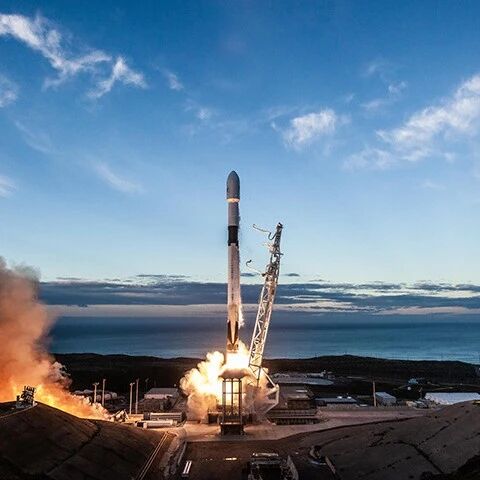
Core Viewpoint - The space data center industry has transitioned from technology validation to the commercialization phase, represented by Starcloud-1 and China's "Three-Body Computing Constellation," with significant potential for industry growth and value creation [1] Group 1: Commercialization of Space Computing - The construction of space data centers offers a disruptive cost advantage, with a ten-year core cost of approximately $8.2 million compared to $167 million for ground solutions, leveraging efficient solar energy and natural vacuum radiation cooling [1] - The first phase of the computing constellation is expected to generate over tens of billions in industry output by 2027, with long-term potential exceeding one trillion [1] Group 2: Infrastructure Reconstruction - The traditional computing infrastructure paradigm is being redefined due to the unique characteristics of the space environment, necessitating new systems for radiation cooling, solar energy, and inter-satellite communication [2] Group 3: Global Competition Landscape - The low Earth orbit satellite network sector is characterized by intense competition, led by the U.S. with companies like SpaceX and Amazon, while China is rapidly advancing its own satellite internet systems under national strategic guidance [3] Group 4: Satellite Launch Plans - Major satellite constellations, including SpaceX, G60, and GW, are expected to conduct satellite launches over the next five years, with an estimated average of 940 rocket launches annually [4] Group 5: Growth in Launch Activities - The number of Falcon rocket launches has increased from 6 in 2014 to a projected 134 in 2024, while the Long March series has risen from 15 to 49 launches in the same period, indicating a robust growth in global space launch activities [5]

SpaceX 宣布卫星降轨行动,太空资源日趋紧张
Changjiang Securities· 2026-01-05 15:26
Investment Rating - The industry investment rating is "Positive" and maintained [7] Core Viewpoints - SpaceX announced a reduction in the orbital altitude of thousands of Starlink satellites to mitigate collision risks, highlighting the increasing competition for limited space resources [2][5] - The adjustment will involve approximately 4,400 Starlink satellites moving from an altitude of 550 kilometers to about 480 kilometers, aiming to reduce space debris and enhance safety [10] - The report emphasizes that the competition for low Earth orbit resources is intensifying, which may accelerate the development of China's commercial space industry, particularly with advancements in reusable rocket technology [10] Summary by Relevant Sections - **Event Description**: SpaceX's decision to lower the altitude of its Starlink satellites is a response to the growing congestion in low Earth orbit, which has become a focal point for international discussions on space resource allocation [5][10] - **Market Dynamics**: The report notes that the number of low Earth orbit satellites is expected to increase by 190% over the next decade, further complicating resource distribution [10] - **China's Commercial Space Development**: China's commercial space sector is projected to enter a rapid growth phase, driven by the competition for orbital resources and advancements in technology, with a focus on key suppliers in the industry [10]
史上最大IPO来袭?SpaceX凭什么值1.5万亿美元?
36氪· 2025-12-24 09:51
Core Viewpoint - SpaceX's valuation of $1.5 trillion raises questions about whether it is a bubble or a reflection of future potential, with significant contributions from its Starlink project and ambitious plans for space AI computing [4][7][9]. Group 1: Business Model and Revenue Streams - SpaceX is not just a rocket company; it generates significant revenue from its Starlink satellite internet service, projected to contribute approximately $128 billion by 2025, accounting for 70.3% of total revenue [11][12]. - The company’s revenue model includes $51 billion from launch services and $3 billion from human landing systems, with total projected revenue of $182 billion by 2025 [12]. - Starlink has rapidly expanded its user base from 900,000 at the end of 2021 to over 8 million currently, covering more than 150 countries [17][19]. Group 2: Technological and Strategic Advantages - SpaceX's success relies on its ability to launch satellites at a low cost, with Falcon rockets reducing launch costs to less than one-tenth of traditional rockets [26]. - The company has established a self-sustaining cycle where revenue from Starlink supports rocket development, which in turn lowers costs for future satellite launches [37]. - The ambitious concept of "space AI computing" aims to leverage the unique conditions of space for cost-effective AI training and processing, potentially creating a new revenue stream [31][34]. Group 3: Challenges and Risks - SpaceX faces significant technical challenges, particularly with the Starship program, which is crucial for its future ambitions [42][46]. - The company’s reliance on government contracts and support poses a risk, as political dynamics can impact its operations and funding [50][53]. - The competitive landscape is intensifying, with new entrants and established players like Blue Origin and various national space agencies increasing competition in the commercial space sector [75][83]. Group 4: Market Dynamics and Future Outlook - The global market for satellite internet and space services is evolving, with increasing competition from both private companies and state-sponsored initiatives [76][81]. - SpaceX's valuation hinges on its ability to maintain user growth for Starlink and successfully execute its ambitious projects, including space data centers and lunar missions [66][90]. - The future of SpaceX and its valuation will depend on navigating complex technological, political, and commercial landscapes, with the potential for significant rewards if successful [89].
史上最大IPO来袭?SpaceX凭什么值1.5万亿美元?
3 6 Ke· 2025-12-23 23:14
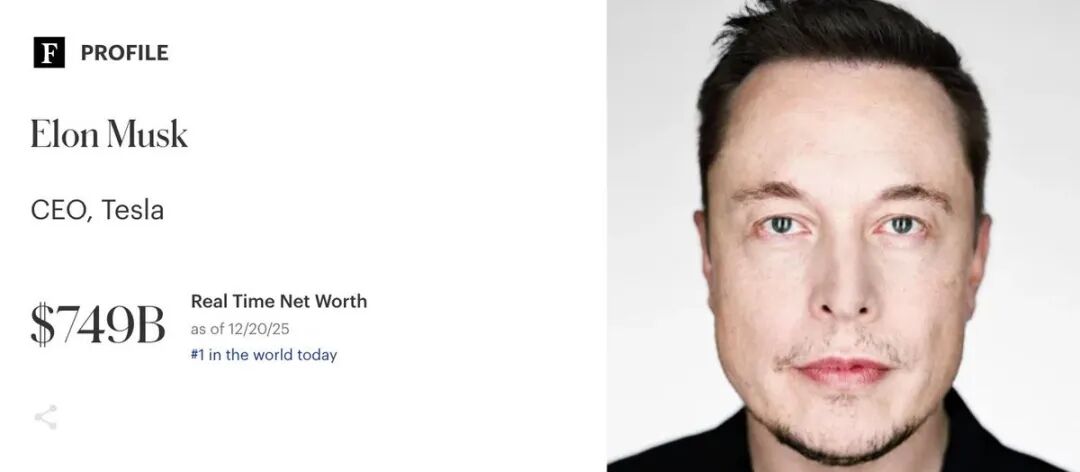
Core Insights - Elon Musk's wealth surged to $749 billion following a Delaware court ruling that validated a batch of Tesla stock options worth over $100 billion, placing him significantly ahead of Google's co-founder Larry Page by nearly $500 billion [1] - The potential for Musk to become the world's first trillionaire is increasingly linked to SpaceX, which is rumored to be planning an IPO next year, aiming to raise over $30 billion and achieve a valuation of $1.5 trillion, surpassing Saudi Aramco's record IPO [3][5] Group 1: SpaceX's Business Model and Revenue Streams - SpaceX is not merely a rocket company; it has diversified its revenue streams, with projections indicating total revenue of approximately $18.2 billion by 2025, of which $12.8 billion (70.3%) will come from the Starlink business [6][7] - Starlink has become the backbone of SpaceX's valuation, with Morgan Stanley estimating that 70% of SpaceX's current valuation is derived from anticipated future revenues from Starlink [7] - As of 2025, Starlink is expected to have around 9,300 satellites in orbit, making it the largest near-Earth satellite network in history [8] Group 2: Starlink's Growth and Market Potential - Starlink's user base has grown from 900,000 at the end of 2021 to over 8 million currently, covering more than 150 countries and regions [11][12] - The operational model of Starlink involves a network of satellites relaying data, which enhances user experience and revenue potential, creating a self-reinforcing cycle of growth [13] - Starlink's acquisition of over $17 billion in wireless spectrum licenses and its partnership with T-Mobile for direct satellite-to-phone connectivity could transform it into a global telecommunications operator [16][18] Group 3: Rocket Launch Business as a Cost Lever - SpaceX's rocket launch business, projected to generate $5.1 billion (28% of total revenue) by 2025, plays a crucial role in supporting Starlink's expansion by reducing launch costs through reusable technology [19][22] - In 2024, SpaceX completed 138 launch missions, with 90 of those dedicated to Starlink, demonstrating a closed-loop system that allows for cost control and operational efficiency [22] Group 4: Future Aspirations and Challenges - Musk's vision includes the ambitious concept of "space AI computing," which aims to leverage the unique conditions of space for cost-effective AI training and processing [25][27] - The potential for space-based data centers could generate significant revenue, with estimates suggesting annual revenues of $80-120 billion by 2030 from this segment alone [25][27] Group 5: Competitive Landscape and Market Dynamics - The commercial space sector is becoming increasingly competitive, with established players and new entrants vying for market share, including Blue Origin, which emphasizes reliability over speed [50][53] - China's rapid advancements in commercial space capabilities, including the successful launch of reusable rockets, pose a significant challenge to SpaceX's market dominance [60][62] - The evolving landscape of space infrastructure is attracting interest from tech giants, indicating that the competition will not be limited to traditional aerospace companies [62][64]
全球首富榜揭晓:美首富造火箭,俄首富搞天然气,中国首富在干啥
Sou Hu Cai Jing· 2025-12-20 00:15
Group 1: Wealth Rankings and Key Figures - Elon Musk remains the world's richest person in 2025 with a net worth of $342 billion, largely driven by Tesla's stock price and SpaceX's valuation exceeding $200 billion [1][5][9] - Mukesh Ambani, India's richest man, has built a significant fortune through Reliance Industries, focusing on oil, petrochemicals, and telecommunications, capturing half of India's mobile users [13][16][18] - Russian billionaire Vagit Alekperov has amassed wealth through the oil and gas sector, specifically with Lukoil, despite ongoing geopolitical tensions and sanctions [20][22][24] - China's richest man, Zhong Shanshan, has a projected net worth of $77.1 billion in 2025, primarily from his bottled water company Nongfu Spring and vaccine producer Wantai [26][28][34] Group 2: Business Strategies and Innovations - Musk's approach involves high-risk ventures, such as SpaceX's reusable rockets and the Starlink satellite project, which aims to provide internet access to remote areas [9][11] - Ambani's strategy includes aggressive market penetration in telecommunications and diversification into renewable energy and digital services [18][20] - Alekperov's Lukoil continues to navigate sanctions by finding alternative markets for oil exports, demonstrating resilience in a resource-dependent economy [22][24] - Zhong's dual focus on everyday consumer goods and high-demand medical products illustrates a balanced business model that mitigates volatility [36][34] Group 3: Emerging Trends in Wealth Creation - The 2024 global wealth landscape is evolving, with traditional tech billionaires still prominent, while new entrants from entertainment and sports are emerging [38][40] - Female billionaires remain underrepresented, comprising only about 10% of the total, highlighting ongoing disparities in opportunities [40][42] - The next wave of wealth creation is expected to come from individuals who can excel in seemingly ordinary sectors, emphasizing innovation and uniqueness [43]
