存款流失

Search documents
存款流失假象背后:权益投资需构筑“吸引力前提”
Xin Lang Cai Jing· 2026-02-12 00:07
Core Viewpoint - The central bank has explored the impact of deposit changes on overall liquidity in its monetary policy report, indicating that a significant portion of deposits flowing into asset management products eventually returns to the banks' balance sheets, resulting in limited impact on overall liquidity [1][2]. Group 1: Deposit Trends and Asset Management - By 2025, asset management products are expected to raise funds of 4 trillion yuan from households and 1 trillion yuan from non-financial enterprises, with deposits and certificates of deposit accounting for 4.6 trillion yuan, or 50% of the new underlying assets in these products [3]. - Although deposits appear to be "moving" to asset management products for higher returns, a large portion of these funds returns to banks in the form of deposits with non-bank financial institutions, reflecting a demand for safety and stable returns among residents and enterprises [3][4]. - The investment strategies of asset management institutions are highly homogeneous, with new assets primarily concentrated in interbank deposits or certificates of deposit, indicating limited investment options [3]. Group 2: Future Interest Rates and Investment Trends - Interest rates in China are expected to remain low in the near term, with a predominant trend of switching financial asset allocations between deposits and fixed-income asset management products [4]. - In the long term, the substantial wealth accumulated by residents and enterprises necessitates a broader range of asset categories for investment, with a trend towards reallocating funds from debt assets to equity assets [4]. - A stable capital market is essential to attract more ordinary investors and gradually shift their risk preferences, highlighting the need for mechanisms that enhance the inherent stability of the capital market to promote healthy development [4].
中国银行_存款流失_规模几何_流向何方_是否持续-China Banks_ Deposit outflow_ how much_ to where_ will it continue_
2026-02-02 02:22
Summary of Key Points from the Conference Call Industry Overview - **Industry**: Chinese Banking Sector - **Context**: The report discusses the implications of significant deposit maturities in 2026 and the potential outflow of deposits from banks to financial investments. Core Insights and Arguments 1. **Deposit Growth and Outflow Concerns**: Chinese households accumulated approximately Rmb8 trillion in excess savings from 2020 to 2025, leading to a retail deposit growth of Rmb17 trillion per year in 2022-2023. Concerns have risen regarding the potential unwinding of this deposit growth in 2026 due to a large volume of maturing deposits and reduced attractiveness of time deposit rates after several cuts since 2022 [2][3][4]. 2. **Maturity Cycle Peak**: 2026 is expected to be the peak year for maturing deposits, with an estimated Rmb55-60 trillion (about 18% of total deposits) set to mature. This concentration of longer-tenor deposits will create significant outflow pressure [3][9]. 3. **Limited Impact on Consumption**: Despite the accumulation of excess savings, consumer sentiment remains cautious, leading to limited spending. Most maturing deposits are expected to be rolled over into new time deposits rather than being used for consumption [4][12]. 4. **Reallocation to Financial Investments**: It is estimated that Rmb2-4 trillion of maturing deposits may migrate into various financial products, including WMPs (Rmb600 billion-1.3 trillion), mutual funds (Rmb300-600 billion), equities (Rmb400-800 billion), and insurance products (Rmb200-500 billion) [11]. 5. **Implications for Banks**: The maturity wave is projected to lower overall funding costs by approximately 14 basis points due to the repricing of high-rate deposits. This could enhance fee income generation for banks, although outflow risks remain a concern, particularly for banks with high loan-to-deposit ratios [5][13]. 6. **Stock Performance Outlook**: Despite the positive effects of deposit repricing, bank stocks may continue to underperform in a strong equity market due to moderate profit growth expectations and sector rotation pressures. High dividend yield banks and those with fast growth and high ROE are viewed favorably [5][14]. Additional Important Insights 1. **Household Saving Rates**: The household saving rate averaged 33% during 2020-2022 and 32% during 2023-2025, higher than the pre-COVID normal of around 30%. This indicates a significant accumulation of excess savings during the pandemic [7]. 2. **Regulatory and Market Factors**: Regulatory tightening and financial market turmoil have contributed to a shift in asset allocation from investments in WMPs and equities to bank deposits, as banks offered more attractive time deposit rates [8]. 3. **Future Consumption Growth**: The report anticipates modest household consumption growth in 2026, with limited release of excess savings for consumption purposes due to ongoing cautious sentiment [12]. 4. **Deposit Rate Cuts**: Following seven rounds of rate cuts since April 2022, demand deposit rates have fallen significantly, which may lead to increased outflow pressure in 2026 as higher-rate deposits reprice to current lower levels [10]. 5. **Long-term Outlook**: The report suggests that while the banking sector may face challenges, the overall impact of deposit maturities will be manageable, and banks with strong fundamentals may still perform well in the medium term [5][14].

多家银行下调存款利率!
Zheng Quan Shi Bao· 2025-09-26 09:11
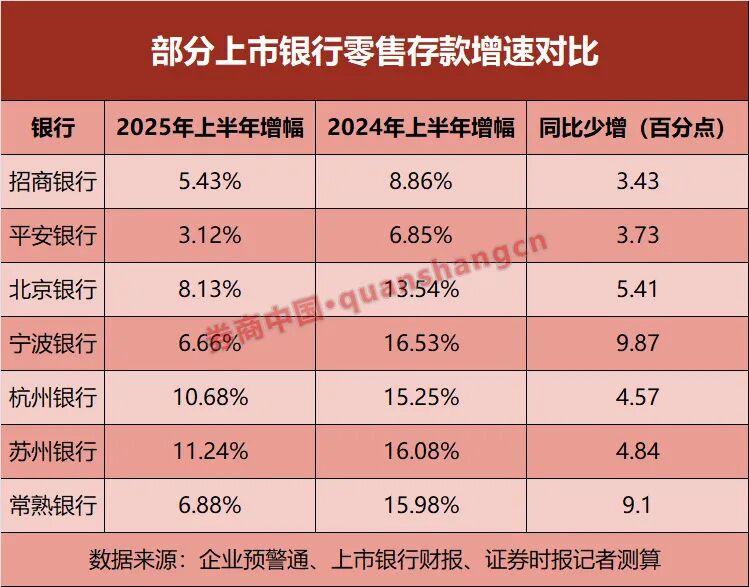
Group 1 - Local small and medium-sized banks are continuously lowering deposit interest rates, with some banks announcing reductions of up to 35 basis points [1][2] - The recent trend of lowering deposit rates is a response to the pressure on net interest margins and follows similar actions taken by larger national banks earlier this year [2][3] - Retail deposit outflows have been significant, prompting banks to focus on wealth management strategies to mitigate the negative impact of declining deposits [1][4] Group 2 - The downward pressure on deposit rates is expected to continue, and banks need to diversify their products and services to enhance competitiveness [3] - Retail deposit growth has slowed for several banks, indicating increased pressure on retail liabilities [5][6] - Specific banks, such as China Merchants Bank and Ping An Bank, have reported significant declines in retail deposit growth compared to the previous year [6][7] Group 3 - In response to declining retail deposits, banks are expanding their wealth management offerings, with a focus on cash management and investment products [8] - The recent bull market in capital markets has led to increased sales of equity funds and other investment products by banks [8] - The "fixed income plus" products are seen as a new avenue for banks to attract deposits in a low-interest-rate environment [8]

浙商银行收到巨额罚单背后:去年下半年存款流失了
Xin Lang Cai Jing· 2025-04-01 04:41
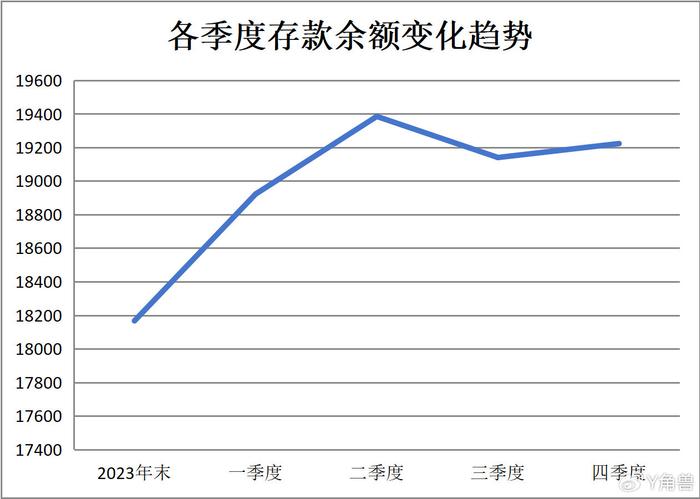
Core Viewpoint - Zhejiang Commercial Bank is facing scrutiny due to multiple regulatory violations related to deposit and loan management, raising concerns about its ability to attract deposits amid increasing competition in the banking sector [1][2][4]. Regulatory Violations - Zhejiang Commercial Bank's Shanghai branch was fined 16.8 million yuan for 15 violations, including inflating deposit figures and improper credit card management [1]. - The Chongqing branch was fined 1.7 million yuan for similar issues, including increasing corporate financing costs through disguised "deposit-loan linkage" practices [2]. Deposit Challenges - The bank's deposit growth has been under pressure, with a reported increase of only 8.297 billion yuan in the fourth quarter of 2024, and a decline in deposits compared to the first half of the year [4][5]. - As of September 30, 2024, the bank's total deposits were 19,139.92 billion yuan, reflecting a 2.43% increase year-on-year but a decrease of 24.487 billion yuan from the previous quarter [2]. Comparison with Peers - In contrast, other banks like Pudong Development Bank and Minsheng Bank reported significant deposit growth, with Pudong adding 213.229 billion yuan in a single quarter [4]. - The overall banking sector saw a substantial increase in deposits, exceeding 16.62 trillion yuan in the third quarter of 2024, highlighting Zhejiang Commercial Bank's struggles [4]. Internal Management Issues - The bank's management has faced significant changes, including the resignation of its president, which may have contributed to the decline in deposit levels [6][7]. - The bank's credit risk is rising, with overdue loans increasing by 20.6% year-on-year, and a decrease in the provision coverage ratio to 178.67%, the lowest in three years [8][10]. Financial Performance - As of December 31, 2024, the bank's overdue loans reached 391 billion yuan, a 40.77% increase from the previous year, indicating challenges in loan management [10]. - The bank's non-performing loan ratio increased to 1.42%, reflecting ongoing difficulties in maintaining loan quality [10].