孝亲文化

Search documents
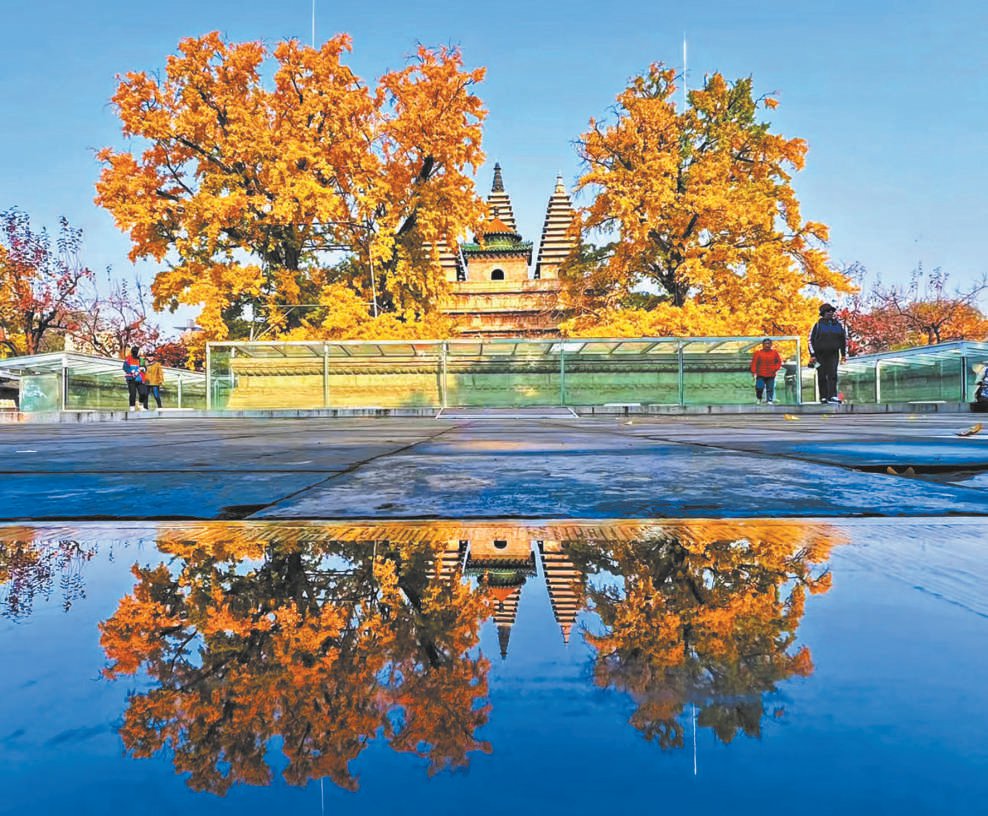
真觉寺古银杏:五百岁的时光印记
Bei Jing Ri Bao Ke Hu Duan· 2025-11-12 22:05
Core Viewpoint - The ancient ginkgo trees at Zhenjue Temple, recognized for their historical and cultural significance, have been included in the first batch of "National Key Protection Units: Ancient Trees and Famous Trees" collaborative protection list, highlighting the highest level of national recognition and importance [1][11]. Summary by Sections Historical Significance - The two ancient ginkgo trees, approximately 500 years old, were planted during the Ming Dynasty when the temple was established, making them contemporaneous with the Vajra Throne Pagoda completed in 1473 [4][5]. - The ginkgo trees symbolize the temple's historical narrative, having survived various periods of decline and destruction, including the late Qing Dynasty and the Republic of China era [5][11]. Architectural Context - The Vajra Throne Pagoda is noted for its exquisite design, combining Indian architectural elements with traditional Chinese features, and is considered one of the most beautiful existing examples of this style in China [5][6]. - The unique positioning of the ginkgo trees in front of the pagoda distinguishes them from other ancient trees in Beijing's temples, which typically grow around the main halls [3][4]. Cultural Heritage - The ginkgo trees have become a living testament to the cultural and artistic heritage of the region, reflecting the intertwining of Buddhist traditions and royal patronage, particularly during the Qing Dynasty [6][8]. - The trees are associated with significant historical events, such as the renovations ordered by Emperor Qianlong to celebrate his mother's birthday, which elevated the temple's status and architectural grandeur [7][8]. Literary Connection - The ginkgo trees have inspired literary works, including poems by notable figures like Hong Liangji, which document their beauty and significance within the temple's landscape [9][10]. - The connection between the trees and the artistic endeavors of the Qing Dynasty, particularly the calligraphy of Prince Yongxing, further emphasizes their cultural importance [10][11].

用孝道连接全球华人 2025旺旺孝亲奖在长沙颁奖
Zhong Guo Xin Wen Wang· 2025-10-29 12:46
Core Points - The 2025 Wangwang Filial Piety Award ceremony was held in Changsha, Hunan, on October 29, awarding a total of 120 prizes [1][3][5] - The event aims to promote filial piety culture within the Chinese community, receiving nearly 7,500 entries for the competition [1][3] - The awards included 10 Filial Piety Models, 10 Most Touching Short Videos, and 100 Best Popular Short Videos [1][3] Group 1 - The Wangwang Filial Piety Award has been held since 2016, focusing on promoting filial piety culture through various forms such as music and storytelling [3][5] - The event has attracted widespread participation from both sides of the Taiwan Strait and overseas Chinese communities, enhancing cultural exchange and emotional connections among Chinese people [3][5] - The Vice Chairman of Wangwang Group emphasized the importance of filial piety as a common cultural value to connect Chinese people [5][7] Group 2 - A new "Modern 24 Filial Piety Living Guidelines" was introduced to encourage the public to practice filial piety in daily life [7] - Wangwang Group plans to expand the Filial Piety Award to more cities, aiming to transform the initiative into actionable practices [7]