学术话语权

Search documents
瞭望 | 自主预印本平台增强学术话语权
Xin Hua She· 2026-01-19 08:21
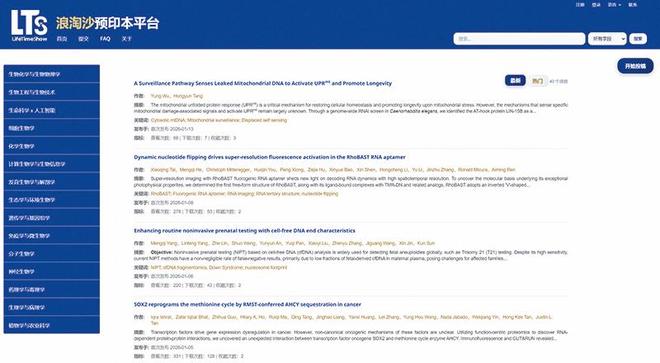
Core Viewpoint - The launch of the domestic preprint platform "Langtaosha" marks a significant step for China's life sciences sector, enabling independent and secure management of research data and academic dissemination, while addressing the challenges posed by international publication systems [1][2]. Group 1: Platform Overview - "Langtaosha" is a preprint platform developed collaboratively by Shenzhen Medical Academy, Shenzhen Bay Laboratory, Tsinghua University, and Westlake University, aimed at enhancing the efficiency and safety of academic communication in China [1][2]. - The platform allows researchers to publish their findings without incurring publication fees, contrasting with the traditional Open Access (OA) model that often requires authors to pay article processing charges (APC) [2][3]. Group 2: Market Context - The global academic publishing market is predominantly controlled by developed countries, with major players like Elsevier and Springer dominating the landscape, leading to over 90% of SCIE papers from Chinese scientists being published in foreign journals [2][3]. - In 2023, Chinese authors paid a total of $750 million in APCs, reflecting a 23% annual growth rate, which highlights the financial burden on researchers and the need for alternative publishing avenues [3]. Group 3: Benefits of Preprint Platforms - Preprint platforms like "Langtaosha" facilitate rapid dissemination of research findings, allowing for immediate feedback and collaboration across disciplines, thus enhancing the overall quality and impact of research [4][5]. - The introduction of blockchain technology in "Langtaosha" ensures transparency and traceability of research records, which is crucial for maintaining academic integrity and prioritizing original contributions [4]. Group 4: Future Development and Recommendations - Experts suggest that the development of preprint platforms in China is still in its exploratory phase and requires improved top-level design, institutional norms, and academic evaluation systems to support high-level scientific independence [6][7]. - Recommendations include establishing a national certification system for preprint platforms, defining qualification criteria, and integrating preprints into existing research management frameworks to enhance their credibility and acceptance [6][7].