
学校家庭社会协同育人

Search documents
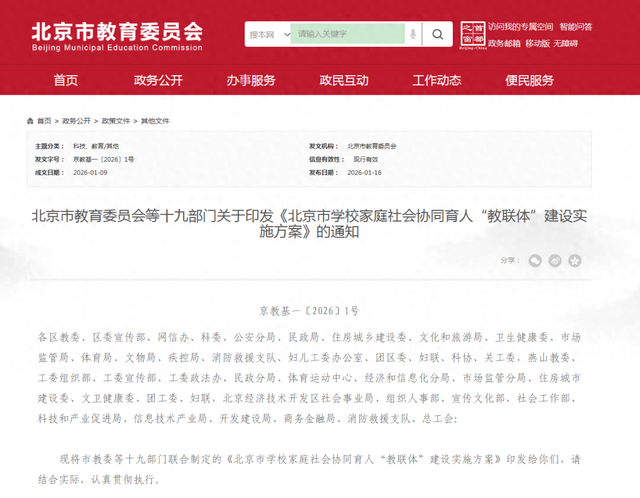
北京将推动高校博物馆向中小学生开放
Bei Jing Shang Bao· 2026-01-20 04:28
Core Viewpoint - The Beijing Municipal Education Commission, along with nineteen other departments, has developed an implementation plan aimed at establishing a collaborative education framework by 2026, focusing on the holistic development of students' physical and mental health [1] Group 1: Implementation Plan - The plan aims to create a "Teaching Alliance" in all districts of Beijing that meets high standards and reflects the characteristics of the capital [1] - It emphasizes the integration of various stakeholders and resources related to student health and safety, utilizing joint responsibilities, resources, and spaces, along with artificial intelligence to address key issues in student development [1] Group 2: Educational Resources and Curriculum - The plan will leverage Beijing's cultural resources, including ancient, revolutionary, local, and innovative cultures, to support the development of immersive and experiential educational courses through public service institutions like museums and libraries [1] - It encourages the opening of university museums and key laboratories to middle and primary school students, aiming to establish a high-quality social classroom and research curriculum system [1]
新方案发布!推动高校博物馆向中小学生开放
Bei Jing Ri Bao Ke Hu Duan· 2026-01-20 00:40
Core Viewpoint - The Beijing Municipal Education Commission and nineteen other departments have jointly developed the "Implementation Plan for the Construction of School-Family-Society Collaborative Education 'Teaching Alliance'" aiming to establish a collaborative education system by 2026 that serves the comprehensive growth of students' physical and mental health [1][15]. Group 1: Objectives and Framework - By 2026, a collaborative education system will be established across all districts in Beijing, focusing on the healthy and happy growth of primary and secondary school students, integrating various resources and responsibilities related to student health and safety [16]. - The plan emphasizes the integration of responsibilities, resources, and spaces, leveraging artificial intelligence to address prominent issues in student development [16]. Group 2: Major Tasks Gathering Social Resources - The plan aims to utilize Beijing's cultural resources to support the development of immersive and experiential educational courses in public service institutions like museums and libraries [4][17]. - It promotes the opening of university museums and laboratories to primary and secondary school students, creating a high-quality social classroom and research curriculum system [5][17]. - The initiative seeks to enhance physical education by integrating sports venues and professional coaches into school activities, promoting innovative sports events that combine cultural transmission and family interaction [18]. Building Consensus Between Home and School - The plan includes optimizing the operation of parent committees and establishing regular communication channels between schools and families to enhance parental involvement in school management [19]. - It introduces a new mechanism for parent meetings and home visits, focusing on key periods such as the start of the school year and exam weeks to provide targeted support for families [20]. Advancing Intelligent Empowerment - The initiative will create a comprehensive intelligent support system for family education, providing 24/7 personalized professional assistance focused on students' health [10][22]. - It aims to develop a digital resource mapping system to connect families with nearby educational resources, facilitating easy access to educational services [10][22]. Group 3: Implementation and Support - The plan calls for strengthening organizational support by including the "Teaching Alliance" construction in the agenda of local education committees, ensuring resource allocation and policy support [23]. - It emphasizes the need for professional support through research and training in collaborative education practices, integrating these capabilities into teacher training programs [23].

为未成年人营造良好成长环境
Jing Ji Ri Bao· 2025-12-25 22:30
Group 1 - The core viewpoint emphasizes the importance of moral education for minors as a strategic and foundational task for national development and rejuvenation [1] - The implementation of Xi Jinping's Thought on Socialism with Chinese Characteristics for a New Era is crucial for guiding youth to establish lofty ideals and take on responsibilities [1] - The article highlights the need for a collaborative effort among various levels of government and organizations to create a conducive environment for the healthy growth of minors [1] Group 2 - Establishing a collaborative education mechanism among schools, families, and society is essential for the comprehensive development and healthy growth of minors [2] - Schools, families, and society must work together to create a high-quality education system that focuses on the moral education of minors [2] - The article stresses the importance of nurturing minors with excellent cultural products and services to shape their values and cultural identity [2]