宇宙学研究

Search documents
氘核及其反物质粒子形成之谜被揭示
Ke Ji Ri Bao· 2025-12-31 03:14
Core Insights - Scientists from the Technical University of Munich and other institutions have revealed the formation secrets of deuterons and their antimatter particles using the Large Hadron Collider (LHC) [1][2] - The research indicates that these fragile atomic nuclei did not originate from the chaotic state of the Big Bang but rather from the decay of "short-lived" high-energy particles within a cooling "fireball" [1][2] - This advancement marks a significant step towards a deeper understanding of the strong nuclear force [1][3] Group 1 - The strong nuclear force is one of the four fundamental forces of nature, responsible for binding protons and neutrons within atomic nuclei [2] - At the LHC, protons collide at nearly the speed of light, recreating extreme conditions similar to those shortly after the Big Bang, allowing scientists to explore the essence of matter at a microscopic level [2] - The latest research from the ALICE experiment at the LHC discovered that the decay of extremely short-lived high-energy particles releases protons and neutrons necessary for forming deuterons [2] Group 2 - Approximately 90% of the observed (anti)deuterons originate from this newly discovered process rather than surviving from the initial moments of the Big Bang [2] - The ALICE experiment functions like a giant camera, capable of tracking and reconstructing up to 2000 particles produced in a single collision, enabling scientists to recreate early cosmic conditions [2] - This discovery has profound implications for fundamental nuclear physics research, enhancing the understanding of the strong nuclear force and expanding the horizons of cosmological studies [3]
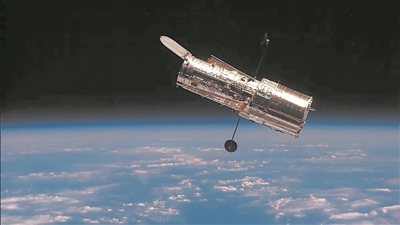
超期服役的哈勃望远镜再续传奇
Ke Ji Ri Bao· 2025-05-19 22:30
Core Viewpoint - NASA celebrates the 35th anniversary of the Hubble Space Telescope, highlighting its significant contributions to space science and its ongoing relevance despite plans for a successor [4][6]. Group 1: Hubble's Achievements - Hubble has transformed human understanding of the universe, providing vivid images and numerous scientific breakthroughs since its launch in 1990 [4]. - The telescope has conducted nearly 1.7 million observations of approximately 55,000 astronomical targets, leading to over 22,000 published papers with more than 1.3 million citations [8]. - Hubble's unique ability to capture ultraviolet light allows it to observe celestial phenomena that ground-based telescopes cannot, achieving ten times the clarity of traditional ground-based observations [7]. Group 2: Current Status and Popularity - Despite being operational for 35 years, Hubble remains one of the most sought-after astronomical instruments, with the number of scientists applying for observation time being six times greater than the available slots [8]. - Hubble's data archive exceeds 400 terabytes, showcasing its extensive contributions to astronomical research [8]. Group 3: Future Considerations - Hubble is currently beyond its intended operational lifespan, with the last maintenance mission conducted 16 years ago, raising concerns about its future viability [9]. - NASA faces budget constraints, with funding expected to decrease significantly, complicating any potential maintenance or operational extension for Hubble [10].