
家校合作

Search documents
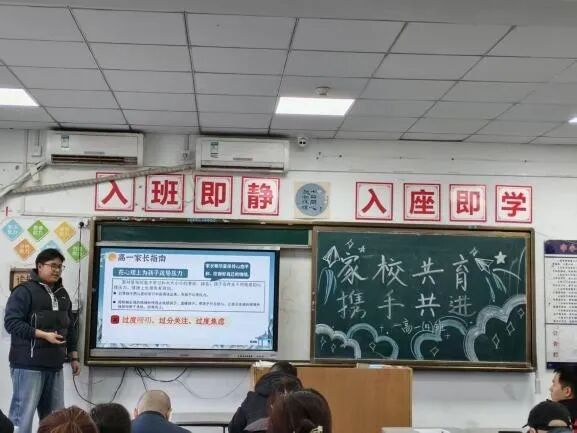
凝心聚力话成长 家校携手启新程丨西安思源中学召开期末家长会
Xin Lang Cai Jing· 2026-02-09 10:02
Group 1 - The core idea of the article is to summarize the outcomes of the semester and provide guidance for the upcoming winter vacation through a parent-teacher meeting held on February 7, 2026 [1] - The meeting was hosted by class teachers and aimed to strengthen communication between home and school, discussing children's growth and educational strategies [1] - Class teachers provided a comprehensive review of class management effectiveness, teaching progress, and overall student performance during the semester [1] Group 2 - The semester focused on the core value of moral education, emphasizing the three main goals of habit formation, knowledge acquisition, and skill enhancement [11] - A positive learning atmosphere was cultivated, leading to significant improvements in students' classroom engagement and assignment quality [11] - The final exam results showed a steady increase in average scores and excellence rates across most subjects, indicating a solid performance from middle-tier students and a competitive edge from top students [13][14] Group 3 - The winter vacation is identified as a crucial period for self-improvement and developing good study habits, with specific recommendations for parents to assist their children in creating a detailed study plan [17] - Students are encouraged to focus on weak subjects and knowledge points identified in their final exam results, with tailored study strategies for subjects like Chinese, Mathematics, and English [18] - Emphasis is placed on cultivating good habits and ensuring overall development, including physical health, family responsibilities, and cultural engagement [19] Group 4 - Safety and health are highlighted as priorities during the winter vacation, with guidelines for parents to ensure their children's well-being [20] - The article underscores the importance of collaboration between home and school in supporting children's growth and development [20] - Appreciation is expressed to parents for their support and cooperation throughout the semester, with wishes for a meaningful winter vacation and success in the new semester [20]

家长不是校门口的“编外保安”
Xin Lang Cai Jing· 2026-01-10 09:09
Group 1 - The concept of "parent duty at school gates" has sparked significant debate, with reports of parents hiring others to fulfill this role for a fee, indicating a shift from voluntary service to a mandatory task [2] - In some regions, the responsibility of maintaining order at school gates has become linked to school performance evaluations, effectively transferring the responsibility from professional safety personnel to parents [3] - The article argues that while parental involvement in education is important, it should not lead to additional burdens on parents, and that the primary responsibility for safety should lie with schools, communities, and law enforcement [3] Group 2 - The lack of training and proper equipment for parents assigned to these duties raises concerns about their effectiveness in emergency situations [2] - The article suggests that instead of relying on parents, schools should focus on improving traffic management and increasing professional security presence to ensure children's safety [3] - The current approach is criticized as a form of formalism, where the educational ecosystem is burdened by unnecessary responsibilities placed on parents, detracting from the core educational mission [3]

家校联系卡要求填写“家长可提供的社会资源”,一小学致歉并收回相关要求,教育须摈弃功利回归初心
Mei Ri Jing Ji Xin Wen· 2025-11-15 14:02
Core Viewpoint - The recent requirement from Changzheng Primary School in Xinzhou, Shanxi Province, for parents to disclose their social resources on a home-school contact card has sparked widespread controversy, leading to an apology and retraction from the school. The core issue is that the collaboration between home and school should focus on supporting children's growth rather than becoming a "resource exchange" [1][2]. Group 1: Education Principles - The principle of "education without class distinction" has been a fundamental value in Chinese education for over two thousand years, and linking education to parents' social resources contradicts this principle [2]. - The practice of assessing parents' resources can create a hierarchy among families, leading to feelings of inferiority among those with fewer resources, which undermines the concept of equality in education [2][3]. Group 2: Home-School Cooperation - Effective home-school cooperation should be based on equal, voluntary contributions focused on children's needs, such as parents sharing their skills in reading or sports, rather than on their social resources [3]. - The requirement to disclose social resources transforms the nature of home-school relationships into a competition over resources, which detracts from the original intent of fostering collaboration [3][4]. Group 3: Trends in Education - There has been a growing trend of schools conducting "resource surveys" to gather information about parents' social resources, which can lead to a commodification of education and a focus on profit rather than nurturing children's potential [4]. - The shift towards a buyer's market in education, due to declining birth rates, suggests that schools that continue to prioritize resource extraction from parents may face obsolescence [4]. Group 4: Educational Values - Education is fundamentally about nurturing talent and character, and schools should adhere to their educational mission by avoiding short-sighted, profit-driven behaviors [5]. - Upholding the principle of "education without class distinction" is essential for achieving true educational equity and developing well-rounded individuals for the future [5].
