
对村巡察工作

Search documents
马上评|从春晚小品《又来了》,看对村巡察如何见效
Xin Lang Cai Jing· 2026-02-17 13:16
Core Viewpoint - The skit "Here We Go Again" from the 2026 CCTV Spring Festival Gala critiques bureaucratic formalism and highlights the challenges faced by grassroots workers, particularly in the context of policy implementation and local governance [1][2]. Group 1: Critique of Bureaucratic Practices - The skit portrays three types of bureaucratic officials: "template-type" officials who focus on report aesthetics rather than real issues, "cross-border" officials who apply irrelevant experiences, and "pass-the-buck" officials who evade responsibility [1][2]. - These officials treat their roles as temporary, failing to address the real problems faced by the community, which leads to ineffective policy implementation [2][3]. Group 2: Emphasis on Effective Supervision - The Central Committee's recent document emphasizes the need for effective supervision of grassroots issues, focusing on the implementation of central policies, addressing corruption, and ensuring the political and organizational functions of village party organizations are fulfilled [2][3]. - The document outlines four key areas for supervision, including the implementation of central decisions in rural areas and addressing local corruption and misconduct [2][3]. Group 3: Importance of Ground-Level Engagement - Effective engagement requires officials to directly interact with local issues, moving beyond superficial assessments to understand the real challenges faced by individuals like the character "Old Wang" [4][5]. - The document stresses the need for actionable outcomes from inspections, ensuring that issues are resolved in a timely manner and that there is clear accountability for addressing community concerns [4][5]. Group 4: Societal Reflection and Expectations - The popularity of the skit reflects public frustration with bureaucratic inefficiency and a strong desire for genuine engagement and problem-solving from officials [5]. - The issuance of the document on strengthening village inspections is seen as a potential tool for addressing persistent governance issues at the grassroots level [5].
加强对村巡察工作打出“组合拳” 多举措做好“后半篇文章”提升百姓获得感
Yang Shi Wang· 2026-01-24 03:57
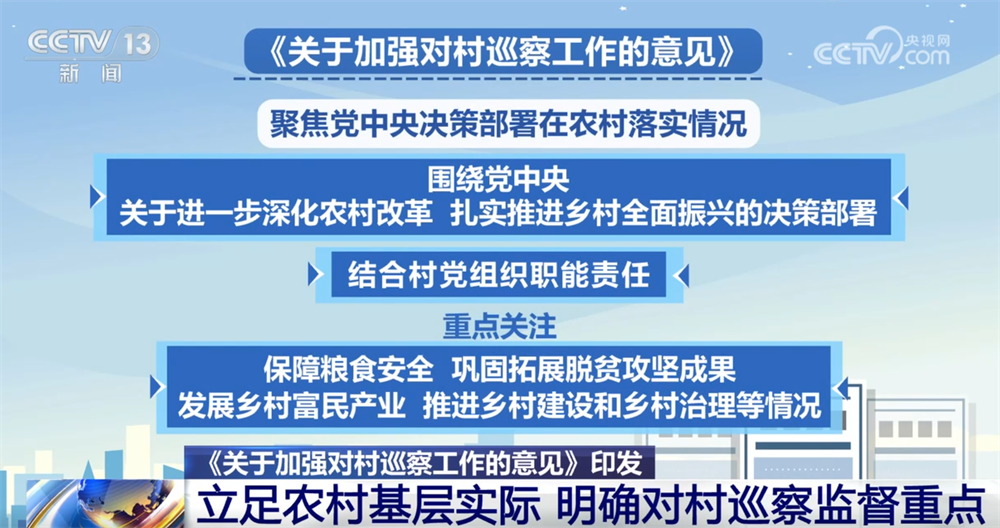
Core Viewpoint - The Central Committee of the Communist Party of China has issued guidelines to strengthen village inspection work, focusing on enhancing supervision to address grassroots issues and concerns of the public [1] Group 1: Supervision Focus Areas - Emphasis on the implementation of the Central Committee's decisions in rural areas, particularly regarding food security, poverty alleviation, rural industry development, and governance [1] - Attention to corruption and misconduct affecting rural communities, including the management of agricultural subsidies and public service projects [3] - Focus on the political and organizational functions of village party organizations, including the responsibilities of village party secretaries and the construction of party member teams [5] Group 2: Rectification and Results Utilization - Clear requirements for rectification and results utilization, emphasizing accountability at the county level for addressing issues identified during inspections [9] - The need for public disclosure of rectification efforts and the establishment of mechanisms for community participation in evaluation [10] - Systematic rectification of common issues identified during inspections through various methods, including rule-making and targeted clean-up efforts [11] Group 3: Efficiency in Rectification - The importance of setting realistic deadlines for rectification to avoid delays or ineffective resolutions, ensuring thorough problem-solving [12]

强化对村巡察 促进解决基层问题和群众身边问题——中央巡视工作领导小组办公室负责人就《关于加强对村巡察工作的意见》答记者问
Zhong Yang Ji Wei Guo Jia Jian Wei Wang Zhan· 2026-01-23 07:51
Core Viewpoint - The Central Committee of the Communist Party of China has issued the "Opinions on Strengthening Village Inspection Work," emphasizing the importance of enhancing inspection at the village level to address grassroots issues and consolidate the Party's governance foundation [2][3]. Group 1: Background and Significance - The issuance of the "Opinions" is a response to the need for improved inspection mechanisms at the village level, as highlighted by the central leadership's focus on grassroots governance and rural revitalization [2]. - The "Opinions" aim to facilitate the implementation of the Party's directives regarding inspection work, addressing existing challenges and promoting high-quality development in village inspections [2]. Group 2: Overall Considerations in Drafting the Opinions - The drafting process combined problem-oriented and goal-oriented approaches, emphasizing political requirements and practical applicability [3]. - Key aspects include highlighting political demands, summarizing practical experiences, clarifying regulatory subjects, maintaining a problem-oriented focus, and considering local realities [3]. Group 3: Supervision Focus of Village Inspections - The "Opinions" outline specific supervision focuses, including the implementation of central policies in rural areas, addressing corruption and misconduct, evaluating the political and organizational functions of village Party organizations, and monitoring the effectiveness of inspection rectifications [4]. Group 4: Classification and Tailored Approaches - The "Opinions" advocate for a classification approach to village inspections, considering factors such as population size, economic development, and local governance challenges [5][6]. - It emphasizes the need for tailored inspection methods based on the unique circumstances of each village, ensuring effective resource allocation [5][6]. Group 5: Innovative Methods and Approaches - The "Opinions" stress the importance of engaging with the community and utilizing various communication methods to gather public opinion and enhance transparency [7]. - It encourages the use of digital tools and data analysis to improve the efficiency and accuracy of inspections [7]. Group 6: Optimizing Inspection Processes - The "Opinions" call for streamlining inspection workflows to reduce the burden on grassroots organizations, focusing on direct engagement with the community [8]. - It suggests simplifying reporting processes and ensuring feedback mechanisms are clear and effective [8]. Group 7: Strengthening Rectification and Follow-up - The "Opinions" emphasize the need for accountability in rectifying issues identified during inspections, with clear responsibilities assigned to various levels of Party organizations [9]. - It highlights the importance of publicizing rectification outcomes and involving the community in evaluation processes [9]. Group 8: Organizational Support and Coordination - The "Opinions" outline requirements for strengthening organizational leadership, enhancing coordination among supervisory bodies, and ensuring adequate staffing for village inspections [10][11]. - It stresses the need for a collaborative approach to integrate various supervisory functions and improve overall inspection effectiveness [10][11]. Group 9: Implementation and Execution - The "Opinions" call for all levels of Party organizations to recognize the significance of village inspections and to actively implement the directives [13]. - It encourages integrating the implementation of the "Opinions" with existing inspection feedback mechanisms and future planning [13].
中央巡视办就《关于加强对村巡察工作的意见》答记者问
Zhong Guo Xin Wen Wang· 2026-01-23 00:48
Core Viewpoint - The Central Committee of the Communist Party of China has issued the "Opinions on Strengthening Village Inspection Work," emphasizing the importance of enhancing inspection at the village level to address grassroots issues and consolidate the Party's governance foundation [2][3]. Group 1: Background and Significance - The issuance of the "Opinions" is a response to the need for improved inspection mechanisms at the village level, as highlighted by the central leadership's focus on grassroots governance and rural revitalization [2]. - The document aims to address existing challenges in village inspections and promote high-quality development in this area [2]. Group 2: Overall Considerations in Drafting the Opinions - The drafting process combined problem-oriented and goal-oriented approaches, emphasizing political requirements and practical applicability [3]. - It aims to summarize effective practices from various regions while ensuring alignment with existing regulations [3]. - The "Opinions" specify the responsibilities of county-level Party organizations and their inspection institutions, while also addressing the need for guidance at provincial and municipal levels [3]. Group 3: Supervision Focus of Village Inspections - The "Opinions" outline key supervision areas, including the implementation of central policies in rural areas, addressing corruption and misconduct, and evaluating the performance of village Party organizations [4]. - Specific attention is given to the management of agricultural subsidies, rural collective assets, and the effectiveness of village governance [4]. Group 4: Classification and Tailored Approaches - The document emphasizes the necessity of classifying villages based on various factors such as population size and governance challenges to tailor inspection methods accordingly [5][6]. - It encourages a flexible approach to inspection organization, allowing for adjustments based on local conditions [6]. Group 5: Innovative Methods for Inspections - The "Opinions" advocate for a people-centered approach, utilizing both traditional and modern communication methods to engage with villagers [7]. - It encourages direct interaction with the community to gather insights and address pressing issues promptly [7]. Group 6: Optimizing Inspection Processes - The document stresses the importance of streamlining inspection workflows to reduce the burden on grassroots organizations [8]. - It calls for a focus on practical engagement with the community rather than excessive documentation and reporting [8]. Group 7: Strengthening Rectification and Follow-up - The "Opinions" highlight the need for clear accountability in addressing issues identified during inspections, with county-level Party organizations bearing primary responsibility [9]. - It emphasizes the importance of publicizing rectification outcomes and involving the community in evaluation processes [9]. Group 8: Organizational Support Requirements - The document outlines the need for enhanced organizational leadership and coordination among various supervisory bodies to ensure effective implementation of village inspections [10][11]. - It calls for the establishment of a talent pool for inspection teams, focusing on training and development for personnel involved in village inspections [11].