小模型优化

Search documents
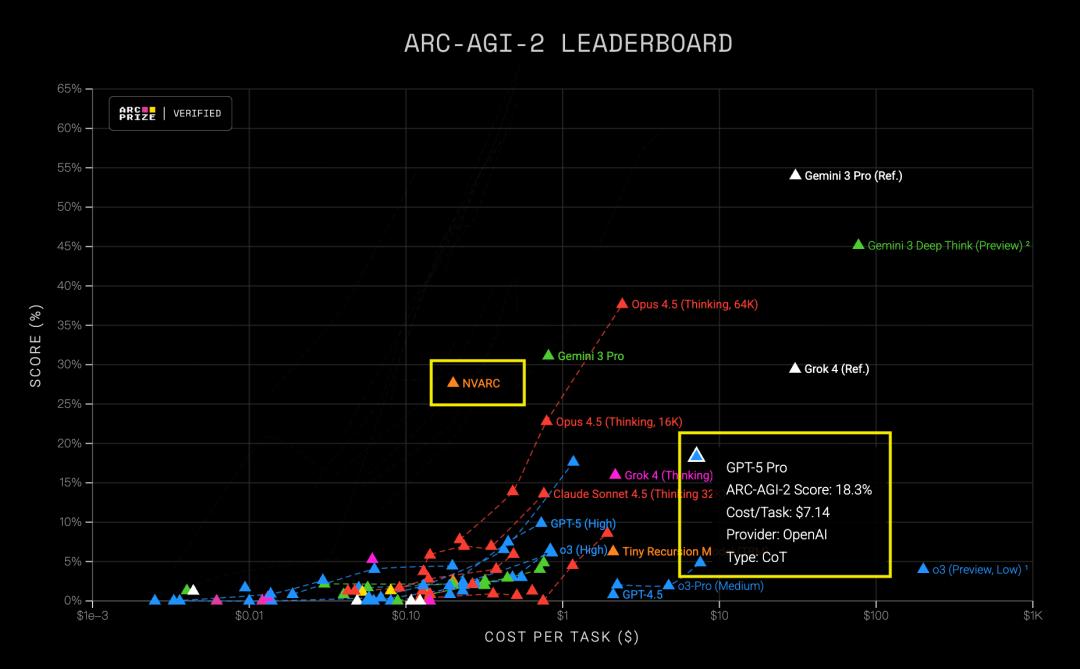
英伟达4B小模型击败GPT-5 Pro,成本仅1/36
3 6 Ke· 2025-12-08 07:23
Core Insights - NVIDIA's small model NVARC achieved a top score of 27.64% in the ARC-AGI 2 competition, outperforming GPT-5 Pro, which scored 18.3% [1][3] - The cost per task for NVARC is approximately $0.20, significantly lower than the over $7 cost per task for GPT-5 Pro, making it a cost-effective solution [1] Group 1: Model Performance - NVARC's success is attributed to its zero pre-training deep learning approach, avoiding biases and data dependencies associated with pre-trained models [3] - The competition utilized a more challenging test that eliminated overlap with public training data, focusing on the model's ability to acquire new skills beyond its training data [3] Group 2: Data and Training Methodology - The NVARC team employed a strategy of transferring complex reasoning tasks to offline synthetic data pipelines, allowing for the training of smaller models that can run efficiently during evaluations [8][10] - A synthetic dataset containing over 3.2 million augmented samples was created, with each sample having up to 7 input/output pairs, ensuring high data quality [11][12] Group 3: Technical Innovations - The core reasoning module of NVARC is based on an improved version of the ARChitects method, utilizing a small parameter model Qwen3-4B and incorporating dialogue templates to simplify problem understanding [14] - Key to NVARC's performance was the implementation of test-time fine-tuning (TTFT) and LoRA fine-tuning techniques, allowing the model to quickly adapt to new problem rules [14][16] Group 4: Strategic Implications - The success of small models like NVARC highlights the potential for targeted optimization in specific domain tasks, demonstrating that smaller models can perform competitively against larger models in certain scenarios [16] - The approach emphasizes the importance of applying the right methods in the right contexts to achieve greater value, suggesting a shift in focus from model size to model agility and adaptability [16]