小比例转让+表决权安排

Search documents
小比例转让+表决权安排,A股控制权交易新玩法密集涌现
Mei Ri Jing Ji Xin Wen· 2025-12-21 04:51
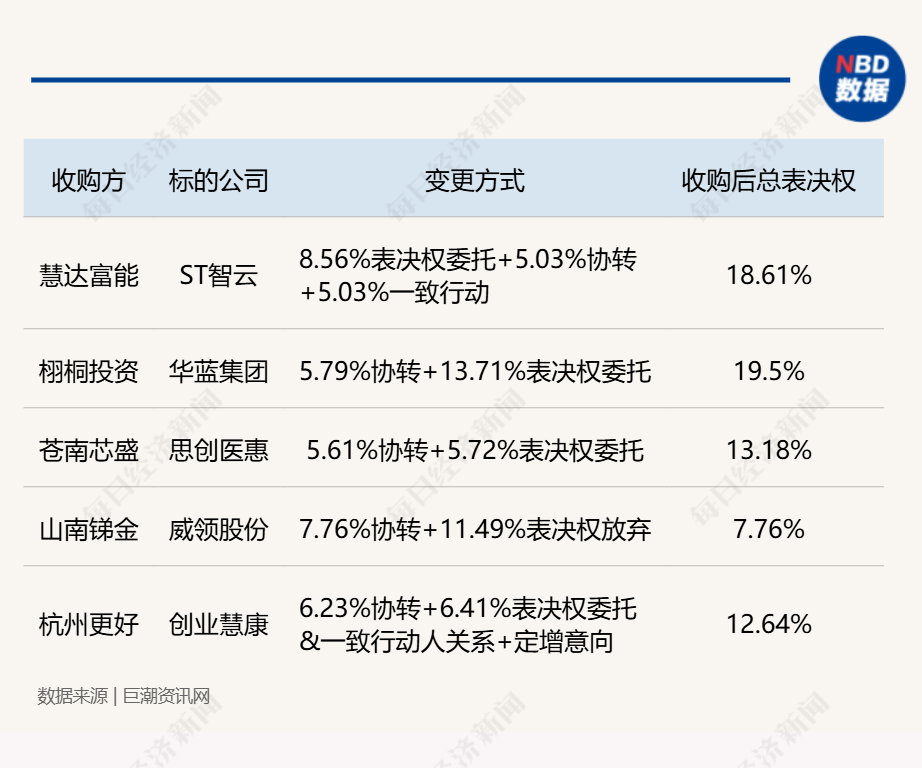
Group 1 - The core viewpoint of the article highlights a new trend in A-share control rights changes, characterized by "small proportion transfer + voting rights arrangement," with five companies announcing such changes since November [1] - The companies involved include Hangzhou Genghao, which acquired control of Chuangye Huikang through a 6.23% equity transfer and a 10.06% voting rights delegation, and Xutong Investment, which took control of Hualan Group via a 5.79% equity transfer and a 13.71% voting rights delegation [1] - This low-cost control model allows acquirers to gain control without holding a high percentage of shares, driven by original controlling shareholders' low shareholding ratios and restrictions on large transfers due to specific conditions [1] Group 2 - The trend is referred to as "small share operation" within the industry, where the acquirer can control the listed company without needing a significant shareholding [1] - Original controlling shareholders aim to maximize profits by selling only a portion of their shares while retaining some, anticipating that the new controlling party will bring in quality industry resources and subsequently increase the stock price for better returns on remaining shares [1]
小比例转让+表决权安排:A股控制权交易新玩法密集涌现,监管新规是否暗藏变数?
Mei Ri Jing Ji Xin Wen· 2025-12-21 03:25
Core Viewpoint - The recent trend of "small proportion transfer + voting rights arrangement" in A-share control changes has gained momentum, allowing acquirers to gain control of companies at a low cost, exemplified by ST Zhiyun's acquisition for 87 million yuan, despite its market value nearing 2 billion yuan [1][2] Group 1: Transaction Characteristics - Five companies have announced control changes through "small proportion transfer + voting rights arrangement" since November, showcasing a high degree of homogeneity in transaction structure, pricing mechanisms, and the nature of the parties involved [2][4] - The acquisition structures typically involve share transfers between 5% and 10%, which meet regulatory requirements while avoiding triggering mandatory takeover bids, thus facilitating low-cost control [4][7] - The pricing mechanism predominantly features discounted transactions, with ST Zhiyun and others selling shares below the market price prior to announcements, reducing financial pressure on acquirers [5][6] Group 2: Financial and Operational Context - The companies involved generally have small to medium market capitalizations, with four out of five having market values between 2 billion and 5 billion yuan, and they face performance pressures, indicating a low risk of delisting [8][9] - Financial data reveals that most companies are underperforming, with four reporting losses in the first three quarters of the year, while only one, Hualan Group, has turned a profit [9][10] Group 3: Stakeholder Dynamics - The acquirers are predominantly private entities, which allows for quicker decision-making processes compared to state-owned enterprises, enhancing transaction efficiency [7][11] - The original shareholders often retain a portion of their stakes, creating a shared interest in the company's future performance, which aligns the interests of both parties [17] Group 4: Regulatory and Market Environment - The emergence of this acquisition model is supported by regulatory changes that encourage market-oriented mergers and acquisitions, particularly for private capital [18][19] - Recent regulatory proposals have raised concerns about the compliance of voting rights arrangements, which could impact future control transactions if enacted [22]