少即是多

Search documents
哭之笑之,四百年来第一流
Xin Lang Cai Jing· 2026-02-07 07:21
Core Viewpoint - The article discusses the enduring legacy and modern relevance of the artist Ba Da Shan Ren (Eight Great Mountain Man), highlighting upcoming exhibitions and the profound impact of his work on Chinese art history [7][8]. Group 1: Historical Context and Artistic Evolution - Ba Da Shan Ren, originally a member of the royal family, faced a dramatic life change after the fall of the Ming dynasty, leading him to seek refuge in monastic life and ultimately influencing his artistic expression [8]. - His art reflects a transition from emotional expression to existential recognition, shaped by personal and historical trauma [8][9]. - The artist's works are characterized by a minimalist approach, utilizing empty spaces and sparse elements to convey deeper meanings and emotional weight [9][10]. Group 2: Artistic Techniques and Philosophical Underpinnings - Ba Da Shan Ren's paintings exhibit a deliberate simplicity, where the use of negative space and restrained composition creates a unique visual tension [9][13]. - His works are influenced by Zen Buddhism, emphasizing a non-conventional perspective that challenges traditional representations and invites viewers to engage with the art on a deeper level [11][12]. - The artist's later works reflect a shift towards broader existential themes, moving away from nationalistic sentiments to focus on individual human experience and value [14][15]. Group 3: Influence and Legacy - Ba Da Shan Ren's art has had a lasting impact on subsequent generations of Chinese artists, serving as a source of inspiration and a catalyst for artistic innovation [15][16]. - His minimalist style and philosophical depth resonate with modernist principles, offering a classical prototype that influences various fields beyond painting, including architecture and design [15][16]. - The artist's ability to convey profound meaning through simplicity has established him as a pivotal figure in the evolution of Chinese art, continuously inviting reinterpretation and engagement from contemporary audiences [16].


阿玛尼谢幕:一个人的时尚帝国与资本的终局博弈
Sou Hu Cai Jing· 2025-09-05 03:21
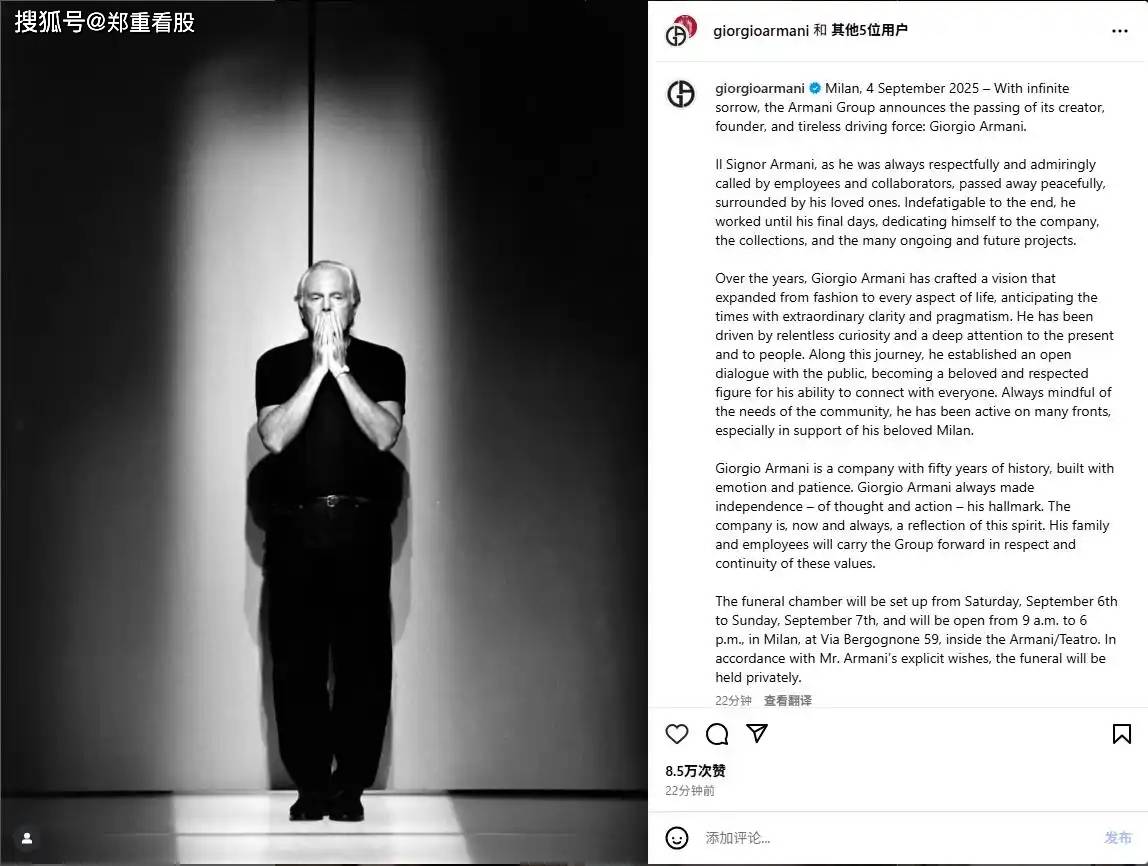
Core Insights - Giorgio Armani, the iconic designer, passed away at the age of 91, leaving behind a fashion empire valued between €80-100 billion, while maintaining a unique independent status in the luxury industry [1][3] - The company is facing challenges in maintaining its valuation and market position, particularly after the founder's death, which may lead to potential acquisition interest from larger luxury groups [3][5] Group 1: Company Overview - Armani Group's revenue is projected to decline by 6% to €2.3 billion in 2024, despite significant investments of €332 million in renovating flagship stores and consolidating e-commerce operations [1] - The company's EBITDA is expected to drop by 24% in 2024, with sales in the Chinese market falling to 19% [3] Group 2: Inheritance and Control - The inheritance plan involves distributing shares among family members and long-term partners while establishing a charitable foundation that holds symbolic shares, ensuring that true control remains within the family [3] - This approach is rare in the luxury sector, contrasting with other brands like Prada and Ralph Lauren, which have brought in external management [3] Group 3: Business Philosophy - Armani's design philosophy emphasizes minimalism, with a product matrix that includes the main line Giorgio Armani, the mid-range Emporio Armani, and the AX series targeting younger consumers, allowing the brand to maintain a 49% market share in Europe despite a global luxury market contraction [4] - The founder's wariness of capital involvement stems from past experiences, leading to a preference for maintaining brand integrity over financial gain [4] Group 4: Industry Implications - The passing of Armani may trigger a chain reaction in the luxury market, with estimates suggesting that brand premium accounts for over 60% of the group's valuation, putting future control at risk [5] - The independent model established by Armani has served as a survival template for smaller luxury brands, and its potential decline may accelerate consolidation among larger players like LVMH and Kering [5]