尺度效应

Search documents
以毫米之躯,揽洪荒之力!微型机器人也能“上天遁地”:港城大港中文登Science子刊
机器人大讲堂· 2026-03-02 11:23
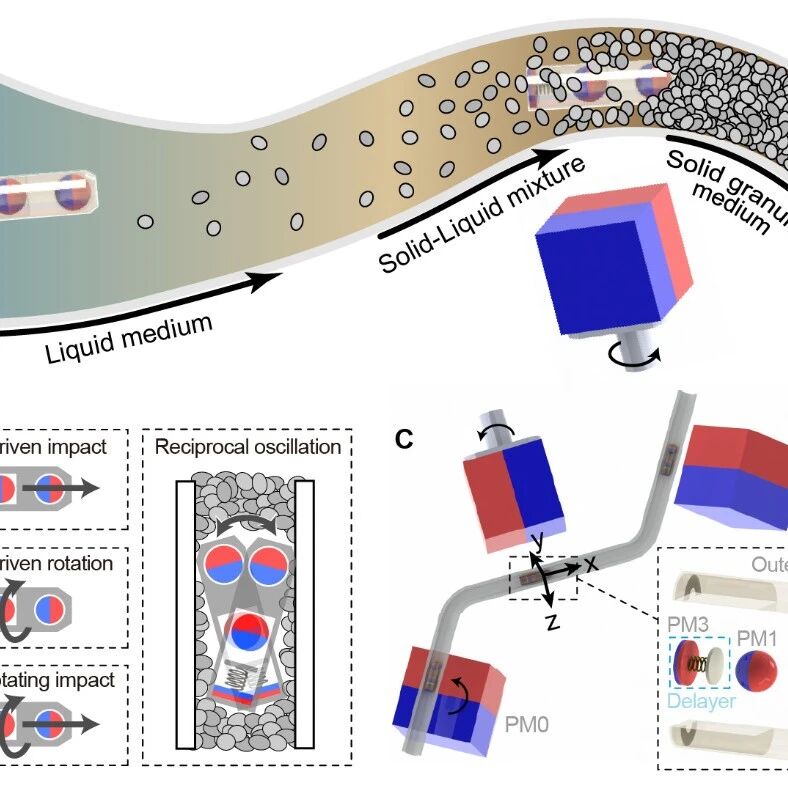
Core Viewpoint - The article discusses the breakthrough of the RoboIMP micro-robot, which overcomes the limitations of traditional micro-robots by achieving significant force output and the ability to navigate complex environments, marking a major advancement in robotics technology [1][22]. Group 1: Challenges in Micro-Robotics - Traditional micro-robots struggle in high-resistance media due to a lack of sustainable strong output, as their force diminishes with size [4]. - Existing technologies rely on short bursts of power from chemical explosions or phase change materials, which are not repeatable [4]. Group 2: Innovations of RoboIMP - RoboIMP, developed by teams from City University of Hong Kong and Chinese University of Hong Kong, can generate over 3 Newtons of impact force, breaking the theoretical limits of magnetic-driven robots [2][6]. - The robot employs a "vibrational fluidization" strategy that reduces environmental resistance by 13 times, allowing it to move freely in solid-liquid mixtures and granular media [2][8]. Group 3: Mechanisms of Operation - RoboIMP features a reciprocating impact structure with two spherical magnets that convert magnetic potential energy into instantaneous impact momentum, allowing for adjustable impact frequency [5]. - An innovative spring-magnet buffer module enhances impact timing, increasing the impact force by 50% to a peak of 3.26 Newtons [5]. Group 4: Performance in Various Environments - RoboIMP demonstrates exceptional navigation stability in high-resistance media such as corn slurry, glass beads, and sand, effectively creating low-resistance pathways [10][11]. - The robot's ability to adapt to heterogeneous environments signifies a breakthrough in autonomous obstacle navigation [12]. Group 5: Practical Applications - In experimental settings, RoboIMP successfully navigated complex pipeline systems and performed tasks such as turning, vertical climbing, and cargo transport [17]. - In biomedical applications, RoboIMP integrated with an endoscopic imaging module was tested in a pig intestine model, showcasing its capability to navigate and capture high-definition images in challenging environments [19][21]. Group 6: Future Prospects - The advent of RoboIMP signifies a revolution in micro-robotics, enabling operations in previously inaccessible environments [22]. - Potential applications include industrial pipeline inspections, geological surveys, and precise medical diagnostics, with further integration of wireless imaging and communication modules [25].