微型机器人

Search documents
以毫米之躯,揽洪荒之力!微型机器人也能“上天遁地”:港城大港中文登Science子刊
机器人大讲堂· 2026-03-02 11:23
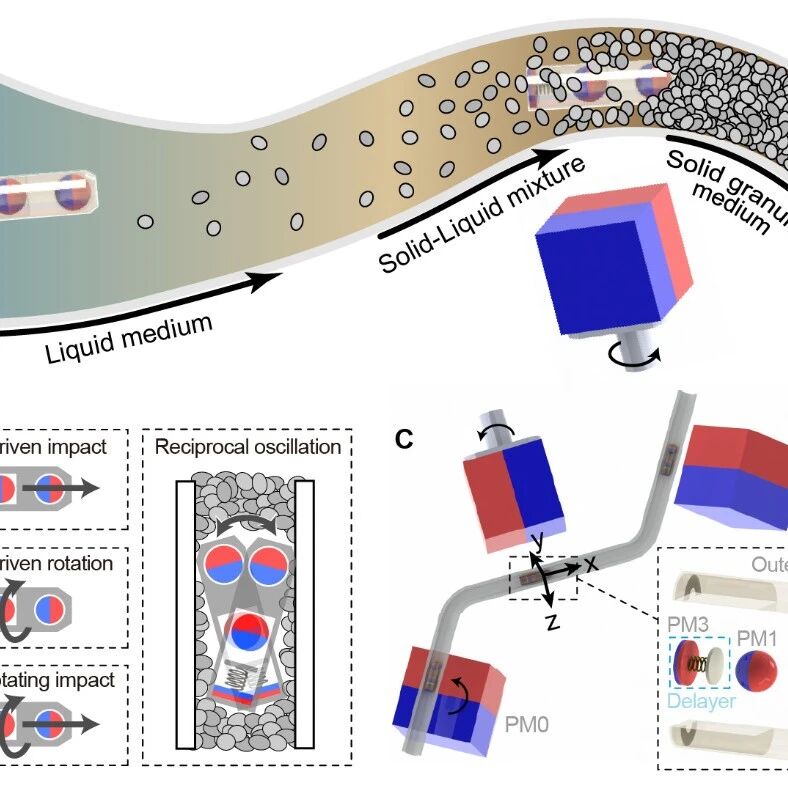
Core Viewpoint - The article discusses the breakthrough of the RoboIMP micro-robot, which overcomes the limitations of traditional micro-robots by achieving significant force output and the ability to navigate complex environments, marking a major advancement in robotics technology [1][22]. Group 1: Challenges in Micro-Robotics - Traditional micro-robots struggle in high-resistance media due to a lack of sustainable strong output, as their force diminishes with size [4]. - Existing technologies rely on short bursts of power from chemical explosions or phase change materials, which are not repeatable [4]. Group 2: Innovations of RoboIMP - RoboIMP, developed by teams from City University of Hong Kong and Chinese University of Hong Kong, can generate over 3 Newtons of impact force, breaking the theoretical limits of magnetic-driven robots [2][6]. - The robot employs a "vibrational fluidization" strategy that reduces environmental resistance by 13 times, allowing it to move freely in solid-liquid mixtures and granular media [2][8]. Group 3: Mechanisms of Operation - RoboIMP features a reciprocating impact structure with two spherical magnets that convert magnetic potential energy into instantaneous impact momentum, allowing for adjustable impact frequency [5]. - An innovative spring-magnet buffer module enhances impact timing, increasing the impact force by 50% to a peak of 3.26 Newtons [5]. Group 4: Performance in Various Environments - RoboIMP demonstrates exceptional navigation stability in high-resistance media such as corn slurry, glass beads, and sand, effectively creating low-resistance pathways [10][11]. - The robot's ability to adapt to heterogeneous environments signifies a breakthrough in autonomous obstacle navigation [12]. Group 5: Practical Applications - In experimental settings, RoboIMP successfully navigated complex pipeline systems and performed tasks such as turning, vertical climbing, and cargo transport [17]. - In biomedical applications, RoboIMP integrated with an endoscopic imaging module was tested in a pig intestine model, showcasing its capability to navigate and capture high-definition images in challenging environments [19][21]. Group 6: Future Prospects - The advent of RoboIMP signifies a revolution in micro-robotics, enabling operations in previously inaccessible environments [22]. - Potential applications include industrial pipeline inspections, geological surveys, and precise medical diagnostics, with further integration of wireless imaging and communication modules [25].

Science重磅:科学家造出微型机器人,在体内精准送药,即将进行人体临床试验
生物世界· 2025-11-17 04:04
Core Viewpoint - The article discusses the development of clinically ready magnetic microrobots for targeted drug delivery, which represents a significant advancement in the field of precision medicine, potentially reducing systemic side effects associated with traditional drug administration methods [5][7]. Group 1: Research Development - Researchers at ETH Zurich have created a magnetic microrobot, approximately the size of a grain of sand (less than 2 mm in diameter), capable of navigating through blood vessels to deliver drugs precisely to targeted areas [5][8]. - The study highlights that about one-third of developed drugs fail to receive approval due to excessive side effects, emphasizing the need for targeted delivery systems [5][7]. Group 2: Technological Breakthroughs - The platform developed by the research team integrates three major breakthroughs: modular design, a clinical-grade navigation system, and safe biodegradable microrobots [8]. - The navigation system utilizes a dual Navion electromagnetic navigation system, providing a workspace of 20×20×20 cm with a magnetic field gradient of up to 1 T/m, ensuring stable navigation within blood vessels [8][11]. - The microrobots are made from a gelatin matrix containing iron oxide nanoparticles for magnetic response, tantalum nanoparticles for X-ray visibility, and therapeutic drugs, all of which are FDA-approved for vascular applications [8][9]. Group 3: Navigation and Drug Delivery Mechanism - The microrobots can adapt to different blood flow environments through three navigation modes: rolling on vessel walls, countercurrent navigation, and downstream navigation, achieving a 95% success rate at bifurcations [11]. - Upon reaching the target site, the microrobots release drugs in a controlled manner using a high-frequency magnetic field, ensuring that drug release is halted if the robot deviates from the target [13][15]. Group 4: Experimental Validation - Experiments in a biomimetic vascular model demonstrated that the microrobots could be accurately navigated to various branches of the middle cerebral artery, with thrombolytic demonstrations showing significant potential for treatment [15]. - Large animal studies confirmed the clinical feasibility of the technology, successfully guiding microrobots to specific arteries in pig and sheep models, indicating potential applications in the central nervous system [15][17]. Group 5: Future Implications - Although clinical applications are still in the future, this research provides a viable technical pathway for precision drug delivery, with the potential to treat conditions such as vascular occlusion, localized infections, or tumors while minimizing systemic exposure [17]. - The research team plans to consider human clinical trials as the next step in the development of this technology [17].
“DNA花朵”微型机器人可自适应环境变化
Xin Lang Cai Jing· 2025-10-21 23:25
Core Insights - A research team from the University of North Carolina has developed a micro-robot called "DNA flower" that can adapt to environmental changes, mimicking biological behavior [1] - The "DNA flower" robot is composed of a unique crystal formed by the combination of DNA and inorganic materials, showcasing one of the most dynamic micro-materials developed to date [1] - This robot can rapidly fold and unfold within seconds, demonstrating significant advancements in micro-robotics technology [1]

快讯|我国研发全球最小“机器蚊”; 特斯拉人形机器人仿生膝关节专利揭秘; 星动纪元推出超拟人服务机器人星动Q5等
机器人大讲堂· 2025-06-20 04:17
Group 1: Micro Robotics - The National University of Defense Technology has developed the world's first mosquito-sized bionic robot, measuring only 2 cm in length and weighing 0.3 grams, setting a new record in micro-robotics. This achievement overcomes the bottleneck of micron-level sensing and power integration technology, combining bionics and micro-electromechanical systems for millimeter-level precision movement. Its stealth characteristics allow it to perform reconnaissance and monitoring tasks in restricted areas [1] - Previous research from Beihang University has achieved a 5.5 times increase in load capacity, and this latest development further enhances operational performance, marking China's international leadership in the micro-robotics field and providing strategic technological support for future distributed reconnaissance networks [1] Group 2: Humanoid Robotics - Tesla has revealed a patent for a sophisticated design of a robot knee joint, addressing core issues of flexibility, efficiency, and power consumption in humanoid robots. The patent outlines the challenges faced in traditional robot joint designs and aims to create a knee joint that mimics a wide range of motion while maximizing efficiency [5][6] - The latest humanoid service robot, StarQ5, launched by Star Motion Era, features a sleek design and aims to redefine human-robot interaction. It is equipped with a bionic 7-axis high-precision robotic arm and can perform 10 clicks per second, lift 10 kg with one hand, and navigate tight spaces using a compact chassis and advanced navigation technologies [13] Group 3: Flexible Robotics - West Lake University's team has introduced the world's first flexible variable-stiffness robotic arm and HEART series robots. This breakthrough addresses the limitations of traditional rigid robots in safety and adaptability, showing great potential in applications such as elderly care and medical rehabilitation. The Mawarm robotic arm can switch from a rigid to a soft state in milliseconds to absorb impacts, enhancing safety and adaptability in complex environments [16]

Nature重磅:90后华人学者开发新型血栓清除术,有望颠覆中风、心脏病等疾病治疗
生物世界· 2025-06-10 04:00
Core Viewpoint - The article discusses the development of a new thrombectomy technique called Milli-spinner thrombectomy, which significantly improves the efficiency of thrombus removal compared to existing methods, potentially transforming treatment for ischemic stroke, heart attacks, pulmonary embolism, and other thrombus-related diseases [4][5][25]. Group 1: Current Thrombectomy Techniques - Mechanical thrombectomy currently fails to clear thrombus in 10%-30% of patients, particularly those with large, fibrin-rich clots [3]. - Existing methods may cause thrombus fragmentation, leading to distal embolization and adverse outcomes [3][8]. Group 2: Milli-spinner Thrombectomy - The Milli-spinner thrombectomy technique is reported to be over twice as effective as current technologies, achieving a 90% success rate in clearing difficult thrombi on the first attempt, compared to approximately 11% with existing devices [5][7]. - This technique utilizes a unique design that applies compressive and shear forces to reduce thrombus volume without causing fragmentation [9][13]. Group 3: Mechanism and Design - The device consists of a hollow, rapidly rotating catheter with fins and slits that create a local negative pressure zone around the thrombus, allowing for effective thrombus reduction [10][15]. - The innovative design allows the thrombus to be reduced to less than 5% of its original volume, enabling red blood cells to flow freely again [16][17]. Group 4: Future Applications and Development - The research team is exploring other potential applications of the Milli-spinner device in the biomedical field, including capturing and removing kidney stone fragments [23]. - A new company has been established to expedite the development and clinical trials of this technology, aiming for rapid approval for patient treatment [24].