
年龄限制放宽

Search documents
广东率先放宽公务员省考年龄,最高43岁可报考
21世纪经济报道· 2025-10-23 05:50
Core Points - The Guangdong Province has announced plans to recruit 11,779 civil servants for 2026, with the exam scheduled for December 7, three months earlier than last year [1][8] - The age limit for applicants has been relaxed, allowing candidates aged 18 to 38, and for 2026 graduates with master's or doctoral degrees, the limit is extended to 43 [1][8] - The trend of relaxing age limits for civil service exams is expected to continue, influenced by the national exam's policies [9] Examination Schedule - The examination period for civil service and public institution positions is entering a peak phase, with various exams scheduled from October to January [3][5] - The national civil service exam will take place on November 30, followed by provincial exams starting in December [3][5] Competitive Landscape - The civil service exams are highly competitive, especially in major cities like Beijing, Shanghai, and Zhejiang, where many positions are limited to fresh graduates [5][11] - Candidates are advised to adopt a "tiered application" strategy, categorizing positions into "target," "main," and "backup" to manage their efforts effectively [6][9] Age Limit Changes - The relaxation of age limits is seen as a significant shift, with implications for the number of candidates and competition levels [8][9] - The potential increase in applicants due to relaxed age limits may not drastically intensify competition, as the number of positions available for non-fresh graduates remains limited [9] Preparation Strategies - Candidates are encouraged to balance their preparation for civil service exams with job applications in the private sector, ensuring they have fallback options [12] - A structured preparation approach, including foundational study, intensive practice, and targeted revision, is recommended for success in these competitive exams [11][12]


2026年,国考更“难”了吗?
Xin Lang Cai Jing· 2025-10-15 02:27
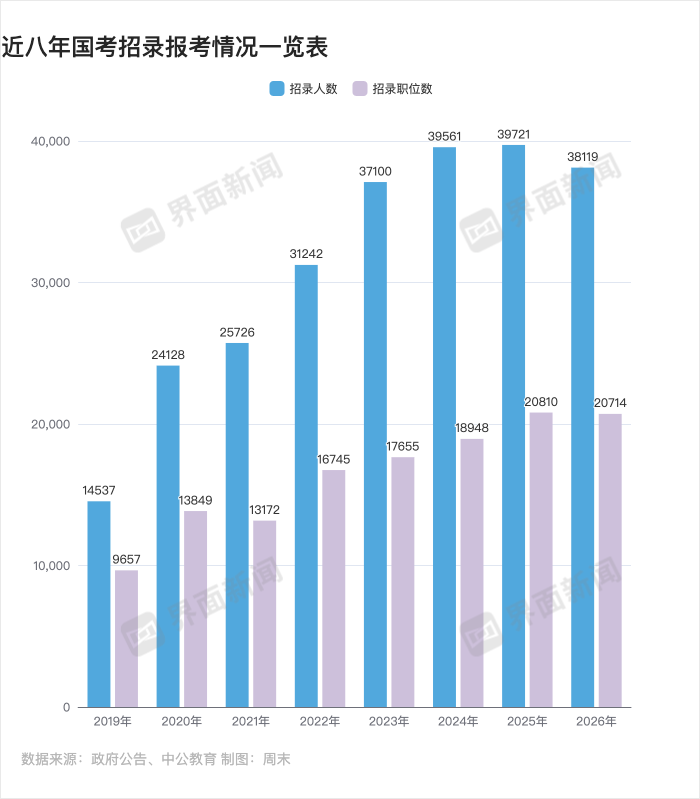
Core Points - The 2026 National Civil Service Examination (国考) has reduced its recruitment scale for the first time in eight years, planning to recruit 38,119 candidates, down from 39,700 in the previous year, indicating a decrease of nearly 2,000 positions [1][3] - Despite the overall reduction, there is a structural differentiation in job supply, with the tax system continuing to be the main recruitment area, accounting for 25,004 positions, which is 65.6% of the total and an increase of 6 percentage points from last year [3][4] - The age limit for applicants has been historically relaxed, with the upper age limit raised from 35 to 38 years, and for master's and doctoral graduates, it is now 43 years [6][10] Recruitment Structure - The tax bureau remains the dominant sector in recruitment, with a significant increase in positions compared to last year [4][5] - Other departments, such as the railway police, have seen substantial reductions, with positions dropping from 1,719 to 479 [4][5] - The overall recruitment scale has decreased, but the demand for specialized talent has intensified, with only 4 positions not requiring specific majors out of 38,119 [8][10] Age and Educational Requirements - The relaxation of age limits aims to attract more experienced candidates, particularly master's and doctoral graduates, to enhance the diversity and expertise within the civil service [6][10] - The proportion of positions requiring a bachelor's degree has increased to 73.3%, while the demand for master's and doctoral candidates has slightly decreased [10][11] - The examination format continues to follow a tiered classification system, with the largest recruitment numbers in administrative enforcement positions [11] Regional Distribution - Guangdong, Shandong, and Sichuan are the top three provinces in terms of recruitment numbers, with Guangdong leading at 3,310 positions [11] - Beijing has seen the most significant reduction in positions, dropping by 462 to fall to the twelfth position in recruitment numbers [11]
国考向“35岁+”敞开大门,大厂还在卡年龄?
Jing Ji Guan Cha Wang· 2025-10-14 13:00
Core Points - The national civil service examination has officially lifted the age limit, allowing candidates up to 38 years old and recent master's and doctoral graduates up to 43 years old, signaling a shift from age-based restrictions to a focus on capability [1][2] - Despite the national examination's age adjustments, the corporate recruitment landscape, particularly in the internet sector, continues to impose a "35-year-old barrier," reflecting outdated hiring practices and a lack of social responsibility [2][3] - The disparity between the national examination's inclusive policies and corporate age discrimination highlights the need for a cultural shift in hiring practices, emphasizing experience and capability over age [4][5] Summary by Sections National Examination Changes - The national civil service examination has expanded the age eligibility for candidates, with general applicants now being able to apply until the age of 38 and recent graduates up to 43, breaking the previous "35-year-old barrier" [1] - This change is seen as a positive signal towards prioritizing ability over age in public service roles [1] Corporate Recruitment Challenges - Over 65% of job seekers over 35 have faced age restrictions, with those over 40 having a success rate of less than one-third compared to younger applicants [1][2] - In the internet industry, 72% of job postings for technical positions explicitly require candidates to be under 35, creating significant barriers for older applicants [1][3] Implications of Age Discrimination - The age discrimination in hiring practices not only exacerbates employment inequality but also reflects a lack of modern understanding of workforce dynamics, where older candidates bring valuable experience and stability [2][4] - The average number of applications needed for candidates over 35 to secure an interview is significantly higher than for younger candidates, indicating a systemic bias in recruitment [3] Recommendations for Change - Companies are encouraged to break down age discrimination as part of their social responsibility and to align with evolving ESG (Environmental, Social, Governance) standards, which increasingly value employment equity [4][5] - A collaborative effort among policymakers, companies, and job seekers is necessary to dismantle the "35-year-old barrier," with a focus on creating a more inclusive hiring culture that values experience and capability [5]