广宣费延续政策

Search documents
财政部 海关总署 税务总局关于增值税法施行后进口环节增值税优惠政策衔接事项的公告财政部 海关总署 税务总局公告2026年第17号
蓝色柳林财税室· 2026-02-12 01:27
Core Viewpoint - The announcement by the Ministry of Finance, General Administration of Customs, and State Taxation Administration outlines the continuation of import VAT preferential policies following the implementation of the VAT Law in China, specifically for anti-cancer drugs and rare disease medications from January 1, 2026, to December 31, 2027 [1]. Group 1: Import VAT Preferential Policies - The import VAT preferential policies for anti-cancer drugs and rare disease medications will continue to be effective from January 1, 2026, to December 31, 2027 [1]. - Other import VAT preferential policies that were in effect before the VAT Law and have expiration dates after January 1, 2026, will continue to be executed according to the original regulations [1]. Group 2: Advertising and Business Promotion Expenses - The policy allows for advertising and business promotion expenses incurred by cosmetic manufacturing or sales, pharmaceutical manufacturing, and beverage manufacturing (excluding alcoholic beverages) to be deductible up to 30% of the annual sales revenue, with the excess being carried forward for deduction in subsequent tax years [7]. - This policy extension provides stability for relevant enterprises from January 1, 2026, to December 31, 2027 [7]. - For ordinary enterprises, the deductible proportion for advertising expenses is set at 15%, while for VIP-level enterprises, it is 30% [7]. Group 3: Tax Sharing among Related Enterprises - Related enterprises that sign advertising and business promotion expense sharing agreements can deduct advertising and business promotion expenses within the sales revenue limit, either in their own accounts or allocate some or all to another party as per the agreement [9]. - When calculating the deductible limit for advertising and business promotion expenses, the amounts allocated to another enterprise will not be included in the calculation for that enterprise [10]. Group 4: Compliance and Documentation - Enterprises must confirm the deduction base for advertising and business promotion expenses, which should include deemed sales revenue as specified in the implementation regulations [11]. - Relevant tax documents, including ledgers, accounting vouchers, reports, tax payment certificates, invoices, and export documents, must be retained for a period of 10 years [11].


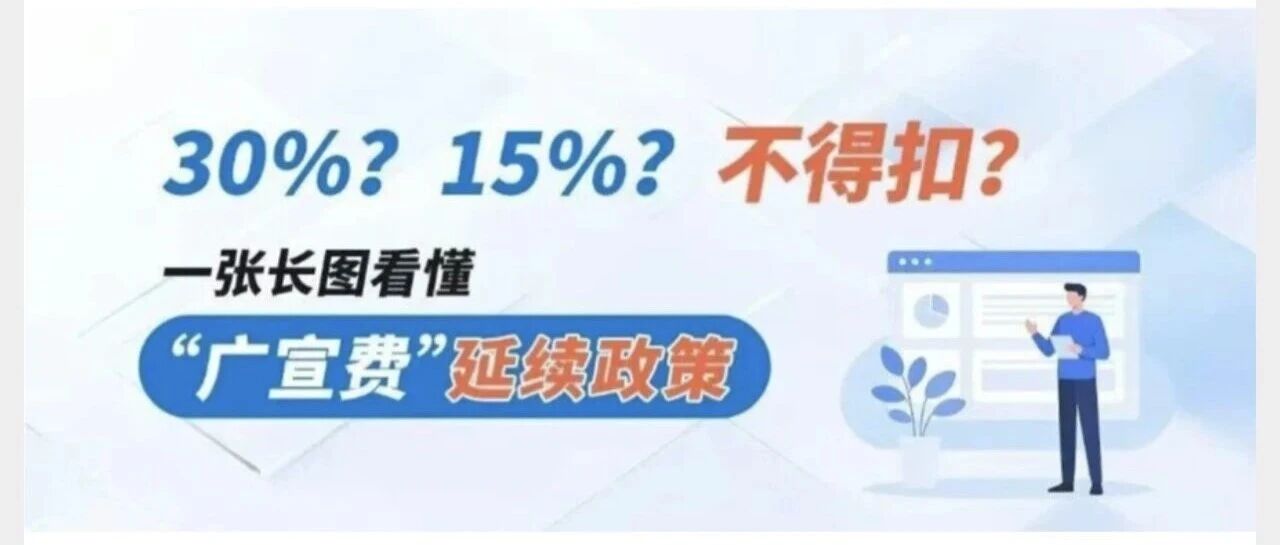
30%?15%?不得扣?一张长图看懂“广宣费”延续政策
蓝色柳林财税室· 2026-01-25 02:02
Core Viewpoint - The article discusses the implementation of Announcement No. 7 by the State Administration of Taxation, effective from September 1, 2025, which allows eligible VAT general taxpayers to apply for refunds of the ending retained tax credits under specific conditions [10]. Group 1: Eligibility Conditions - Taxpayers must have a credit rating of A or B [12]. - No instances of fraudulent tax refund claims or issuance of false VAT invoices in the past 36 months [12]. - No more than one tax evasion penalty from tax authorities in the past 36 months [12]. - Taxpayers must not have enjoyed VAT immediate refund or deferred refund policies since April 1, 2019, unless specified otherwise by Announcement No. 7 [12]. Group 2: Specific Industry Taxpayers - For manufacturing and three other industries, taxpayers must have over 50% of their VAT sales from these sectors based on the previous 12 months [15]. - Taxpayers in real estate development must have over 50% of their VAT sales and prepayments from real estate activities based on the previous 12 months [19]. - Other industry taxpayers must meet specific criteria regarding their retained tax credits to apply for refunds [23]. Group 3: Policy Highlights - Taxpayers can apply monthly to the tax authority for refunds of ending retained tax credits [17]. - For real estate developers, if the new retained tax credits in the sixth month exceed 500,000 yuan, they can apply for a refund of 60% of the new increase [20]. - Other taxpayers can receive a 60% refund on new retained tax credits up to 100 million yuan, and 30% on amounts exceeding that [24][26].