应用场景拓展

Search documents
5月13-15日|高工锂电「云上看展」探展招募开启
高工锂电· 2026-03-25 11:12
Core Viewpoint - The article highlights the significance of the upcoming CIBF 2026 event in Shenzhen, focusing on the lithium battery industry's evolving landscape, technological advancements, and the importance of real-world applications and industry consensus [1]. Group 1: Key Topics of the Event - The event will cover various critical topics, including the expansion of battery applications beyond vehicles, advancements in eVTOL and drones, and the competition between battery swapping and ultra-fast charging in heavy-duty trucks [2]. - Discussions will also include the development of humanoid robot batteries, electric shipping, safety standards, and the progress of solid-state batteries [2]. - The materials segment will focus on competitive strategies among material companies, including the use of silicon-based anodes and LMFP as alternatives to nickel-rich ternary batteries [2]. Group 2: Presentation and Engagement - The event will feature a three-day live broadcast, allowing industry leaders and experts to engage directly with key battery enterprises and supply chain representatives [3]. - The live sessions aim to provide in-depth discussions with executives and technical leaders, showcasing new product launches and technological breakthroughs [8]. - The initiative seeks to bridge the gap between technology and industry, offering insights into the latest advancements in power batteries, energy storage, and electrification scenarios [8].


研判2026!中国血液透析机行业发展背景、患者数量、市场规模、竞争格局、发展趋势分析:血液透析机行业规模持续增长,未来国产替代空间广阔[图]
Chan Ye Xin Xi Wang· 2026-02-28 01:14
Core Viewpoint - The blood dialysis machine market in China is experiencing rapid growth, with the market size expected to reach 4.131 billion yuan by 2025, reflecting a year-on-year increase of 6.4% [1][6]. Industry Overview - Blood dialysis machines, also known as artificial kidneys, are essential medical devices for treating renal failure and uremia, consisting of a blood monitoring alarm system and a dialysis liquid supply system [3][4]. - The increasing elderly population and rising prevalence of chronic kidney diseases are driving the demand for blood dialysis machines [5][6]. Market Size and Growth - The market size for blood dialysis machines in China is projected to grow significantly, driven by an aging population and an increasing number of patients requiring dialysis treatment [1][6]. - The number of patients undergoing dialysis in China is expected to rise from 385,100 in 2015 to 1,027,300 by 2024, with male patients making up a significant portion of this demographic [5][6]. Competitive Landscape - The Chinese blood dialysis machine industry is primarily dominated by foreign companies such as Fresenius Medical, B. Braun, Baxter, and Nipro, indicating substantial room for domestic companies to capture market share [7][8]. - Domestic companies are enhancing their R&D capabilities, leading to improvements in technology and product quality, which positions them to compete more effectively against international brands [7][8]. Industry Development Trends - The process of domestic substitution for blood dialysis machines is accelerating, with local companies focusing on core technology and key component development to reduce reliance on foreign brands [10][11]. - Future technological advancements in blood dialysis machines will focus on smart and precise upgrades, integrating IoT and AI for improved monitoring and safety [11][12]. - The application scenarios for blood dialysis machines are expanding beyond traditional hospitals to include community healthcare settings and home dialysis solutions, driven by the increasing demand for accessible and convenient treatment options [12].


华西证券:科技是中长期主线,目前还处于“硬件先行”的上半场
Mei Ri Jing Ji Xin Wen· 2025-12-01 00:21
Core Viewpoint - The article emphasizes that China is still in the early stage of transitioning between old and new driving forces, with technology being the medium to long-term focus, currently in the "hardware first" phase, and yet to enter the "application scenario expansion" phase [1] Group 1: Industry Insights - Technology is identified as the main theme for medium to long-term investment, with current emphasis on hardware development [1] - The capital expenditure of technology giants is below expectations, and the high concentration in the sector may lead to increased market volatility [1] Group 2: Market Outlook - The performance in 2026 is expected to outperform that of 2025, indicating a potential for better returns in the near future [1] - The low interest rate environment continues to support dividend logic, which may benefit from pure bond substitution logic and temporary risk-averse sentiment [1]

2025年中国风电机组行业相关政策、产业链、平均单机容量、竞争格局及发展趋势研判:风电机组平均单机容量不断增加,海陆风电机组大型化进程持续提速[图]
Chan Ye Xin Xi Wang· 2025-04-14 01:26
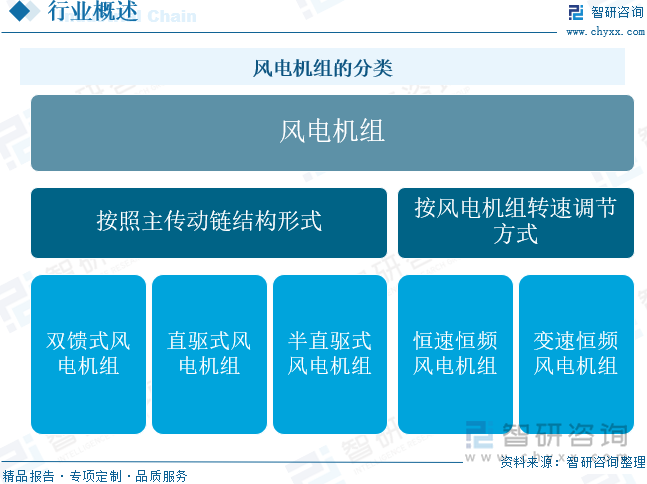
Core Viewpoint - Wind power is a clean and renewable energy source that significantly reduces greenhouse gas emissions and pollution, thereby alleviating climate change and improving air quality. The wind power industry in China has maintained high-quality development, with a notable trend towards larger wind turbine capacities [1][21]. Industry Overview - Wind turbines convert wind energy into mechanical energy and then into electricity, playing a crucial role in the transition to clean energy. The average capacity of newly installed wind turbines in China for 2024 is projected to be 6046 kW, an increase of 8.1% year-on-year [1][19]. - The average capacity of onshore wind turbines is expected to reach 5885 kW, up 9.6%, while offshore wind turbines will average 9981 kW, a 3.9% increase [1][19]. - The share of wind turbines with a capacity of 5 MW and below has rapidly decreased from over 50% in 2022 to around 5%, while the share of offshore wind turbines with a capacity of 10 MW and above has increased from 12.1% in 2022 to 58% [1][19]. Industry Policies - The Chinese government has implemented various policies to enhance the strategic position of the wind power industry, including the "Thousand Villages and Ten Thousand Villages Wind Action" initiative aimed at promoting wind power development in rural areas [9][12]. - The Ningxia government has proposed a plan to upgrade and replace old wind turbines, targeting the renovation of over 200,000 kW of outdated wind power capacity by 2027 [9][12]. Industry Chain - The wind turbine industry chain includes upstream component manufacturing, midstream assembly, and downstream application markets. Key components include blades, generators, gearboxes, and converters [13]. Market Size and Growth - The wind turbine blade market in China is projected to reach 47.6 billion yuan in 2024, driven by advancements in technology and the trend towards larger blades [15]. - The total installed wind power capacity in China is expected to reach 520.68 GW by 2024, with a year-on-year growth of 18% [19]. Key Companies - Major players in the wind turbine industry include Goldwind Technology, Dongfang Electric, and Harbin Electric, which dominate the market share. The industry is characterized by a high concentration of production capacity [29][31]. - Goldwind Technology reported a revenue of 12.768 billion yuan from wind turbine sales in the first half of 2024, while Dongfang Electric's clean energy equipment revenue reached 14.065 billion yuan, a 41.03% increase year-on-year [31][33]. Development Trends - The wind turbine industry is expected to undergo significant technological innovations, with advancements in design and materials leading to higher energy capture efficiency [36]. - The industry will see deeper vertical integration and specialized division of labor, with leading companies extending into upstream core component production [37]. - New business models, such as shared wind power and community wind power, are emerging, alongside the integration of wind power with hydrogen and energy storage solutions [38].