
清洁能源转型

Search documents
Structural Silver Deficit: Navigate Volatility With a Dual-Asset Approach
Etftrends· 2026-03-31 21:29
Core Insights - Silver is currently facing a complex situation characterized by structural undersupply and short-term uncertainty, despite a recent rally at the beginning of the year [3][4] - The market is experiencing a significant multi-year deficit in silver, with demand consistently outpacing supply for the sixth consecutive year [5][8] Supply and Demand Dynamics - The world is consuming more silver than it is producing, leading to an expected silver deficit this year [5] - Silver's dual role as both a monetary asset and an industrial metal contributes to its ongoing supply deficit, particularly due to its essential use in solar panels, electric vehicle electronics, and high-performance computing [5][8] Economic Influences - Current price volatility in silver is driven by competing forces: a long-term supply deficit and a liquidity-driven macro environment [4][8] - Economic events can negatively impact industrial demand for silver, which may affect short-term prices [6] Investment Opportunities - For investors seeking silver exposure, the Sprott Silver Miners & Physical Silver ETF (SLVR) is recommended, offering a blend of physical bullion stability and equity-driven growth potential [7][8] - The ETF strategy is particularly relevant in the current macro environment of prolonged higher interest rates, which may negatively impact investment demand for silver [8] Future Outlook - A potential rally in gold could positively influence silver prices, as silver is sensitive to movements in gold [9] - The fundamental demand for silver in global electrification efforts is expected to counterbalance market forces affecting its price as a precious metal [9]



中信证券:电力板块有望迎来基本面与估值的双重修复机遇
Di Yi Cai Jing· 2026-03-31 00:25
Core Viewpoint - The ongoing conflict between the U.S. and Iran continues to impact the global energy supply chain, highlighting the necessity for energy self-sufficiency [1] Group 1: Energy Supply and Demand - China's energy consumption structure is diverse, and the overall risk of foreign dependence is manageable [1] - Significant progress has been made in the transition to clean energy, although there is still room for development in infrastructure and high-end manufacturing sectors [1] Group 2: Policy and Investment Outlook - In response to the demands for energy security and the promotion of energy transition, it is anticipated that electricity pricing policies will be introduced, leading to an early recovery in electricity prices [1] - The electricity sector is expected to experience a dual recovery in both fundamentals and valuations, boosting investment enthusiasm in the industry [1]

贵金属周报:中东冲突延续,金银延续调整-20260330
Zhong Yuan Qi Huo· 2026-03-30 08:36
1. Report Industry Investment Rating - Not provided in the content 2. Core Viewpoints of the Report - For gold and silver, the continuous conflict in the Middle East has kept crude oil prices high, leading to an increase in the market's inflation expectations for the US. Meanwhile, the inhibitory effect of high oil prices on the economy is gradually emerging. The Federal Reserve maintained its policy in March, and the market expects less than one interest rate cut this year. The US dollar index is running strongly, and gold and silver may continue to be under pressure for adjustment. As the market's expectation of the Fed's interest rate cut changes, gold and silver may continue to decline, and attention should be paid to the regression of the gold - silver ratio [4]. - For platinum and palladium, there is limited short - term fundamental data. In the medium term, platinum is in a tight - balance pattern, while palladium is in a relatively surplus pattern. In addition, the guidance of the gold price should be noted in the medium term. This week, they may follow the weak trend of the gold price, and the platinum - palladium ratio may continue to strengthen [4]. 3. Summary According to the Directory 3.1 Market Review - **Price Changes**: From March 20 to March 27, 2026, the prices of gold, silver, platinum, and palladium in various markets generally declined. For example, the price of London gold dropped from $4562.55 per ounce to $4504.15 per ounce, and the price of London silver dropped from $72.37 per ounce to $67.795 per ounce [8]. - **Inventory Changes**: COMEX gold inventory decreased by 340,747 ounces, COMEX silver inventory decreased by 4,397,891 ounces, NYMEX platinum inventory decreased by 25,033 ounces, and NYMEX palladium inventory remained unchanged [8]. - **Market News**: The US adjusted its sanctions policy on Venezuela's key mineral sector, allowing certain investment and operation activities. From January to February 2026, China's silver ingot exports increased by 9.2% year - on - year, and imports increased by 707.7% year - on - year. China's silver concentrate imports decreased slightly by 1.2% year - on - year. Turkey's gold reserves decreased significantly in two consecutive weeks. The gold - platinum ratio has reached about 2.4, attracting investors to turn to platinum. Russia will restrict gold exports from May 1, and some central banks may increase their gold purchases in 2026 [10][11]. 3.2 Market Analysis - **Spot Basis**: Analyze the spot basis of gold, silver, platinum, and palladium, with data from Wind [13][16]. - **Ratio**: Analyze the relevant ratios, but specific content is not detailed in the text [19]. - **Market Positions**: Analyze the market positions of gold and silver, as well as overseas market positions, with data from Wind [21][24]. - **Futures Warehouse Receipts**: Analyze the futures warehouse receipts of gold, silver, platinum, and palladium, with data from Wind [25][28]. - **ETF Positions**: Analyze the ETF positions of gold and silver, with data from Wind [30].
比亚迪股份(01211)发布年度业绩,股东应占溢利326.19亿元 研发投入同比上升17%至634亿元
Zhi Tong Cai Jing· 2026-03-27 14:51
Group 1 - The company reported a revenue of RMB 803.965 billion for the year ending December 31, 2025, representing a year-on-year increase of 3.46% [1] - The profit attributable to shareholders decreased by 18.97% to RMB 32.619 billion, with basic earnings per share at RMB 3.58 [1] - The company plans to distribute a cash dividend of RMB 39.74 per 10 shares, along with a bonus issue of 8 shares and a capital reserve conversion of 12 shares per 10 shares [1] Group 2 - The company completed a USD 5.6 billion H-share placement, marking the largest ever in the global automotive industry, attracting significant interest from top long-term funds and sovereign wealth funds [2] - An employee stock ownership plan was approved, involving up to 25,000 employees with a total fund of no more than RMB 4.1 billion, aimed at enhancing long-term incentives and operational efficiency [2] - The company has established itself as a leader in the global electric vehicle market, achieving the top position in sales in China and globally, and has been recognized for its strategic positioning and technological strength [2] Group 3 - The company's overseas business saw significant growth, with vehicle exports surpassing one million units, a year-on-year increase of 140% [3] - The company ranked first in China's electric vehicle export market and was the fastest-growing among the top ten vehicle exporters [3] - The company reached a milestone of producing its 15 millionth electric vehicle, becoming the first automaker to achieve this feat globally [3]

中集安瑞科(03899) - 2025 H2 - 电话会议演示
2026-03-24 10:00
CIMC Enric Holdings Limited (Stock code: 3899.HK) Annual Results Presentation 2025 Contents 1. Financial Performance 2. Segment Results and Orders 3. Business Highlights, Review and Outlook Overall Revenue Increased YoY, with Robust Growth in Clean Energy Revenue 17,183 20,565 3,116 2,141 4,451 3,620 24,756 26,326 2024 2025 Unit: RMB million Clean energy revenue increased significantly YoY Clean Energy Chemical & Environmental Liquid Food China 57.4% Overseas 42.6% Revenue breakdown by segment Revenue break ...

甲醇燃料电池全球市场规模、选型建议、产业链及发展趋势
QYResearch· 2026-03-19 01:08
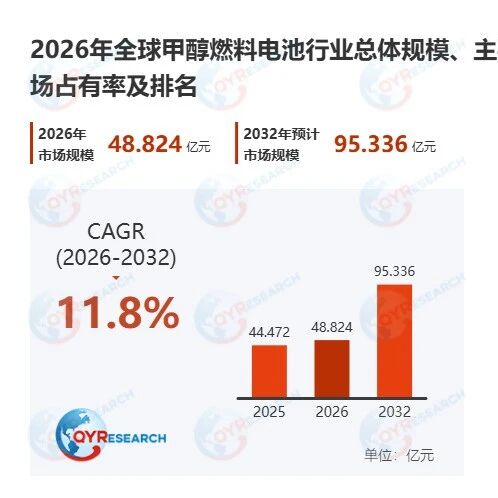
Market Overview - Methanol fuel cells convert chemical energy directly into electrical energy through electrochemical reactions, distinguishing them from traditional combustion methods [2] - They can be categorized into direct methanol fuel cells (DMFC) and reforming methanol fuel cells (RMFC), with the former being simpler and the latter offering higher power output but increased complexity [2] Structure and Technology - The main components of methanol fuel cells include the stack system, fuel supply system, air supply system, cooling and water management system, and control module [3] - Methanol fuel cells are more convenient for storage and transportation compared to hydrogen fuel cells, as methanol is a liquid at room temperature and pressure [3] - Key technological aspects include catalyst activity, electrolyte membrane performance, and fuel utilization efficiency, with advancements in materials technology contributing to miniaturization and portability [3] Application Fields - Methanol fuel cells are widely used in portable power sources, backup power, and small distributed generation systems, particularly in outdoor equipment and communication base stations [4] - They are also being explored for applications in drones, IoT devices, and remote monitoring systems due to their energy density and convenient fuel supply [4] Market Size - The methanol fuel cell market is projected to reach USD 654 million by 2025 and USD 718 million by 2026, with a compound annual growth rate (CAGR) of 11.8% over the next six years [6] Industry Chain, Policies, and Development Trends - The upstream supply chain includes methanol raw material supply, catalyst materials, and key components like proton exchange membranes [8] - The development of green and renewable methanol technologies is shifting the upstream material structure towards low-carbon solutions [8] - Downstream applications focus on portable power, backup power, and small distributed generation, with communication base stations being a significant market [8] - Industry policies supporting clean energy transitions and carbon reduction goals are crucial for the growth of methanol fuel cells [10] Development Trends - The industry is moving towards increasing power density, reducing precious metal catalyst usage, and extending lifespan [11] - Challenges include lower system efficiency compared to hydrogen fuel cells and the high cost of catalyst materials [11] - Methanol fuel cells are seen as advantageous in applications requiring convenient fuel storage and transportation [11] Entry Barriers - The methanol fuel cell industry has certain technical and capital barriers, requiring expertise in electrochemical materials, stack design, and system integration [12] - Establishing a stable customer base and experience with demonstration projects is essential for market entry [12]
行业聚焦:全球空冷氢燃料电堆市场规模及主要企业排名情况
QYResearch· 2026-03-16 01:05
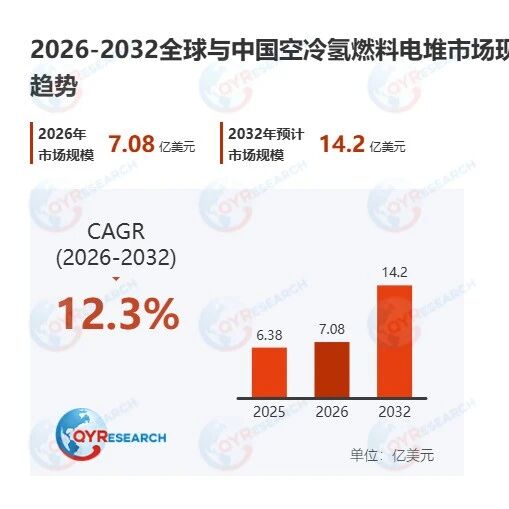
Core Viewpoint - The air-cooled hydrogen fuel cell stack is a key component that generates electricity from hydrogen through electrochemical reactions, with a projected global market size of $820 million by 2031 and a CAGR of 12.3% from 2025 to 2031 [3]. Market Overview - The global air-cooled hydrogen fuel cell stack market is expected to reach $820 million by 2031, with a CAGR of 12.3% [3]. - The top ten manufacturers are projected to hold approximately 68.0% of the market share by 2025 [5]. Key Players - Major manufacturers in the global air-cooled hydrogen fuel cell stack market include Intelligent Energy, Doosan Mobility, Ballard, PowerCell, Qingneng Co., Nedstack, TerraLIX, H2SYS, EKPO, and Spectronik [5]. Product Segmentation - The 3-6 kW segment is currently the largest, accounting for about 42.0% of the market share in 2025 [8]. - The communication sector is the leading application segment, representing approximately 31.1% of the market share in 2025 [10]. Driving Factors - The development of air-cooled hydrogen fuel cells is primarily driven by the transition to clean energy and hydrogen industry policies, with increasing demand in distributed energy, light transportation, and portable power sectors [9]. - The advantages of air-cooled systems, such as simpler structure, smaller size, and lower maintenance costs, make them suitable for low-power applications like drones and backup power systems [9]. Challenges - The air-cooled hydrogen fuel cell industry faces challenges including insufficient hydrogen infrastructure and high system costs, which limit large-scale commercialization [12]. - Core materials for fuel cells, such as proton exchange membranes and catalysts, are costly, making the overall system less competitive compared to traditional power solutions [12]. Opportunities - Future growth opportunities in the air-cooled hydrogen fuel cell industry stem from policy support, technological breakthroughs, and the expansion of new application scenarios [13]. - Innovations in catalyst reduction, membrane performance enhancement, and lightweight structural design are expected to lower costs and improve reliability, enhancing competitiveness in low-power fields [13].
国际能源署署长:目前全球在建核电装机容量已达约70吉瓦,创40年来新高
中国能源报· 2026-03-13 14:03
Core Viewpoint - The global nuclear power capacity under construction has reached approximately 70 gigawatts, marking a 40-year high, according to the International Energy Agency (IEA) Director Fatih Birol [1][3]. Group 1: Nuclear Energy Development - The current global trend shows a significant recovery in nuclear energy, with the installed capacity under construction reaching about 70 gigawatts, the highest level in four decades [1][3]. - Nuclear energy is highlighted as an essential and reliable energy source that operates around the clock, alongside renewable energy, as key pillars of clean energy [1][3]. Group 2: Climate Change and Energy Transition - The upcoming COP31 conference, scheduled for November 9-20 in Antalya, Turkey, will focus on clean energy transition, climate-resilient urban development, and mechanisms for implementing climate actions [1][3]. - The Turkish Minister of Environment, Urbanization, and Climate Change emphasized the vulnerabilities in energy supply chains due to geopolitical conflicts and the increasing pressures on global food and energy systems caused by climate change [1][3].

宏盛华源:公司点评报告:预中标特高压直流输电工程项目,巩固输电线路铁塔行业领先地位-20260312
Zhongyuan Securities· 2026-03-12 10:24
Investment Rating - The report assigns a rating of "Accumulate" for the company, indicating an expected relative increase of 5% to 15% compared to the CSI 300 index over the next six months [21]. Core Viewpoints - The company has recently announced a pre-bid win for the ±800 kV UHVDC transmission project from Southeast Tibet to the Guangdong-Hong Kong-Macao Greater Bay Area, with a pre-bid amount of approximately 975 million yuan, accounting for about 9.61% of the company's audited revenue for 2024 [6][8]. - The company is a leading player in the transmission tower industry, with significant participation in major national projects, showcasing its technical strength and brand reputation [8]. - The domestic and international power facility investments are entering a sustained upward cycle, indicating a growing market for transmission towers [8]. - The company benefits from its state-owned enterprise background, which provides advantages in securing major projects and financing [8]. - The company has achieved a market share of 21.33% and 24.05% in the State Grid and Southern Power Grid respectively, leading the industry [8]. - The company is actively expanding into international markets, with a total of 1.225 billion yuan in bids for international projects in countries such as Oman, Tanzania, and Australia [8]. Financial Summary - The company’s projected revenues for 2025, 2026, and 2027 are 9.369 billion yuan, 12.132 billion yuan, and 14.827 billion yuan respectively, with growth rates of -7.59%, 29.48%, and 22.21% [10]. - The net profit for the same years is expected to be 347 million yuan, 410 million yuan, and 467 million yuan, with growth rates of 50.74%, 18.24%, and 13.97% [10]. - The earnings per share (EPS) are projected to be 0.13 yuan, 0.15 yuan, and 0.17 yuan for 2025, 2026, and 2027 respectively, with corresponding price-to-earnings (P/E) ratios of 53.21, 45.00, and 39.49 [10].

地缘局势与商品周期共振国际油价中期有望延续强势
Zhong Guo Zheng Quan Bao· 2026-02-25 20:22
Core Viewpoint - International crude oil prices have continued their strong performance since the Spring Festival, with Brent crude futures experiencing the highest increase in 13 years during this period, driven primarily by geopolitical tensions rather than supply-demand fundamentals [1][2]. Geopolitical Influence - The current rise in international oil prices has diverged from the oversupply fundamentals, with geopolitical factors, particularly the U.S.-Iran situation, becoming the main influence [2][3]. - Analysts suggest that the geopolitical risk premium in the oil market is currently around $1, which could rise to $4-$5 if tensions escalate, while a de-escalation could lead to a rapid price drop [2]. Historical Trends Post-Spring Festival - Historical data from 2013 to 2025 indicates that oil prices tend to have a higher potential for increase in the month following the Spring Festival, with an average increase of approximately 10.96% during the years when prices rose [2][3]. - Despite more years of price declines, the magnitude of increases in rising years significantly outweighs the declines, suggesting a favorable risk-reward ratio for price increases post-holiday [2]. Factors Affecting Oil Prices - Key supportive factors for oil prices include geopolitical uncertainties and U.S. sanctions on oil-producing countries, while global economic weakness and ongoing oversupply remain as negative factors [3]. - Historical events have shown that significant geopolitical events have a greater impact on oil prices than conventional supply-demand dynamics [3]. Commodity Cycle and Oil Price Outlook - The current global commodity cycle, characterized by rising prices in precious and industrial metals, is expected to provide upward momentum for oil prices [4][5]. - The analysis indicates that the transmission of price increases from precious metals to industrial metals and then to oil is effective, driven by liquidity improvements and economic recovery [4][5]. - Despite the unique characteristics of the current cycle, two main supportive factors for oil prices are identified: bullish market expectations and geopolitical risk premiums [5]. Short-term and Long-term Predictions - In the short term, geopolitical factors are expected to strongly influence oil prices, with potential fluctuations based on developments in U.S.-Iran relations [5]. - In the long term, historical trends suggest that oil prices may rise to the range of $75 to $80 per barrel by 2026, supported by bullish market sentiment and geopolitical risk premiums [5].