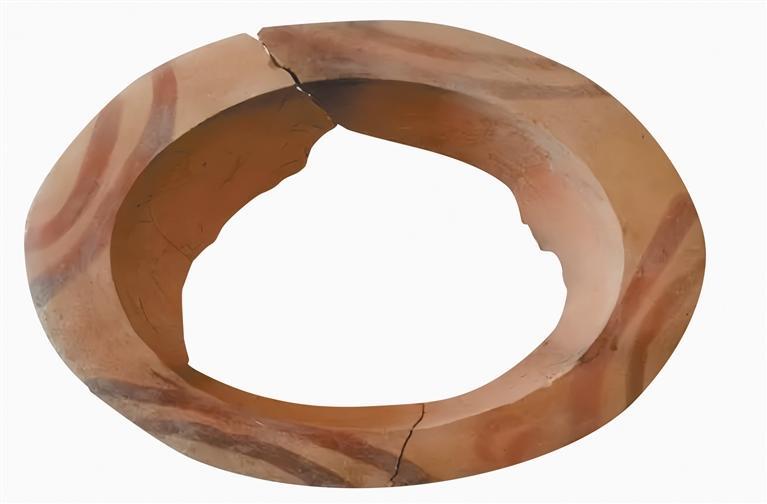
庙底沟文化

Search documents
【省文物局】“华山玫瑰——渭河流域史前彩陶文化展”开展
Shan Xi Ri Bao· 2025-12-18 22:46
Core Viewpoint - The "Huashan Rose - Prehistoric Painted Pottery Culture Exhibition" showcases 245 artifacts from 18 cultural heritage institutions, highlighting the significance of the Weihe River basin's painted pottery culture in early Chinese civilization [1][2] Group 1: Exhibition Details - The exhibition is held at the Weinan Museum and features archaeological findings from the Weinan Jiangjia site and artifacts from the fourth national cultural relics census [1] - It is organized by the Shaanxi Provincial Cultural Heritage Bureau and the Weinan Municipal Government, with the Qin Shi Huang Emperor Mausoleum Museum and Weinan Museum as co-organizers [1] - The exhibition will run until April 5, 2026, and is divided into three sections focusing on the Weihe River basin's painted pottery culture [1] Group 2: Cultural Significance - The exhibition interprets the "Huashan Rose" as a symbol of the early formation of the Huaxia nation, playing a crucial role in cultural integration and social unification [2] - It highlights the influence of the Weihe River basin's Miao Diko culture on shaping the early multi-faceted unity of Chinese civilization and its impact on the early ritual system [2] Group 3: Visitor Experience - To enhance visitor experience, the exhibition employs miniature scenes, interactive touch screens, and digital projections [2] - It includes expert lectures and activities like pottery pattern check-ins to deepen visitors' appreciation of prehistoric pottery art and cultural significance [2] - Concurrently, the Weinan Museum is hosting a photography exhibition titled "Seeking Beauty along the Weihe," featuring selected works that resonate with the prehistoric pottery culture [2]
陕西发现一处大规模仰韶时代聚落 营建经统一规划
Zhong Guo Xin Wen Wang· 2025-10-11 09:27
Core Insights - A large-scale Yangshao culture settlement has been discovered in Weinan, Shaanxi Province, featuring well-planned structures, pottery kilns, and burial sites, with significant archaeological findings including vivid clay figurines [1][2] Group 1: Archaeological Findings - The Jiangjia site has revealed nearly 1,100 archaeological remains, including double moats, large house sites, ash pits, pottery kilns, and urn burials [1] - The majority of artifacts unearthed are pottery, primarily red pottery with some gray and yellow-brown pottery, showcasing various decorative styles [1][2] Group 2: Cultural Significance - The discovery of early Baidi culture artifacts at the site provides valuable data for studying the evolution from Banpo culture to Baidi culture, which is rare in the Guanzhong region [2] - The site illustrates the dynamic development process of the settlement from the Yangshao middle period to the late period, indicating a southward migration along the Donghe River [2] Group 3: Research Implications - The Jiangjia site serves as a significant archaeological find following the Beiliu site, offering new clues and materials for exploring the origins of Baidi culture, settlement forms, and the civilization process in the Central Plains [2]
博物中国丨开在彩陶上的花!带你打卡课本“同款”文物
Yang Shi Xin Wen Ke Hu Duan· 2025-08-17 12:46
Group 1 - The design inspiration for the Spring Festival Gala's artistic installation comes from the "flower petal pattern" of the Miao Digu culture, which is a significant aspect of the Yangshao culture [3] - The Miao Digu culture is highlighted as the most brilliant cultural type during the middle period of the Yangshao culture, known for its colorful pottery [3] - The flower petal pattern is identified as the most iconic decoration of the Miao Digu culture, emphasizing its importance in historical education [3] Group 2 - The Miao Digu Museum is promoted as a place where visitors can explore the cultural significance of the flower petal pattern and its representation in historical artifacts [5] - The museum encourages visitors to bring their history textbooks to enhance their learning experience [5]


【渭南】富平发现史前红陶宽沿彩陶盆
Shan Xi Ri Bao· 2025-07-13 00:03
Group 1 - A prehistoric red pottery basin with a diameter of 41 cm was discovered by the archaeological team in Weinan City during the fourth national cultural relics census, providing valuable evidence for understanding the prehistoric cultural distribution in the region [2] - The red pottery basin features polished surfaces and is decorated with four sets of double arc lines, indicating its significance in the context of the Yangshao culture, particularly the Miao Digo type of the middle to late period [2] - The discovery site of the basin is part of a larger archaeological site that spans approximately 100 meters in length and width, with evidence of pottery shards and clear gray pits found at the cliff edge [2] Group 2 - In addition to the red pottery basin, over 100 new Paleolithic sites have been discovered in Weinan City, filling gaps in the understanding of the Paleolithic era in various counties and districts [3] - These new sites are primarily located in the Fuping area of the Weibei Shichuan River basin, as well as in several other regions including the northern Luo River basin and the right bank of the Yellow River [3] - The series of important new discoveries is enhancing the academic community's understanding of the survival history and cultural characteristics of ancient humans in the region [3]