开学收心

Search documents
不到90天!“超短学期”来了,最新提醒!
Xin Lang Cai Jing· 2026-02-28 03:42
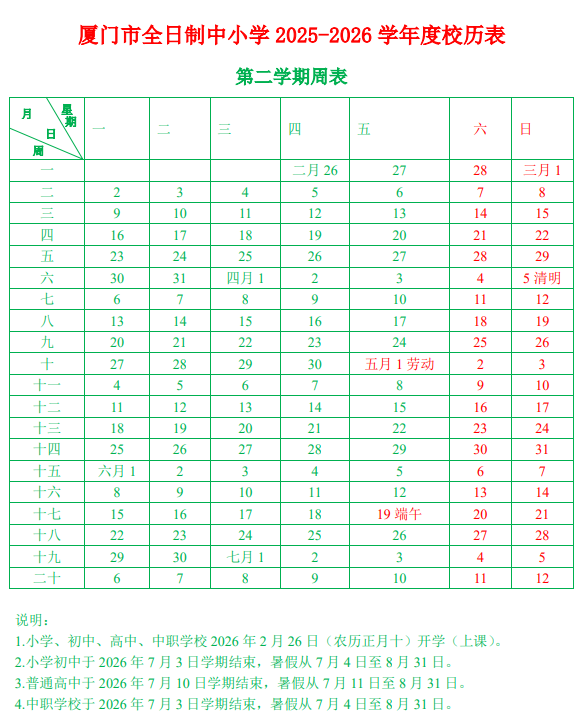
Core Viewpoint - The 2026 spring semester will be significantly shorter, referred to as a "super short semester," due to the late arrival of the Lunar New Year and the compression of the academic calendar [2][5]. Group 1: Reasons for the "Super Short Semester" - The occurrence of the "super short semester" is attributed to the leap month in 2025 and the late date of the 2026 Spring Festival (February 17), which delays the start of the spring semester to late February or early March [2]. - Various educational departments have released calendars indicating that the actual teaching weeks in regions like Jiangsu, Fujian, and Jiangxi will be reduced to 18 to 20 weeks, resulting in only 80 to 90 days of actual classroom instruction [2][5]. Group 2: Specifics of the Academic Calendar - For example, in Xiamen, Fujian, the spring semester starts on February 26 and ends around July 4, totaling approximately 20 weeks, but with holidays deducted, the actual teaching days are less than 90 [2]. - In Jiangxi, the high school seniors will start on February 26, while other grades will begin on March 2, with the total semester length being 19 weeks and actual teaching days also falling below 90 [5]. Group 3: Implications for Students - The short semester necessitates a focus on adjusting to the new academic environment, emphasizing the importance of gradually transitioning back to a regular schedule rather than abrupt changes [7]. - Students may experience anxiety and emotional distress as the semester begins, which should be acknowledged and addressed by parents [9].

“超短学期”来了,这份开学收心指南请查收
Yang Shi Xin Wen· 2026-02-27 22:25
Group 1 - The article highlights the upcoming "super short semester" in the spring of 2026, which has raised concerns among parents and educators [1] - It emphasizes the importance of gradually adjusting children's routines after the holiday break to prepare for the new school term [2][4] - The article suggests that parents should avoid a one-size-fits-all approach when helping children readjust their schedules, advocating for a gradual shift in sleep patterns [4] Group 2 - Dietary adjustments are recommended to help children recover from the heavy holiday meals, with a focus on balanced nutrition and regular meal times [5][7] - The article advises against last-minute cramming of homework, encouraging efficient study habits and avoiding late-night work sessions [8][10] - It discusses the psychological aspects of returning to school, urging parents to acknowledge children's anxieties and provide emotional support [11] Group 3 - Physical activity is encouraged as a means to boost children's mood and focus, with suggestions for daily exercise routines [12][14] - The article stresses the need for efficiency in learning during the short semester, advising students to concentrate on core knowledge and avoid procrastination [15][17] - Parents are advised to limit excessive new material and instead focus on reviewing previous knowledge and familiarizing themselves with new curriculum frameworks [17]

寒假来了!这份带娃秘籍请查收 轻松解锁愉快假期
Yang Shi Xin Wen· 2026-02-06 05:35
Group 1: Core Insights - The article emphasizes the challenges parents face during the winter break, balancing children's leisure time with learning, safety, and parental anxiety [1] - It provides a comprehensive guide for parents to help children have a safe, fulfilling, and meaningful holiday while allowing parents some respite [1] Group 2: Routine Management - The article highlights the importance of maintaining a regular daily routine for children during the holiday to avoid disruptions in sleep patterns [3] - It suggests creating a flexible schedule based on the child's age, recommending 10-11 hours of sleep for elementary school children and 9-10 hours for middle school students, with fixed wake-up and bedtime [4] Group 3: Nutrition Guidelines - Parents are advised to establish regular meal times to prevent overeating or skipping meals, emphasizing the necessity of breakfast [5] Group 4: Learning Strategies - The article encourages a balanced approach to learning during the break, focusing on addressing weaknesses and expanding interests rather than excessive tutoring [7] - It recommends dedicating 30-60 minutes daily for targeted practice on weak subjects and engaging in enjoyable activities like reading, crafts, or outdoor sports [8][10] Group 5: Safety Precautions - Safety is prioritized, with guidelines for home safety, travel safety, food safety, and general precautions to protect children during the holiday [11] - Specific recommendations include educating children about dangerous items at home, ensuring safe travel practices, and maintaining food hygiene [11][13] Group 6: Parent-Child Interaction - The article stresses the importance of quality time spent with children, suggesting activities like household chores, outings, and creative projects to enhance bonding [14][15] - It encourages daily conversations with children to understand their feelings and experiences during the holiday [17] Group 7: Transitioning Back to School - As the holiday ends, parents are advised to help children adjust back to school routines by gradually shifting sleep schedules and reviewing holiday assignments [18][20] - The article suggests discussing the holiday experiences and setting expectations for the new school term to alleviate anxiety [20]